
Risk-Benefit Calculator
Understand Your Medication
Enter the numbers from your drug label to see what they really mean.
How This Works
Drug labels often use relative risk reduction (e.g., "27% less risk") but this can be misleading. This calculator shows you the actual numbers.
Results
Enter values above to see your calculation results
When you pick up a new prescription, the tiny print on the drug label isn’t just legal fine print-it’s your roadmap to understanding whether the medicine is right for you. The FDA requires every drug label to include a risk-benefit statement, but most patients don’t know how to read it. These statements are meant to answer one simple question: Do the benefits of this drug outweigh the risks? But too often, they’re buried in jargon, vague numbers, and confusing comparisons that leave patients feeling more anxious than informed.
What Exactly Is a Risk-Benefit Statement?
A risk-benefit statement in an FDA-approved drug label isn’t just a list of side effects. It’s a structured summary that explains why the FDA decided the drug should be sold, despite its dangers. For example, a cancer drug might cause severe nausea and hair loss-but if it extends life by six months for patients with no other options, the FDA considers the benefit worth the risk. This isn’t guesswork. Since 2021, the FDA has used a formal Benefit-Risk Framework to evaluate every new drug. Reviewers look at four key areas: the seriousness of the disease, how well the drug works compared to existing treatments, how common and severe the side effects are, and whether there are ways to reduce those risks.
These assessments are written into the label’s Highlights section, then expanded in Sections 5, 6, 8, and 14. But here’s the problem: most of that detail is written for doctors and regulators, not patients. A 2022 survey found that only 22% of patients felt very confident understanding their drug’s risk-benefit profile. For those with low health literacy, that number dropped to 9%.
Why Most Drug Labels Feel Like a Foreign Language
Take a common cholesterol drug. The label might say: “Reduced major cardiovascular events by 27% compared to placebo.” Sounds good, right? But that’s a relative risk reduction. If 4 out of 100 people on placebo had a heart attack, and 3 out of 100 on the drug did, the absolute risk reduction is just 1%. That’s not the same as saying “you’ll cut your risk by almost a third.” Patients hear the big number and assume the benefit is huge. That’s misleading-and it’s not uncommon.
Dr. Thomas Fleming from the University of Washington pointed out in a 2020 study that drug labels often rely on relative risk numbers because they make benefits look bigger. The FDA knows this. In fact, their own 2021 guidance says labels should describe the “clinical importance” of benefits and risks. But few labels do it well. Most still say things like “increased risk of pancreatitis” without explaining how likely that actually is. Is it 1 in 1,000? 1 in 10? 1 in 100? Without context, patients either overestimate the danger or ignore it entirely.
Where Labels Do It Right
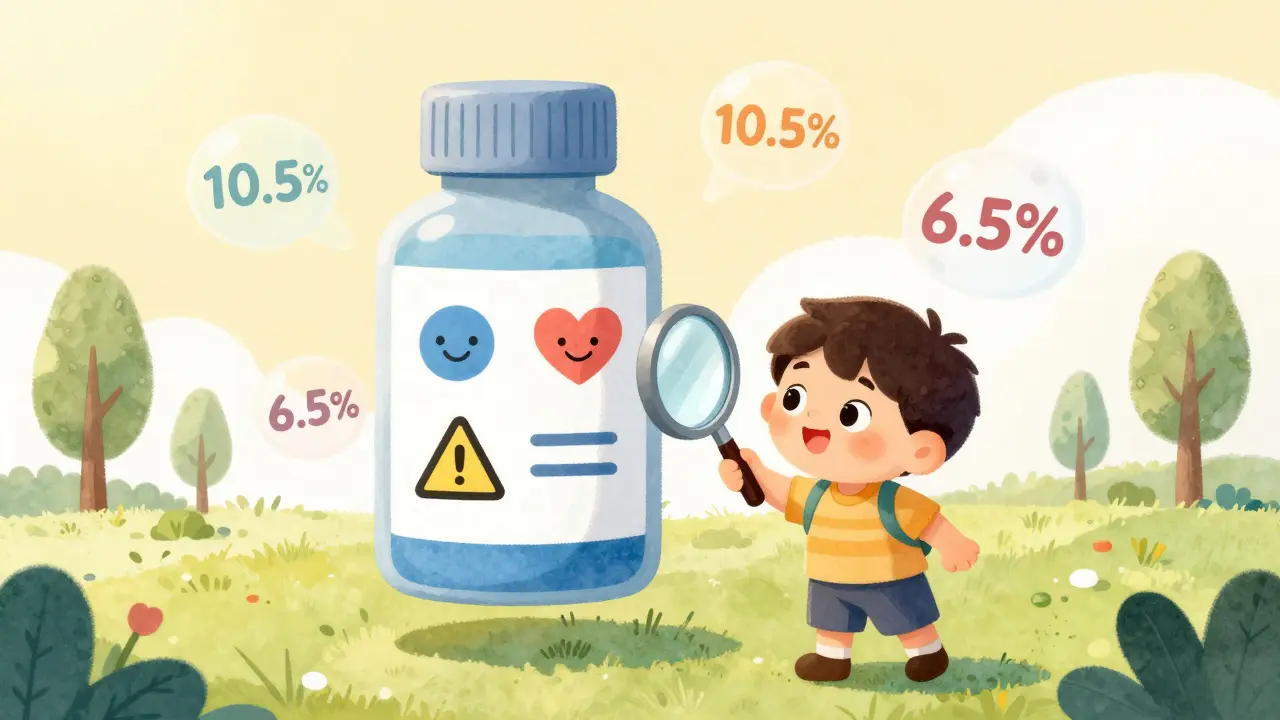
There are exceptions. Jardiance, a diabetes drug, is one of the clearest examples. Its label says: “In adults with type 2 diabetes and cardiovascular disease, JARDIANCE reduced the risk of cardiovascular death by 38% (10.5% with placebo vs. 6.5% with JARDIANCE).” That’s powerful. It gives you the actual numbers. You can see that 10.5 out of 100 people on placebo died from heart problems, but only 6.5 out of 100 on the drug did. That’s not just a percentage-it’s real people. That’s the kind of clarity the FDA wants to see more of.
Another good example is the label for certain HIV drugs, which now include a simple table comparing side effects to other treatments. One drug might say: “Diarrhea occurred in 12% of patients on this drug vs. 5% on other similar drugs.” That’s useful. It doesn’t just say “diarrhea is a side effect.” It tells you how common it is compared to alternatives.

Why This Matters More Than You Think
When patients don’t understand risk-benefit information, they make worse decisions. Some stop taking life-saving drugs because they’re scared of a rare side effect they don’t fully understand. Others take drugs with serious risks because they think the benefit is bigger than it is. The FDA’s Patient-Focused Drug Development program collected over 1,200 patient comments. Seventy-eight percent asked for clearer comparisons to other treatments. Sixty-three percent wanted visuals-charts, icons, graphs-that show the trade-offs.
Right now, only 17% of new drugs approved in 2022 included any visual benefit-risk summary. That’s changing. In September 2023, the FDA launched a pilot program requiring six new cancer drugs to include a “Patient Benefit-Risk Summary” written at a 6th-grade reading level. These summaries use simple language and pictograms-like a scale with a heart icon on one side and a warning triangle on the other-to show whether benefits outweigh risks. Early tests with 1,500 patients showed they understood the information 40% better than with traditional labels.
What’s Holding Back Better Labels?
It’s not just about writing better text. It’s about time, training, and culture. FDA reviewers spend 40 to 60 hours per drug just writing the benefit-risk assessment. That’s a huge investment. In 2022, the FDA rolled out a mandatory 16-hour training course for all medical reviewers on how to communicate risk clearly. But changing decades of industry habits takes time. Drug companies have long focused on marketing benefits and downplaying risks. Even now, only 68% of top pharmaceutical companies have hired specialists just to help write patient-friendly labels-a role that barely existed in 2015.
There’s also the problem of individual vs. population risk. The FDA looks at what’s best for the average patient. But you’re not average. You might be 70, have kidney issues, and be terrified of hospital visits. Your doctor might say the drug is worth it. Your spouse might say no. The label can’t capture that. That’s why the FDA says in its guidance: “Some patients might be willing to accept such risks when considering their individual circumstances.” That’s why talking to your doctor isn’t optional-it’s essential.
What You Can Do Right Now
You don’t have to wait for the FDA to fix everything. Here’s how to read your label like a pro:
- Look for absolute numbers, not percentages. If it says “reduced risk by 50%,” ask: “50% of what? From what baseline?”
- Find the comparison. Does the label say how this drug stacks up against others? If not, ask your pharmacist or doctor.
- Check the frequency. “Risk of liver injury” means nothing unless you know if it’s 1 in 10,000 or 1 in 100.
- Use the patient summary section. If your drug has one, read it first. It’s usually at the end of the label.
- Ask your doctor: “What’s the chance this will help me? What’s the chance it will hurt me?” Don’t accept vague answers.
There’s no perfect label yet. But the FDA is moving in the right direction. By 2025, they plan to require standardized benefit-risk metrics for major drug categories. By 2026, nearly half of new drug labels are expected to include visual summaries. That’s progress.
What’s Next for FDA Labels?
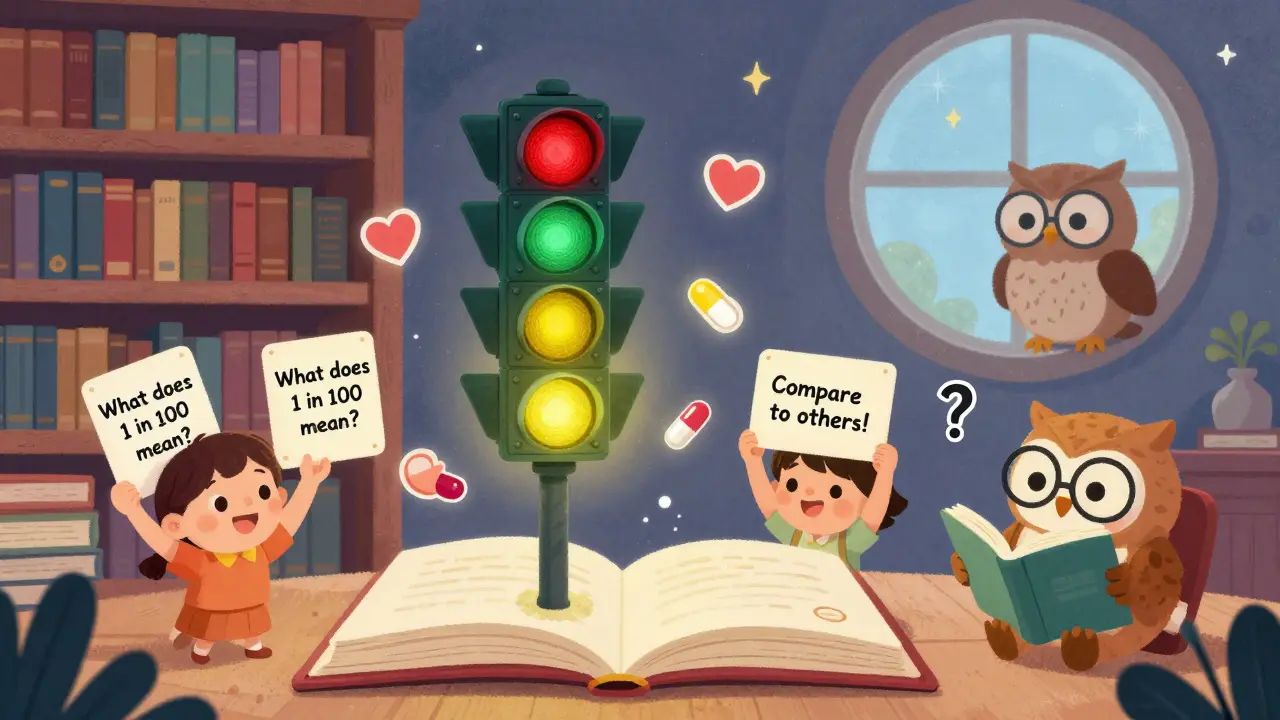
The future of drug labeling is simpler, clearer, and more visual. The FDA is testing “Benefit-Risk Icons”-small pictures that show whether benefits are large, small, or uncertain, and whether risks are common or rare. Think of them like traffic lights: green for strong benefit, yellow for moderate risk, red for serious concern. These icons will soon appear on patient information sheets and pharmacy websites.
More drug companies are also starting to include short video summaries-under 90 seconds-on their websites that explain the key trade-offs. And the National Library of Medicine is building a public database where you can compare benefit-risk profiles across similar drugs, not just one at a time.
This isn’t just about compliance. It’s about trust. When patients understand what they’re taking, they’re more likely to stick with treatment, report side effects early, and feel in control of their health. That’s the real goal-not just getting drugs approved, but making sure people can actually use them safely.
Why do FDA drug labels use percentages instead of real numbers?
Drug labels often use percentages because they make benefits look bigger. Saying a drug reduces heart attack risk by 30% sounds impressive, even if it only means going from 3 out of 100 people to 2 out of 100. Absolute numbers-like ‘10.5% with placebo vs. 6.5% with the drug’-are clearer but harder to fit into tight label space. The FDA now encourages absolute numbers, but many labels still use relative risk. Always ask your doctor to explain the real numbers behind the percentages.
Can I trust the risk-benefit info on the label if it’s written by the drug company?
The drug company writes the initial draft, but the FDA reviews and approves every word. They require evidence from clinical trials and often demand changes to make the language clearer or more accurate. The FDA doesn’t just rubber-stamp submissions-they push back. If a company tries to hide a risk or exaggerate a benefit, the FDA can delay approval or require stronger warnings. Still, it’s not perfect. Always cross-check with your doctor or pharmacist.
Why don’t all drug labels have visual charts or icons yet?
Because it’s still new. The FDA only started requiring visual summaries in pilot programs in 2023. Most labels were designed decades ago with text-only formats in mind. Updating them requires redesigning the entire label system, which takes time and money. Also, not all drugs have clear, measurable benefits or risks-especially psychiatric medications-so visualizing them is harder. But by 2026, nearly half of new drug labels are expected to include visuals, and the FDA plans to expand this to all breakthrough therapies.
What if I don’t understand the label even after reading it?
You’re not alone. Most patients struggle with drug labels. Ask your pharmacist-they’re trained to explain them in plain language. You can also call the FDA’s MedWatch hotline or visit the Drugs@FDA website, where you can search for the full clinical review documents. These are written for experts but contain the raw data behind the label. Your doctor can help you find and interpret them.
Are there apps or tools to help me understand my drug’s risk-benefit profile?
Yes. The National Library of Medicine’s MedlinePlus website offers plain-language summaries of FDA-approved drugs. Some pharmacy chains now offer QR codes on prescription bottles that link to short video explanations. The FDA’s own Patient-Focused Drug Development website has tools to help you prepare questions for your doctor. And in 2024, the FDA began partnering with health tech companies to build apps that compare benefit-risk profiles across similar drugs-so you can see which one has the best balance for your situation.
Final Thoughts: Your Health, Your Questions
The FDA’s job is to make sure drugs are safe and effective for the population. Your job is to decide if they’re right for you. The label is a starting point-not the final word. The best way to make sense of risk and benefit isn’t to read faster. It’s to ask better questions. What’s the chance this will help me? What’s the chance it will hurt me? How does it compare to what I’m doing now? Don’t wait for the label to be perfect. Start the conversation now.



15 Comments
Bennett Ryynanen
Bro, I read my blood pressure med label and it said 'reduced risk by 40%' - I thought I was basically immune now. Then my pharmacist laughed and said 'that's from 5% to 3%' - so I'm still gonna have a 3% chance of dropping dead. Thanks, pharma.
Aaron Bales
Always check the absolute numbers. Relative risk is marketing. Absolute risk is reality. If you don't know the baseline, you don't know shit.
Paul Huppert
My grandma took her statin because the label said 'reduces heart attacks' - she didn't know it only helped 1 in 50 people. She stopped after a month because her legs hurt. No one told her the trade-off. We need better.
Deepika D
Let me tell you something, y'all - I’ve been a nurse for 22 years and I still have to sit down with patients and translate these labels like they’re ancient hieroglyphics. The FDA’s new pilot with the pictograms? YES. A thousand times yes. One patient last week saw the heart icon with a green check and said, 'Ohhh, so it’s worth it?' And I cried. Not because it was sad - because it was the first time she understood without me having to spell it out in crayon. We’re not asking for poetry. We’re asking for clarity. And it’s not that hard. Just stop treating patients like interns at a medical conference.
Stewart Smith
So the FDA finally realized people aren’t doctors? Took ‘em long enough. 🤦♂️
Retha Dungga
They’re just trying to make us feel better so we keep buying the pills 🤡 the real risk is the system itself... the pills are just the symptom 🌱
Kayla Kliphardt
I once Googled 'Jardiance risk-benefit' and found the original FDA clinical review. It had tables with numbers I could actually understand. Why isn’t this link on the label? Why do I have to be a detective to get real info?
Sara Stinnett
Of course the labels are confusing - the FDA is just a puppet of Big Pharma. They don’t want you to know the truth: most of these drugs are just glorified placebos with a side of organ failure. The 'benefits' are statistically insignificant, and the 'risks'? They’re just not counting the suicides, the depression, the chronic fatigue. Wake up, sheeple.
Chandreson Chandreas
Man... we live in a world where a pill can save your life but you need a PhD to read the fine print 😅 Maybe the real medicine is asking questions... and not being afraid to say 'I don’t get it' 🤔❤️
Darren Pearson
While I appreciate the sentiment behind this post, one must acknowledge that the complexity of risk-benefit analysis is inherent to pharmacovigilance. The FDA’s framework is rigorously evidence-based, and the notion that laypersons can-or should-interpret these metrics without clinical training is both naive and potentially hazardous. Simplification without contextual grounding risks misinterpretation, not empowerment.
anggit marga
USA thinks it owns the world’s medicine and now wants to teach us how to read? We in Nigeria have been taking pills with no labels for decades and still alive. You people overthink everything
Lawver Stanton
Let me tell you about the time I tried to read my antidepressant label. I got to the part about 'increased risk of suicidal ideation in adolescents' and immediately thought, 'Oh great, so this is what they mean when they say 'it takes weeks to work' - it takes weeks to make you want to die?' And then I saw the absolute numbers: 2% vs 1%. So basically, if you're a teen, your chance of getting suicidal thoughts goes from 1 in 100 to 2 in 100. And the benefit? 'Improved mood in 60% of patients.' So 40% of people just feel... nothing? And the other 60% feel a little less sad? But now they're twice as likely to think about killing themselves? And the label says 'benefits outweigh risks'? Who the fuck wrote this? I swear, if this were a car manual, the NHTSA would shut the company down. But no - we just hand it to people and say 'take this, good luck.'
Jenny Salmingo
My mom didn't know what 'absolute risk' meant. I drew her a picture with two jars - one with 100 marbles, 5 red (the risk), and another with 100 marbles, 3 red. She said, 'Oh, so it's like trading 2 red marbles for a better day?' I cried. We need more pictures.
Hanna Spittel
They’re hiding the truth. The FDA knows these drugs cause brain fog and emotional numbness. But if patients knew, they’d stop taking them. So they bury it in tiny print. #PharmaCoverUp 🕵️♀️💊
Brady K.
Let’s be real - the entire benefit-risk paradigm is a statistical illusion constructed by epidemiologists who’ve never met a patient. You’re reducing a human being’s lived experience - sleepless nights, fear of side effects, existential dread - into a p-value and a hazard ratio. And then you call it 'informed consent.' The real benefit? The placebo effect. The real risk? The erosion of trust in medicine. The FDA’s new icons? Cute. But they’re just glitter on a corpse.