
Every month, pharmacists face the same frustrating pattern: a patient shows up two weeks early for a 30-day prescription, insists they need it now, and claims their doctor said it was okay. Sometimes, they even say their insurance allows it. But what if that same patient is getting the same drug from another pharmacy? Or worse - what if they’re getting two different prescriptions for the same thing, from two different doctors? These aren’t just inconveniences. They’re dangerous mistakes that can lead to overdose, addiction, or deadly drug interactions.
Why Early Refills and Duplicate Therapy Are Dangerous
Early refills and duplicate therapy aren’t just administrative headaches. They’re serious medication safety risks. The CDC and DEA both warn that repeated early refill requests - especially for controlled substances like opioids, benzodiazepines, or stimulants - are strong indicators of misuse or diversion. One patient might claim they lost their pills. Another says their child spilled them. But when the same person does it month after month, across multiple pharmacies and prescribers, it’s not an accident. It’s a pattern. Duplicate therapy is just as risky. Imagine someone prescribed oxycodone by their pain specialist, then gets another prescription for hydrocodone/acetaminophen from their primary care doctor - both for chronic back pain. Neither provider knows about the other’s prescription. The patient ends up taking double the intended opioid dose. That’s not just a mistake. It’s a potential overdose waiting to happen. According to research published in PMC, up to 24% of refill requests fail standard protocols because of missing lab tests or overdue appointments. That means nearly one in four refills should have been paused - but weren’t - because there was no system in place to catch it.Know the Rules: DEA and Insurance Limits
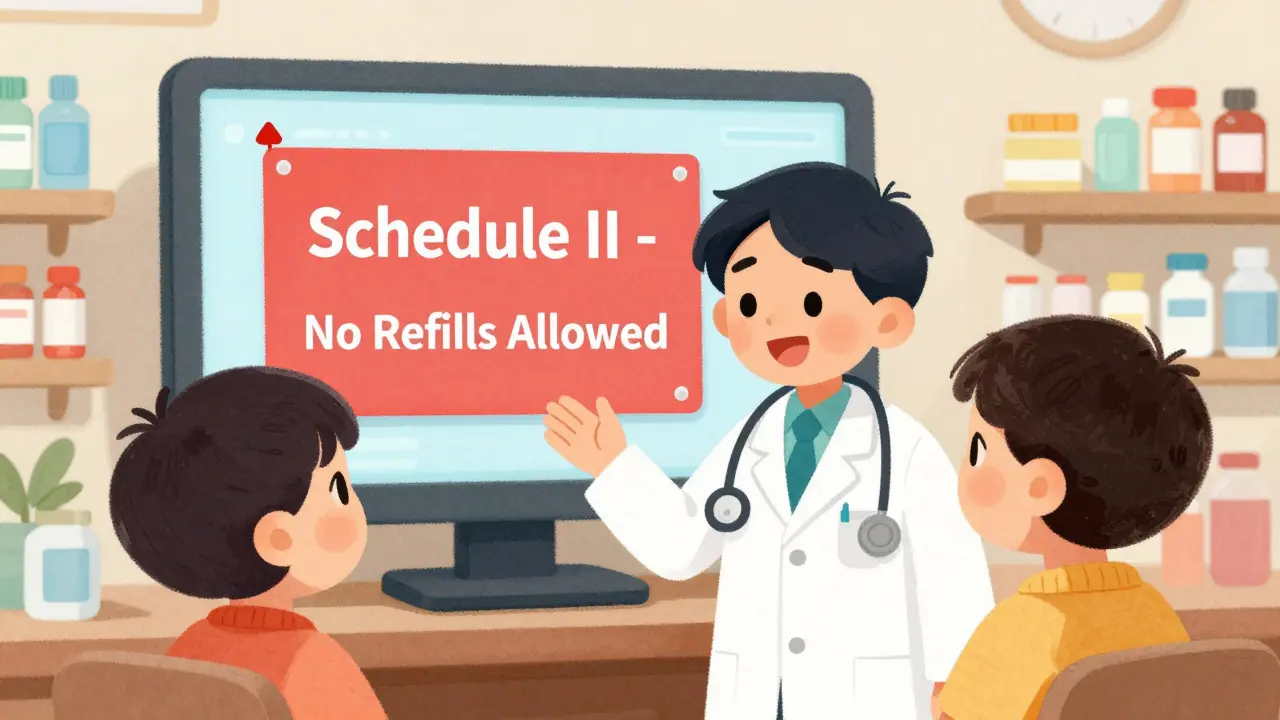
Not all medications are created equal when it comes to refills. The DEA has clear rules: Schedule II controlled substances - like oxycodone, fentanyl, or Adderall - cannot be refilled under any circumstances. A new prescription is required every time. No exceptions. Not even if the patient has a note from their doctor. Schedule III and IV drugs - like tramadol or alprazolam - can be refilled up to five times within six months, but only if the prescriber authorizes it. Even then, many pharmacies have internal policies that limit early refills to just two days before the script is due. That’s not a suggestion. It’s a policy. Insurance plans add another layer of confusion. Most allow a 30-day supply to be filled up to five days early. But patients often misunderstand this. They think, “If I can get it five days early, I can use it five days early.” So they finish their pills on day 25 and show up on day 26, demanding a refill. That’s not how it works. The five-day window is for pharmacy processing, not for consuming the medication faster. The SHPNC Medicare Retirees Base PPO Plan 7030 explicitly states that early refills are designed to “minimize excessive use, waste, and stockpiling.” That’s the goal: prevent hoarding, prevent misuse, and protect patient safety.Build a Three-Tier Refill Protocol System
The best way to stop early refills and duplicate therapy isn’t to say no every time. It’s to build a system that says yes - safely - when it’s appropriate. The American Academy of Family Physicians (AAFP) recommends a three-tiered approach:- Low-risk meds: Things like nasal steroids, topical creams, or thyroid meds. These can be refilled automatically if the patient has been seen within the last year. No extra steps needed.
- Chronic condition meds: Blood pressure pills, diabetes drugs, statins. These can be refilled for up to three months if the patient had a visit within the last 90 days. Nurses or medical assistants can approve these after checking for recent labs or vitals.
- High-risk meds: Opioids, benzodiazepines, stimulants. These require direct provider approval every time. No automation. No exceptions.

Use Your EHR and Clinical Viewers
Technology isn’t optional anymore. It’s essential. Electronic Health Records (EHRs) can flag early refill requests before they even reach the pharmacy. Set up alerts that trigger when a patient tries to refill a controlled substance before the legal date. Add notes like “cancel all prior” to stop automatic refill reminders from popping up. But EHRs only show what’s happening in your practice. What about the other 30% of prescriptions filled at different pharmacies? That’s where Clinical Viewers come in. In states with prescription drug monitoring programs (PDMPs), pharmacists can log in to see a patient’s full prescription history across multiple providers and pharmacies. If someone’s getting oxycodone from Dr. Smith in January and hydrocodone from Dr. Jones in February - the system will show it. No more guessing. OCP Info recommends pharmacists regularly check these tools when dispensing any new or refill prescription. Don’t assume the patient’s history is safe just because they’ve taken the drug before. Always re-assess.Train Your Staff - and Empower Them
A protocol is useless if your front desk staff doesn’t know how to use it. Train every team member - pharmacists, technicians, front desk, nurses - on what qualifies as an early refill, what counts as duplicate therapy, and what to say when a patient pushes back. Role-play tough conversations. Practice responses like:- “I understand you need this, but we’re required to check with your doctor first because of safety rules.”
- “I see you got this same medication last week from another pharmacy. Let me help you talk to your provider about why you’re getting it from two places.”
- “Your insurance only allows early fills five days before your last prescription runs out. You’re 10 days early. We can’t fill it yet.”
Work With Prescribers - Don’t Just Wait for Them
Pharmacists aren’t the only ones who need to change. Prescribers often send refill requests without checking if the patient already got a fill. Or they approve refills without reviewing the patient’s history. Ask your providers to sign prescriptions in advance for predictable refills. If they know they’ll be out of the office next week, they can pre-sign the next month’s script. That eliminates the 24-hour delay that sometimes sends patients to the ER because they ran out of albuterol. Also, encourage providers to use EHR alerts to flag patients with early refill patterns. If someone’s requesting early refills three months in a row, the system should notify the prescriber - not the pharmacy.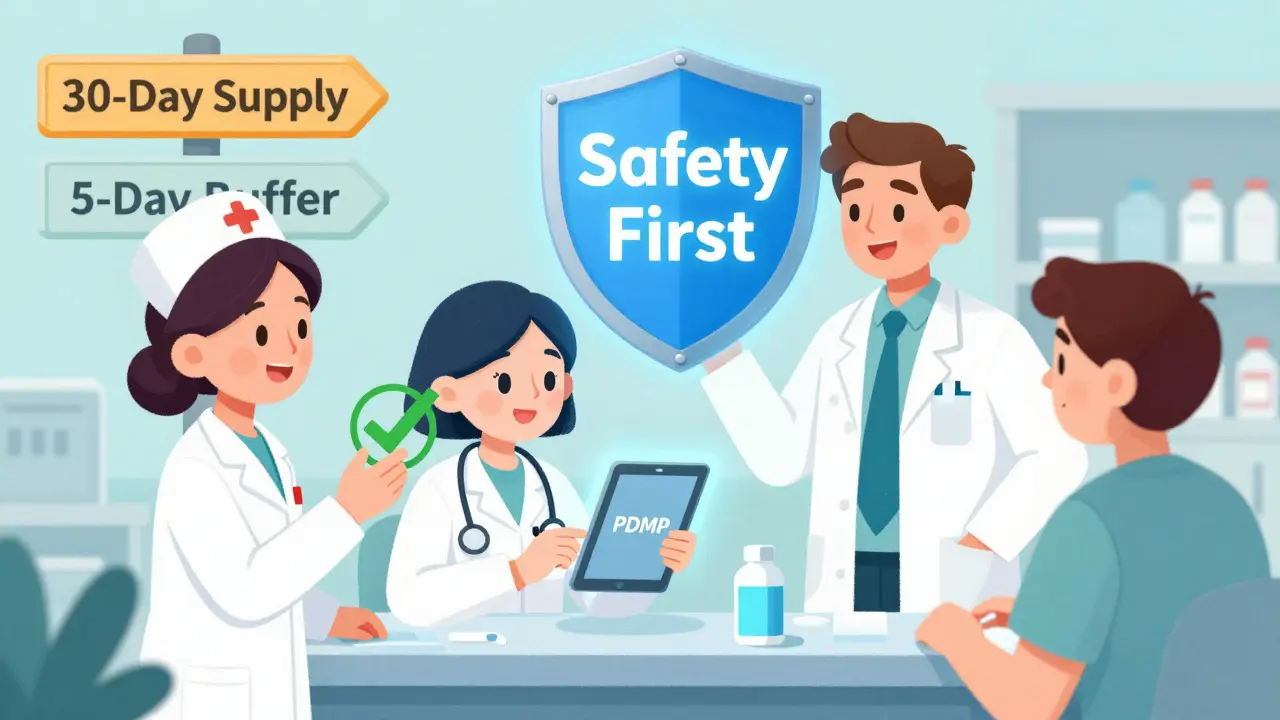
What to Do When a Patient Pushes Back
Patients will get upset. They’ll say, “My doctor said it was okay.” Or, “I paid cash - why does it matter?” Don’t argue. Don’t apologize. Just explain the rule calmly:- “I’m not saying no. I’m following federal rules designed to keep you safe.”
- “If you’re running out early, something might be wrong. Let’s figure out why.”
- “We can schedule a quick visit with your doctor to make sure this is still the right treatment.”
Track, Review, and Improve
Don’t set your protocols and forget them. Every quarter, review your refill data. How many early refills were denied? How many were approved with provider input? How many led to duplicate therapy flags? Which medications had the most issues? Use that data to update your protocols. If you notice a spike in early refills for gabapentin - a drug increasingly misused for its sedative effects - adjust your rules. Add it to the high-risk list. Require provider approval. The goal isn’t to block all refills. It’s to make sure every refill is safe, appropriate, and intentional.Final Thought: Safety Is a System, Not a Single Decision
Preventing early refills and duplicate therapy isn’t about being strict. It’s about being smart. It’s about using technology to see the full picture. It’s about training staff to act with confidence. It’s about working with prescribers to build predictable, safe systems. Every time you stop a dangerous refill, you don’t just prevent a mistake. You might prevent an overdose. A hospital visit. A relapse. A death. That’s not just good pharmacy practice. That’s what pharmacy is for.Can a Schedule II drug ever be refilled early?
No. Under DEA regulations, Schedule II controlled substances - including oxycodone, fentanyl, Adderall, and methadone - cannot be refilled under any circumstances. Even if the patient has a note from their doctor, a pharmacy cannot legally dispense a refill. A new, original prescription is required each time. Some states allow emergency partial fills under very limited conditions, but these are rare and require documentation.
Why do some pharmacies allow refills 5 days early?
Insurance plans often allow a 30-day prescription to be filled up to five days early to account for pharmacy processing delays, weekends, or holidays. This is not permission to use the medication early. It’s a buffer for administrative time. Patients who finish their pills on day 25 and demand a refill on day 26 are misinterpreting the policy. Pharmacies should enforce the actual supply duration - meaning the next fill should be on day 30, not day 25.
How do pharmacists find out if a patient is getting duplicate therapy?
Pharmacists use Prescription Drug Monitoring Programs (PDMPs) and Clinical Viewers to access a patient’s complete prescription history across multiple pharmacies and prescribers. These tools show all controlled substances and high-risk medications filled in the past six to twelve months. If a patient is getting two different opioids or two different benzodiazepines, the system will flag it. Pharmacists are trained to review these records before dispensing any new or refill prescription.
What should I do if a patient says they paid cash and doesn’t need approval?
Paying cash doesn’t override federal or state medication safety laws. Whether a prescription is paid for by insurance, cash, or Medicaid, the same rules apply. Schedule II drugs still can’t be refilled. Duplicate therapy still poses overdose risks. Pharmacists have a legal and ethical duty to protect patients - regardless of payment method. Always follow protocol, even if the patient offers to pay out of pocket.
Can nurses or medical assistants approve refill requests?
Yes - but only for low-risk and chronic condition medications under a pre-approved protocol. For example, if a patient has been seen within the last 90 days and their blood pressure or HbA1c is stable, a nurse can approve a refill of their hypertension or diabetes medication without involving the doctor. This reduces provider burnout and speeds up care. But for controlled substances or any medication with monitoring requirements, direct provider approval is required.
How often should refill protocols be reviewed?
Refill protocols should be reviewed at least every six months, or sooner if new evidence emerges or if there’s a spike in early refill requests for a specific drug. For example, gabapentin was added to high-risk lists in many clinics after data showed increasing misuse. Protocols must evolve with the medication landscape to remain effective and safe.


11 Comments
Sangeeta Isaac
so like... i just got my oxycodone refill 7 days early and the pharmacist gave me side-eye like i stole her dog. i paid cash, my back hurts, and i didn't even ask for extra. now i feel like a criminal. why do we make nice people feel guilty for being in pain?
MAHENDRA MEGHWAL
The systemic integrity of pharmaceutical safety protocols must be upheld with unwavering diligence. Early refills, irrespective of patient assertion or payment modality, represent a critical vulnerability in controlled substance management. Adherence to DEA regulations is not discretionary; it is a non-negotiable pillar of public health stewardship.
Stephen Rock
pharmacists are the new gatekeepers of the opioid apocalypse and theyre acting like theyre guarding the holy grail of painkillers while patients are dying in their living rooms from untreated chronic pain. its not about safety its about control and profit
Jerry Rodrigues
i get why the rules exist but i also know people who take their meds exactly as prescribed and still get treated like addicts because someone else abused the system. it sucks for everyone
michelle Brownsea
I cannot believe that anyone would even consider allowing a Schedule II refill under any circumstance-this is not a suggestion, this is a federal law designed to prevent catastrophic harm. To argue otherwise is not just irresponsible-it is morally indefensible. We are not here to cater to convenience; we are here to save lives.
shubham rathee
you know what they dont tell you the feds are using pdmps to track every single pill and sell the data to insurance companies so they can raise your premiums if you refill too often its not about safety its about money
Roisin Kelly
so let me get this straight… if i run out of my benzos because my cat knocked them into the toilet and i have anxiety so bad i can’t breathe, i’m supposed to wait 5 days and suffer while some pharmacist plays cop? and if i go to another pharmacy they’ll call me a drug seeker? i’m not a criminal i’m just a person with a broken brain
Malvina Tomja
this whole system is a joke. nurses approving refills? you think they know what they’re doing? half of them can’t spell ‘hypertension’ and you’re letting them decide who gets opioids? this isn’t healthcare this is a bingo game with pills
Kevin Narvaes
every time someone says 'safety first' they're really saying 'i don't want to think about the fact that people are suffering and we have no real solution'
Dee Monroe
I think what we're really talking about here is not just medication management, but the entire structure of how we treat human beings in pain within a system that prioritizes bureaucracy over empathy. Every time a pharmacist says no, they're not just denying a pill-they're denying dignity. And if we continue to treat suffering as a compliance issue rather than a human one, we're not protecting people-we're punishing them for being alive in a broken world. The protocols are necessary, yes, but they must be wrapped in compassion, not rigidity. We can have rules and still see the person behind the prescription.
Alex Carletti Gouvea
this whole thing is just another example of why america needs to stop letting foreigners run our healthcare. if we had real american pharmacists who actually cared about american patients instead of following some global compliance checklist, we wouldn't be in this mess. stop overcomplicating it.