
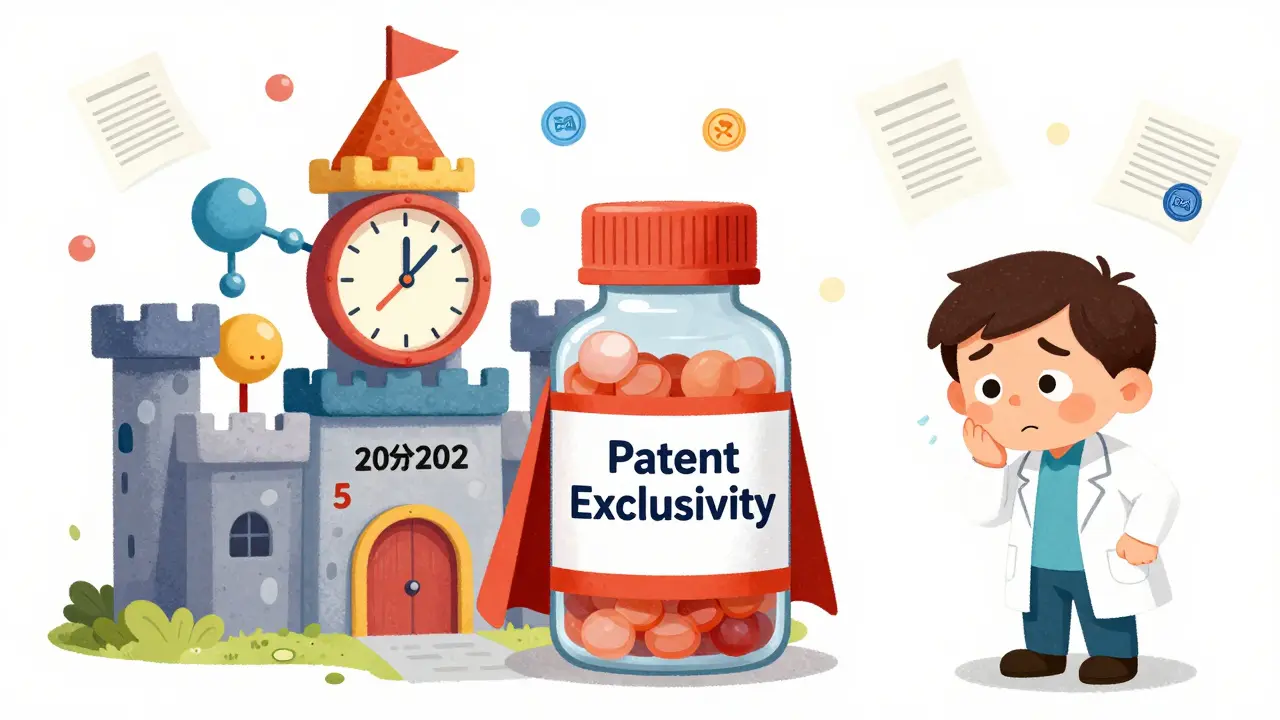
When a new drug hits the market, it doesn’t just have a patent. It has two layers of protection that keep competitors out - and most people don’t even know the difference. One is called patent exclusivity. The other is market exclusivity. They sound similar. They both block generics. But they work in completely different ways - and knowing which is which can mean the difference between a drug staying expensive for years… or suddenly becoming affordable.
Patent Exclusivity: The Legal Shield
Patent exclusivity comes from the U.S. Patent and Trademark Office (USPTO). If you invent a new chemical compound, a new way to make it, or a new use for an old one, you can file a patent. That patent gives you the legal right to stop others from making, selling, or using your invention - for 20 years from the day you file it.
But here’s the catch: most drugs take 10 to 15 years just to get approved by the FDA. That means by the time your drug actually hits shelves, you might only have 5 to 8 years of patent life left. A 20-year patent sounds long - until you realize half of it’s gone before you even start selling.
That’s why drug companies use tricks like patent term extension (PTE). If the FDA took too long to approve your drug, you can ask for up to 5 extra years of patent life - but only if your remaining patent time doesn’t go beyond 14 years after approval. So a drug approved in 2020 with a patent filed in 2010 might get extended to expire in 2029 instead of 2030.
Patents can cover different things: the actual molecule (composition of matter), how it’s made (process), how it’s packaged (formulation), or what it treats (method of use). The strongest patent? The one on the molecule itself. But many companies file dozens of secondary patents - on coatings, dosing schedules, or delivery systems - just to stretch out protection. The FTC found that 68% of patents listed in the FDA’s Orange Book are secondary, not core.
Market Exclusivity: The FDA’s Secret Weapon
Market exclusivity isn’t a patent. It’s a regulatory gift from the FDA. And it doesn’t care if your drug is new or old. It only cares about the data you submitted to get approval.
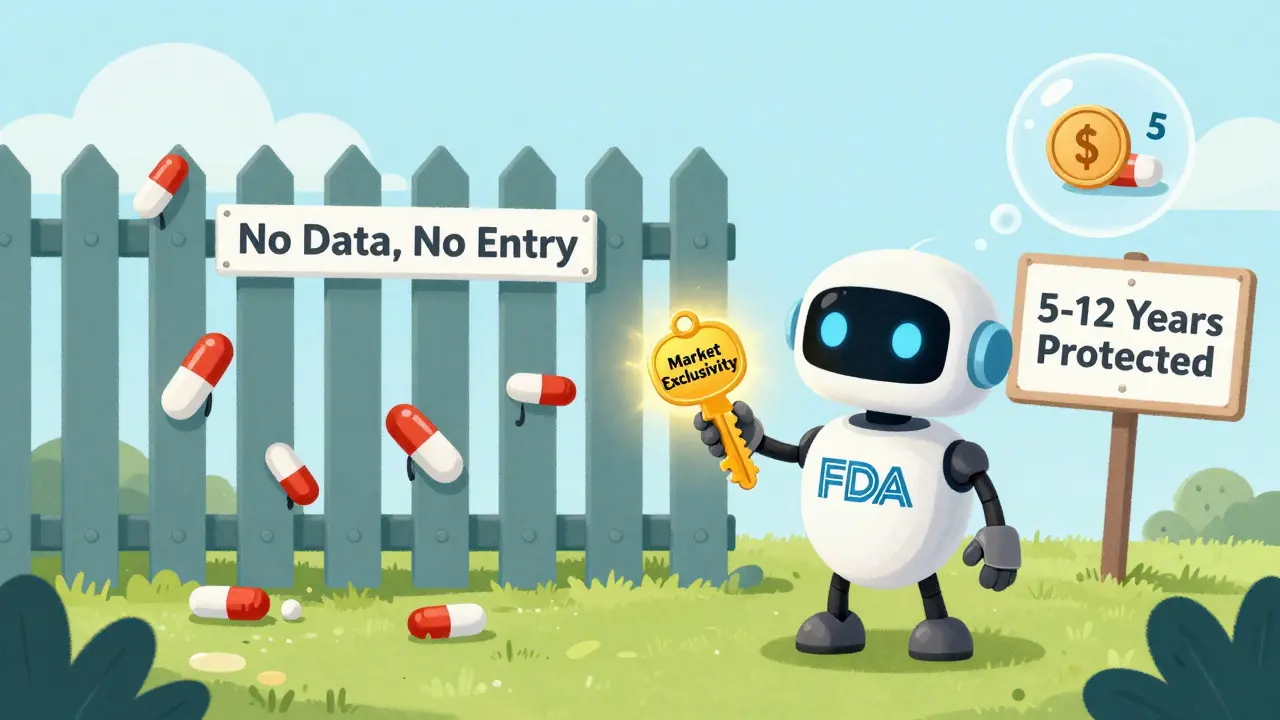
When a company spends millions on clinical trials to prove a drug is safe and effective, the FDA promises: "We won’t let anyone else use your data to get approved for 5, 7, or even 12 years." That’s market exclusivity. It’s automatic. No lawsuit needed. No patent filing. Just submit your data, get approval, and the FDA blocks generics - no questions asked.
There are different types:
- New Chemical Entity (NCE) exclusivity: 5 years. No generic can even apply during this time.
- Orphan drug exclusivity: 7 years. For drugs treating rare diseases (under 200,000 U.S. patients). Even if the drug isn’t patented, this blocks competition.
- Pediatric exclusivity: +6 months. If you study the drug in kids as requested by the FDA, you get this bonus.
- Biologics exclusivity: 12 years. Created in 2009 under the BPCIA. This one’s huge - it’s why biologic drugs like Humira stayed expensive for over a decade.
- 180-day exclusivity: Given to the first generic company to challenge a patent and win. This is a race - and the winner can make hundreds of millions before others even enter.
Here’s the kicker: market exclusivity can exist even when there’s no patent. In 2010, a drug called colchicine - used since ancient times - got 10 years of exclusivity just because a company submitted new clinical data. The price jumped from 10 cents a tablet to nearly $5. No patent. Just exclusivity.
How They Work Together - Or Don’t
Think of patent and market exclusivity as two separate keys to the same door. You might have one, both, or neither.
The FDA’s own data shows:
- 27.8% of branded drugs have both
- 38.4% have only patents
- 5.2% have only market exclusivity
- 28.6% have neither
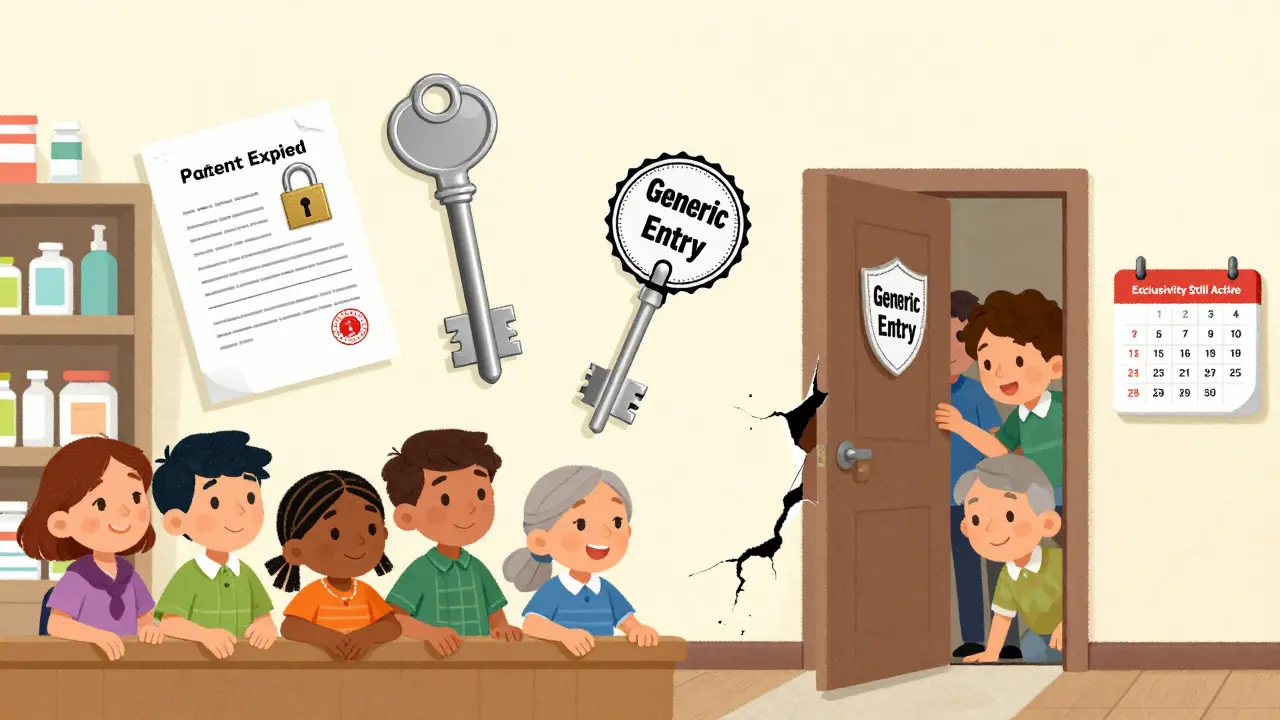
That last group? They’re the ones that get generic competition fast. But the 5.2% with only exclusivity? They’re the real surprise. In 2021, the Congressional Research Service found that 78% of drugs with regulatory exclusivity but no patent still had no generic competition during the exclusivity period. That’s not a glitch - that’s the system working as designed.
Take Trintellix, an antidepressant. Its patents expired in 2023. But the FDA had granted it 3 years of market exclusivity. So generics couldn’t enter until 2024. Teva Pharmaceuticals lost $320 million because they didn’t realize exclusivity was still active.
And here’s the real-world impact: the average branded drug makes 65% of its total revenue in the first year after approval - thanks to this dual protection. A 2022 study by Evaluate Pharma showed that without both patent and exclusivity, many drugs wouldn’t recoup their $2.3 billion development costs.
Why This Matters for Patients and Prices
When exclusivity overlaps with patents, it creates a "patent thicket" - a maze of legal barriers. But when exclusivity stands alone, it’s even more powerful. A company can take an old, cheap drug, tweak it slightly, run a new trial, and lock out generics for 5 to 12 years - all without a patent.
That’s why drugs like colchicine, metformin, and allopurinol - all decades-old - suddenly became unaffordable. It wasn’t because of patents. It was because of market exclusivity.
The FDA’s new Exclusivity Dashboard, launched in September 2023, now lets anyone see when each drug’s exclusivity expires. Generic manufacturers are using it to plan their entry. But for patients? It means waiting longer for cheaper versions.
Even more concerning: 43% of small biotech firms mistakenly assume patent protection equals market exclusivity. They spend millions on patent lawyers, only to find out their drug qualifies for regulatory exclusivity - and they didn’t even apply for it. The Biotechnology Innovation Organization found that 22% of innovators missed claiming exclusivity entirely - leaving an average of 1.3 years of protection on the table.
What’s Changing Now?
The system is under pressure. In 2023, the PREVAIL Act proposed cutting biologics exclusivity from 12 to 10 years. The FDA also started requiring more detailed justifications for exclusivity claims - starting January 1, 2024.
McKinsey predicts that by 2027, regulatory exclusivity will account for 52% of total market protection time for new drugs - up from 41% in 2020. Why? Because patent challenges are winning more often. Courts are striking down secondary patents left and right. So companies are shifting focus to exclusivity - the one thing the FDA enforces automatically.
And it’s not just the U.S. The EU gives 8 years of data protection, plus 2 years of market exclusivity, plus 1 extra year for new uses. That’s 11 years total - longer than the U.S. system for many drugs.
Global debates are growing. The WTO’s waiver of patent rights for COVID-19 vaccines has opened the door for similar moves on other drugs. If that happens, exclusivity could become the last line of defense for drugmakers.
Bottom Line
Patent exclusivity protects inventions. Market exclusivity protects data. One is legal. The other is administrative. One requires lawsuits. The other just needs paperwork.
Most patients think generics arrive when patents expire. But they don’t. They arrive when both protections end. And in many cases, that’s years later.
If you’re a patient waiting for a cheaper version of your medication, check the FDA’s Exclusivity Dashboard. If you’re a company trying to bring a generic to market, don’t just look at patents - look for exclusivity. Because sometimes, the real barrier isn’t the patent. It’s the FDA’s stamp of approval.
14 Comments
Tricia O'Sullivan
Thank you for this incredibly clear breakdown. As someone who works in regulatory affairs in Ireland, I’ve seen firsthand how market exclusivity can quietly extend monopolies far beyond what patents alone would allow. The colchicine example is chilling - a centuries-old remedy suddenly priced out of reach because of a regulatory loophole. It’s not innovation; it’s exploitation dressed as incentive.
Brandon Osborne
Oh PLEASE. These pharma bros are laughing all the way to the bank while seniors choose between insulin and rent. You think this is about R&D? Nah. It’s about rent-seeking. The FDA is basically a paid shill for Big Pharma. Patent? Who cares. Exclusivity? That’s the real monopoly weapon. And don’t even get me started on how they game pediatric exclusivity like it’s a video game cheat code.
Marie Fontaine
THIS. I’m a nurse and I see patients struggle every day. I had one lady who cried because her $300/month med became $800 after exclusivity kicked in. She didn’t even know why. We need transparency. The FDA dashboard is a start, but it’s buried under 10 layers of bureaucracy. Can we make this info pop up when doctors prescribe? Please?? 😭
Elan Ricarte
Let’s be real - this whole system is a Rube Goldberg machine of corporate greed. Patents? Pfft. Secondary patents are just legal spam. But market exclusivity? That’s the nuclear option. You take a drug older than my grandpa’s dentures, slap on a new pill coating, run a 30-patient trial, and BAM - 12 years of monopoly. And the FDA? They don’t even blink. It’s not regulation. It’s a corporate protection racket with a white coat.
And don’t get me started on 180-day exclusivity. That’s not innovation - that’s a legal bounty hunt. The first generic company to sue wins a golden ticket to print money. Meanwhile, patients wait. Again.
McKinsey says exclusivity will be 52% of protection time by 2027? Yeah. Because patents are getting shredded in court. So pharma’s playing chess while we’re still playing checkers. And we’re losing.
Angie Datuin
Interesting. I never realized market exclusivity could exist without a patent. The colchicine case really sticks with me - it’s wild how something so old and cheap can be locked up like that. Makes me wonder how many other drugs are being quietly monopolized this way.
Camille Hall
Thank you for sharing this. I think this is one of those topics that flies under the radar, but impacts so many lives. I’ve worked with patients who’ve had to switch meds because they couldn’t afford the new price - even though the active ingredient hasn’t changed. The fact that exclusivity can be granted without innovation is deeply troubling. Maybe we need public education campaigns? Or at least mandatory disclosures on prescriptions?
Ritteka Goyal
USA is so lazy in healthcare why do they allow this nonsense? In India we have generic drugs for pennies because we don’t play these stupid games. Why should a company get 12 years to charge $500 for a pill that costs 2 cents to make? This is why poor people die in America. You have money? You live. No money? You die. And you call this a democracy? I am from India and we make generics for the world - and now you are stealing our market with legal tricks? Shame on you. FDA should be ashamed. This is not innovation - this is robbery with paperwork.
Lyle Whyatt
Really well articulated. I’ve been following this for years as an Aussie pharmacist. The EU system is actually more balanced - 8 years data protection plus 2 market exclusivity plus 1 for new use. That’s 11 years max. The US gives 12 for biologics AND lets them stack exclusivity on top of patents. It’s a free-for-all. And the worst part? The public pays for the R&D through taxes and then gets gouged again at the pharmacy. It’s a double dip.
Also, the fact that 22% of innovators miss claiming exclusivity? That’s not incompetence - that’s systemic failure. Someone should be auditing this. And why isn’t the FTC cracking down harder on patent thickets? They’ve got the data. They’ve got the power. Why not use it?
Random Guy
so like… the FDA is basically a paid bodyguard for big pharma? 🤡
patents? pfft. exclusivity? that’s the real magic wand. colchicine from 10 cents to $5? that’s not science. that’s a con.
Brett Pouser
As someone who grew up in a country with universal healthcare, this feels surreal. In my home country, we negotiate drug prices as a nation. Here, it’s a free-for-all. The fact that a company can take an ancient drug, tweak it, and lock it away for a decade? That’s not capitalism - that’s feudalism with a FDA stamp.
And the 180-day exclusivity? That’s not a reward - it’s a bribe to incentivize lawsuits. The system is rigged to make litigation the path to profit. Who wins? The lawyers. Who loses? Everyone else.
Joshua Smith
Okay but why does no one talk about how the FDA doesn’t even verify if the new data is meaningful? Like, if you run a trial on 20 people and call it "pediatric" just to get 6 extra months - is that even science? Or just paperwork theater?
Jessica Klaar
Replying to @7597 - exactly. I’ve seen studies where "new" pediatric data was just a re-analysis of adult data with kids thrown in. No new efficacy. No new safety. Just a form filled out. And the FDA approves it anyway. It’s not oversight - it’s rubber-stamping.
PAUL MCQUEEN
Wow. This post is basically a 2000-word ad for Big Pharma. Congrats. You really sold me on how brilliant these guys are.
John Watts
Let’s flip this: what if we treated exclusivity like a public service? If you get exclusivity, you agree to license the data to generic manufacturers after 5 years. No lawsuits. No delays. Just lower prices. The FDA could enforce it. The drug companies still make money - just not 12 years of monopoly profits. We could save billions. And patients wouldn’t have to wait.
It’s not radical. It’s just rational.