
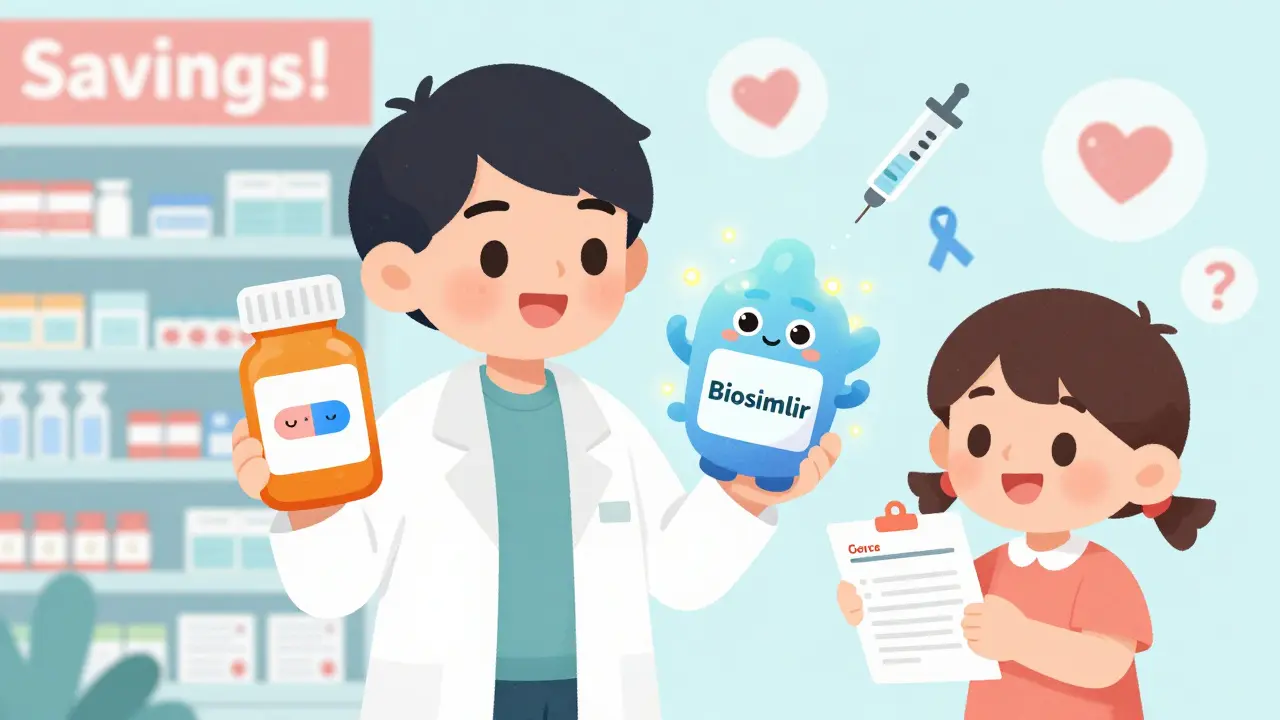
When you’re prescribed a medication, you might hear your doctor or pharmacist mention a biosimilar or a generic. At first glance, they sound like the same thing: cheaper versions of expensive drugs. But they’re not. And confusing them could mean missing out on real savings-or even making a choice that doesn’t fit your treatment needs.
What’s the real difference?
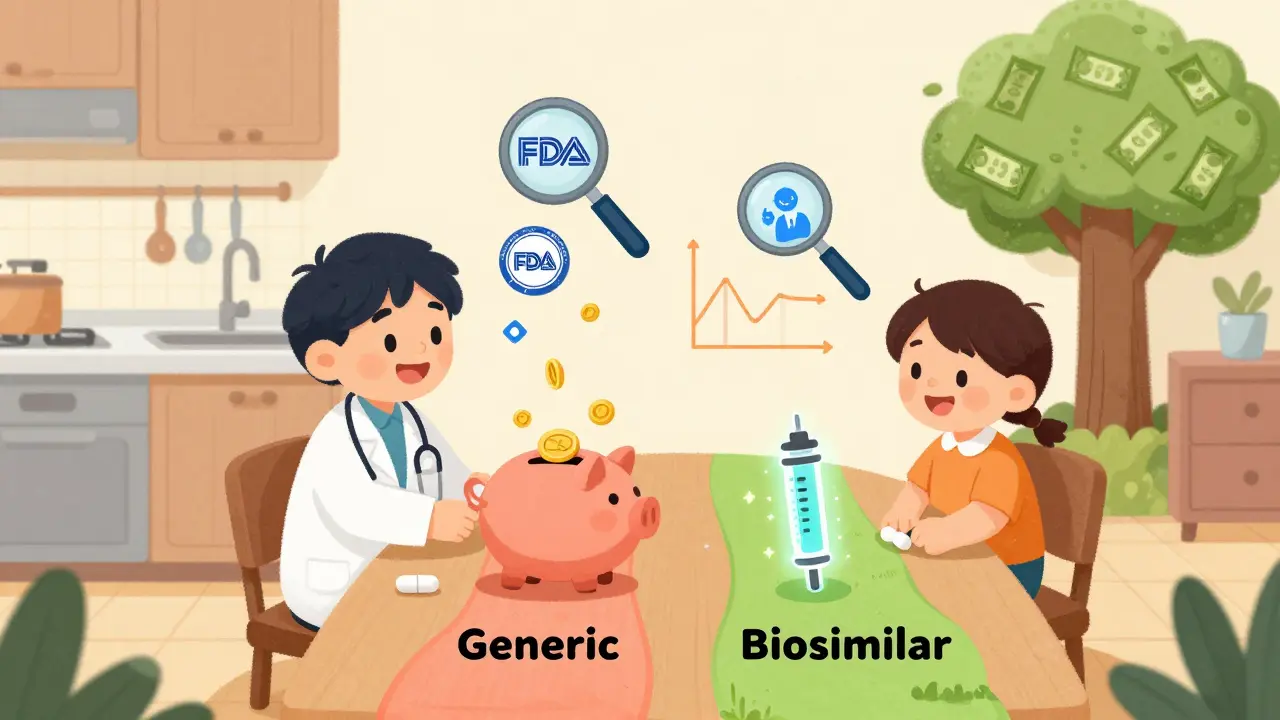
Generics and biosimilars both lower costs, but they come from completely different worlds of science.Generics are small-molecule drugs. Think of them as exact chemical copies. If your brand-name drug is atorvastatin (Lipitor), the generic is the same molecule, made in a lab using precise chemical reactions. The FDA requires generics to have the same active ingredient, strength, dosage form, and route of administration as the original. They must also prove they’re bioequivalent-meaning your body absorbs them the same way. That’s why you can swap a generic for the brand without any fuss. Studies, including a major 2019 JAMA analysis of 47 trials, show no meaningful difference in effectiveness for heart drugs, thyroid meds, or antibiotics.
Biosimilars are something else entirely. They’re not copies. They’re highly similar versions of complex biologic drugs-large proteins made from living cells. Think insulin, Humira, or Herceptin. These drugs are too big and too intricate to be replicated exactly. Even tiny changes in the cell line, temperature, or purification process can affect the final product. That’s why biosimilars don’t need to be identical-they just need to show no clinically meaningful difference in safety, purity, or potency. The FDA approves them after thousands of lab tests, animal studies, and at least one clinical trial comparing them directly to the original.
Cost savings: big gap, different rules
Here’s where it gets practical.Generics cut costs dramatically. On average, they’re 80-85% cheaper than their brand-name counterparts. A 2022 FDA report found that generics saved the U.S. healthcare system over $300 billion in a single year. That’s why you’ll find generics for nearly every common condition: high blood pressure, diabetes, depression, infections.
Biosimilars? They’re more modest. They save 15-20% compared to the original biologic. That might sound small, but when the original costs $20,000 a year for a cancer or autoimmune drug, that’s still $3,000-$4,000 saved annually. The RAND Corporation estimated in 2023 that biosimilars will generate $34 billion in global savings by 2028. The real value? They’re the only affordable option for biologics-because there are no generics for them. Ever.
Substitution: who decides?
Switching from brand to generic is usually automatic. In 49 U.S. states, pharmacists can swap a generic without asking your doctor-unless your prescription says "dispense as written." Biosimilars? It’s not that simple. Only interchangeable biosimilars can be swapped at the pharmacy. And even then, 28 states require the pharmacist to notify your doctor within 72 hours. As of 2024, only a handful of biosimilars have been approved as interchangeable-like Semglee (insulin) and Cyltezo (adalimumab). Most others still require a new prescription.Why the extra steps? Because switching biologics isn’t like switching pills. While evidence shows switching between a biosimilar and its reference product is safe for most people, some conditions-like inflammatory bowel disease-require careful monitoring. A 2023 study in Patient Preference and Adherence found 19% of patients felt anxious about switching, even though their disease activity didn’t change. That’s why many doctors prefer to make the decision with you, not leave it to the pharmacy.
Which one is right for you?
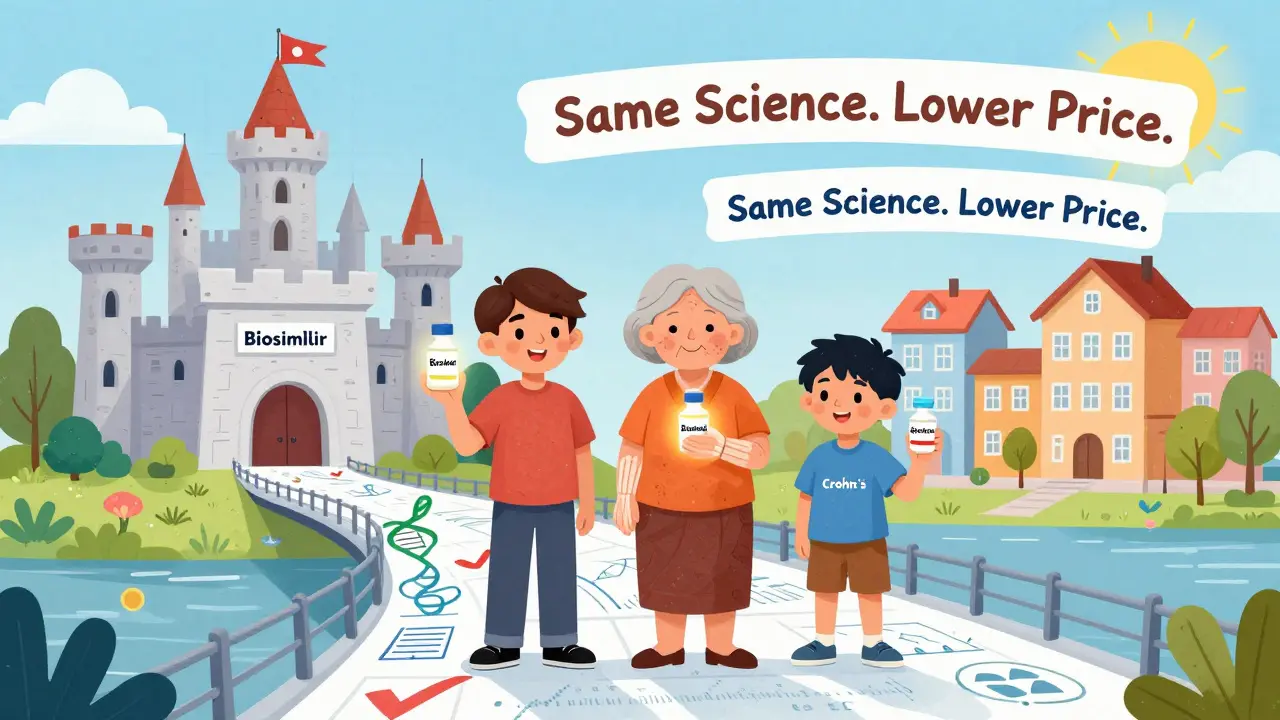
If you’re taking a pill for high cholesterol, high blood pressure, or acid reflux, the answer is simple: go generic. It’s safe, proven, and saves you money.If you’re on a biologic-like a shot for rheumatoid arthritis, psoriasis, Crohn’s disease, or cancer-then a biosimilar is your best option. There’s no generic alternative. And the data is clear: multiple studies, including a 2022 review in Clinical Rheumatology of over 38,000 patients, show biosimilars work just as well as the original.
But here’s the catch: not all biosimilars are the same. Some are approved for all the same uses as the original. Others have more limited indications. Your doctor needs to check the exact FDA-approved uses before prescribing. A biosimilar for Humira might be approved for rheumatoid arthritis but not for pediatric Crohn’s. That detail matters.
Real-world experiences
Patients are seeing real results.A rheumatoid arthritis patient in Perth reported saving over $8,000 a year after switching to an adalimumab biosimilar. No flare-ups. No side effects. Just lower costs.
A colon cancer patient on bevacizumab saw their out-of-pocket cost drop from $450 to $75 per infusion after switching to a biosimilar. Their tumor markers stayed stable.
But it’s not always smooth. Some patients struggle with new delivery devices. A biosimilar insulin pen might look different from the original. An elderly patient might misread the dose. Pharmacists in online forums report these small changes causing confusion-even when the drug works perfectly.
And then there’s trust. A 2022 survey by the National Psoriasis Foundation found 42% of patients were hesitant to switch. Many worried biosimilars were "second-rate." But the science says otherwise. The FDA, European Medicines Agency, and major medical societies all agree: approved biosimilars are safe and effective.
What you need to ask your doctor
Don’t assume. Ask.- Is my medication a biologic? If yes, a biosimilar is your only affordable option.
- Is there a biosimilar available for my drug? Check the FDA’s Purple Book-it lists all approved biosimilars and their interchangeability status.
- Is the biosimilar approved for my exact condition? Not all biosimilars cover all uses of the original.
- Will my insurance cover it? Some plans still push the brand-name drug first.
- Can we switch? If you’re stable on the original, switching isn’t urgent-but it could save you thousands.
What’s changing in 2026?
The landscape is shifting fast. The Inflation Reduction Act removed financial penalties for doctors who use biosimilars in Medicare Part B. That’s pushing more hospitals and clinics to adopt them. In 2023, 89% of U.S. hospitals used a biosimilar version of infliximab. That number is climbing.The first interchangeable biosimilar for a monoclonal antibody (Cyltezo for Humira) was approved in August 2023. More are coming. In 2024, the first biosimilar for Stelara (ustekinumab) is expected-potentially saving $5 billion a year in the U.S. alone.
But barriers remain. Patent lawsuits delay entry. A 2023 FTC report found an average of 144 patent claims per biologic drug. That’s why some biosimilars take years to reach the market after the original patent expires.
And prescriber confidence? Still low. A 2023 AMA survey found only 58% of non-specialist doctors felt very confident prescribing biosimilars. Compare that to 89% for generics. Education is improving, but it’s still a hurdle.
Bottom line
Choose based on your drug, not your assumptions.If it’s a pill-go generic. It’s safe, simple, and saves big.
If it’s an injection or infusion for a chronic disease-biosimilar is your smart choice. It’s not a downgrade. It’s a scientifically validated, cost-effective alternative that’s been tested on tens of thousands of patients.
Don’t let confusion cost you. Ask your doctor. Check your insurance. And know that you’re not sacrificing quality-you’re gaining access.

9 Comments
Jazminn Jones
The fundamental misunderstanding in public discourse regarding biosimilars stems from a conflation of chemical synthesis with biological complexity. Generics, by virtue of their small-molecule architecture, are amenable to exact replication-this is not true of biologics, which are inherently heterogeneous due to post-translational modifications. The FDA’s regulatory framework for biosimilars, while rigorous, operates under a principle of totality of evidence, not equivalence. To assert that biosimilars are "just as good" is to ignore the nuanced pharmacokinetic and immunogenic profiles that may vary across manufacturing batches. The clinical data, while statistically non-inferior, rarely captures long-term immunogenicity risks in heterogeneous populations.
Stephen Rudd
You people are delusional if you think biosimilars are safe. The FDA approves these things based on a single clinical trial? That’s a joke. I work in biotech and I’ve seen the raw data-there are always hidden inconsistencies in glycosylation patterns that get smoothed over in the reports. And don’t even get me started on how the big pharma companies manipulate patent cliffs to delay competition. You’re being sold a lie wrapped in a white coat. This isn’t medicine-it’s corporate theater.
George Vou
lol so generics are like exact copies but biosimilars are just "similar"? sounds like big pharma just made up a word to charge more money. i heard a guy on youtube say biosimilars are made in labs with alien tech and they make you glow in the dark. i dont trust this stuff. my cousin took one and his dog got sick. not sure if related but still…
Mantooth Lehto
I switched to a biosimilar for my RA and it changed my life. I cried the first time I paid $25 instead of $4,000. No flare-ups. No weird side effects. Just peace. People who say they’re "not the same" have never had to choose between rent and their meds. This isn’t theoretical-it’s survival. Thank you to the scientists who made this possible. You’re heroes.
Neeti Rustagi
It is imperative to underscore that the regulatory pathways for biosimilars are among the most stringent in global pharmacology. The European Medicines Agency, in particular, has demonstrated unparalleled rigor in its evaluation criteria, requiring extensive analytical, non-clinical, and clinical data packages. To dismiss biosimilars as inferior is to disregard the collective expertise of regulatory bodies spanning six continents. The data is not merely robust-it is definitive. Patients deserve access to scientifically validated alternatives, not fear-driven misinformation.
Janelle Pearl
I read this whole thing and I just want to say-thank you. As someone who’s been on biologics for 8 years, I’ve felt so alone in this. The fear of switching, the weird looks from pharmacists, the guilt over "settling"-it’s all real. But this? This article made me feel seen. I switched to a biosimilar last year. My insurance saved me $7k. My body didn’t miss a beat. I wish everyone knew how safe and normal this is. You’re not losing anything. You’re gaining freedom.
Ray Foret Jr.
my doc just switched me to a biosimilar and i was nervous as heck but like… it worked? no weird side effects. the pen looked different at first but i got used to it. saved me like 3k a year. i think people are scared of stuff that looks new but honestly? science is cool. keep it up 🙌
Robert Bliss
Same here! I was scared too but my doc said the FDA checks these way harder than generics. I thought biosimilars were just knockoffs but now I get it-they’re like a really close cousin, not a fake. And now I can afford my shots without stress. Thanks for writing this!
Peter Kovac
While the article presents a largely favorable view of biosimilars, it omits critical context regarding immunogenicity surveillance. The post-marketing data on biosimilars remains sparse compared to originator biologics, which have decades of real-world exposure. Furthermore, the assumption that all biosimilars are interchangeable is a regulatory fiction-each product has a unique indication profile, and switching between non-interchangeable biosimilars lacks robust clinical validation. The narrative of universal safety is premature and potentially dangerous. Transparency, not optimism, must guide policy.