
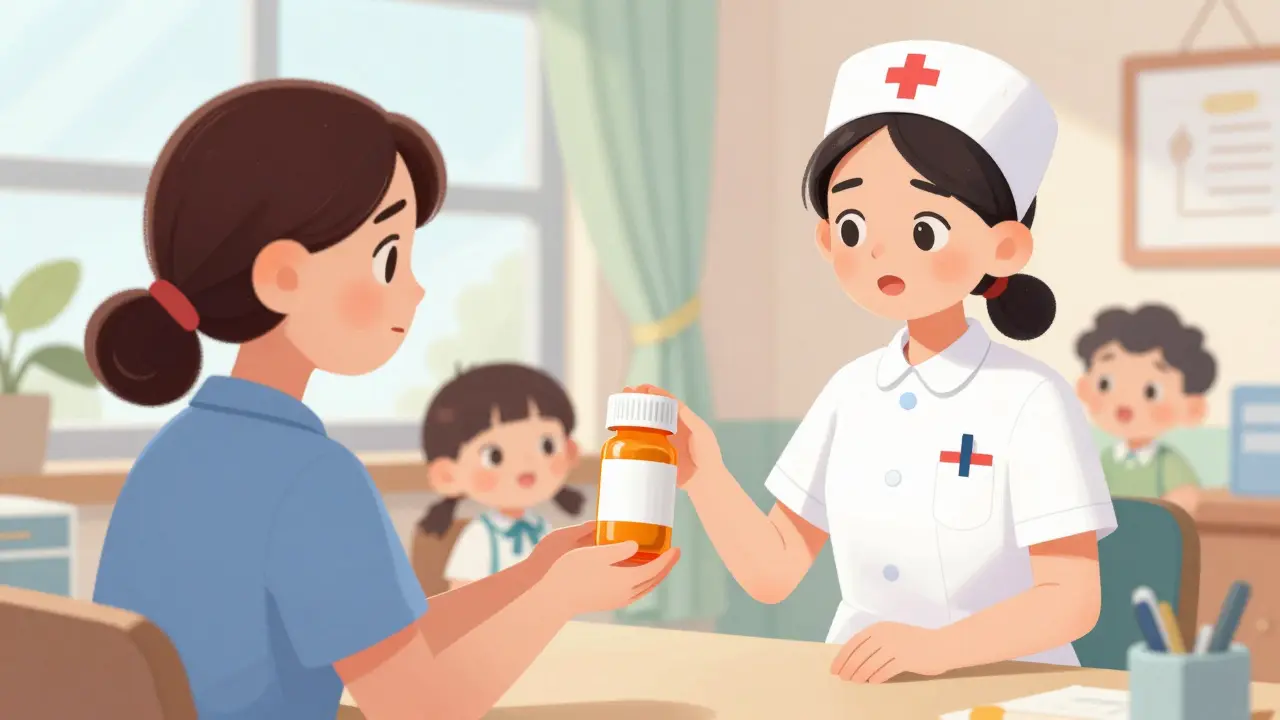
Every morning, thousands of children swallow pills, use inhalers, or get injections before lunch - not at home, but in the classroom. For many families, this isn’t optional. It’s necessary. If your child takes medication during school hours, whether it’s for asthma, ADHD, diabetes, or allergies, you need to know exactly how to make sure it’s done safely. Schools aren’t pharmacies. They’re classrooms. And without clear rules, mistakes happen. The good news? When parents, schools, and doctors work together the right way, medication errors drop by up to 75%. Here’s how to get it right.
What You Must Bring to School
Don’t send your child to school with a pill bottle in their backpack. That’s not just unsafe - it’s against the rules in nearly every district. All medications, prescription or over-the-counter, must be delivered by a parent or guardian directly to the school nurse’s office. The container must be the original, factory-sealed packaging with the child’s full name clearly printed on it. No unlabeled pills. No transferred doses. No expired meds.
The label needs more than just a name. It must show the medication name, exact dose, how often to give it, the route (swallowed, inhaled, injected), and the prescribing doctor’s name. If the bottle doesn’t have all this, the school won’t accept it - even if it’s a common medicine like ibuprofen or an inhaler. The American Academy of Pediatrics says the bottle label alone is never enough. You need a signed form too.
Paperwork Is Non-Negotiable
You can’t just drop off the medicine and walk away. Every school requires two signed forms: one from your child’s doctor, and one from you, the parent. This isn’t bureaucracy - it’s legal protection for everyone involved. The doctor’s form must include: the child’s full name, medication name, dosage, timing, route, duration of treatment, possible side effects, and the doctor’s license number. Some states, like New York, require this form to be renewed every year.
Your consent form confirms you’ve read and understood the risks, know how the medication works, and agree to the school’s procedures. Many districts, like Frederick County Schools, use a specific form called the “Request and Authorization for Administering Long-Term Prescription Medication.” If your child needs medication for more than 30 days, this form is mandatory. Submit it early. New York City Public Schools recommends turning it in by June 1 so there’s no gap when school starts.
Timing Matters More Than You Think
Medications work best when they’re given at the right time. If your child takes a daily pill at 8 a.m. at home, the school should give it between 7:30 a.m. and 8:30 a.m. That’s the standard 30-minute window allowed by the American Academy of Pediatrics - unless the doctor says otherwise. Some meds, like insulin or seizure drugs, require exact timing. Those need special instructions on the form.
Don’t assume the school knows your child’s routine. If you change the time or dose at home, you must tell the school immediately. According to the National Association of School Nurses, 18% of medication errors happen because parents didn’t update the school. A missed dose or an extra pill can be dangerous. Call the nurse. Email the office. Don’t wait.
Who Gives the Medication?
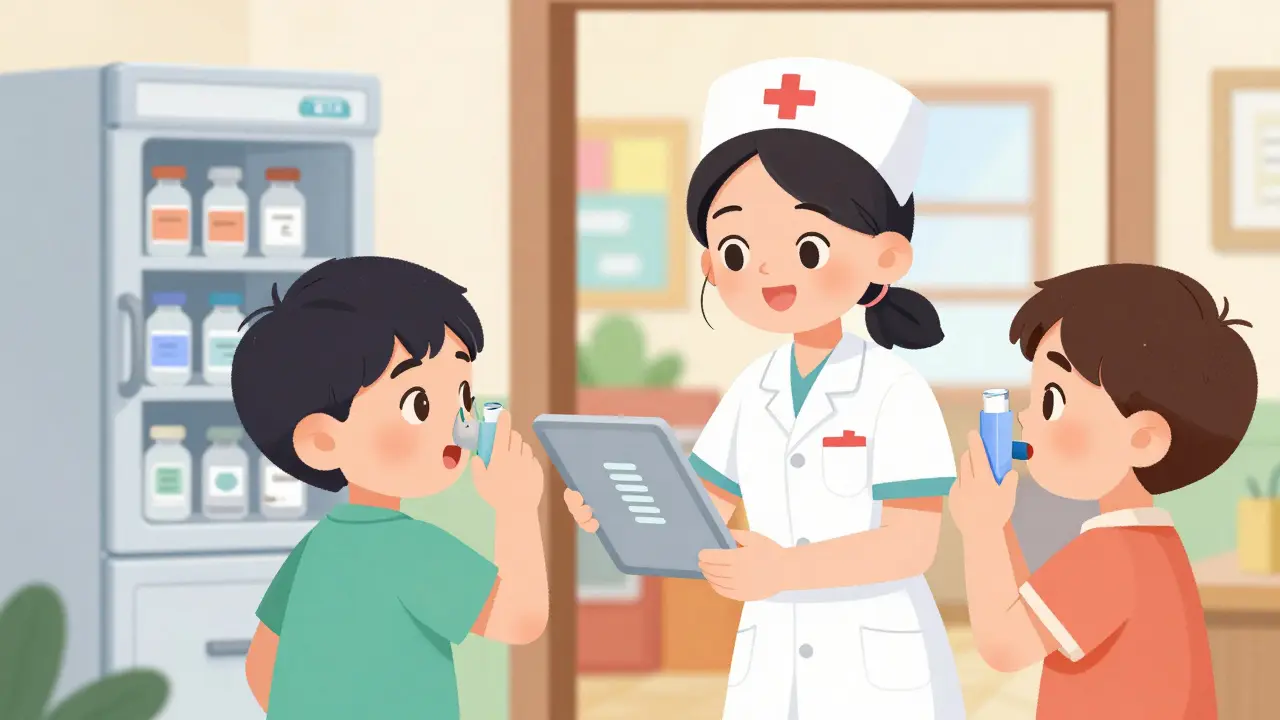
Only trained staff - usually the school nurse or a designated aide - are allowed to give medications. In most cases, students can’t pick up their own pills from a locker. But there are exceptions. In New York, students can self-administer asthma inhalers or epinephrine auto-injectors if both the doctor and parent sign a “Self-Medication Release Form.” California requires students to demonstrate they can use their inhaler correctly under supervision before being allowed to carry it.
Even when self-administration is allowed, the school must still have a backup plan. If your child refuses to take their medicine, the nurse must contact you right away. Some kids feel embarrassed. Others are scared. Some just don’t want to be different. The school can’t force them. That’s why parent involvement doesn’t end at signing forms. Talk to your child. Help them understand why the medicine matters.
Storage Is Critical
Medications aren’t stored in the principal’s office or a teacher’s desk. They’re kept in locked, temperature-controlled cabinets - often in the nurse’s office. Refrigerated meds, like insulin or certain biologics, must be stored between 2°C and 8°C (36°F-46°F) in a dedicated fridge - never next to lunch trays. The National Association of School Nurses says this is non-negotiable. Heat, humidity, or being left in a backpack can ruin a medication before it’s even used.
Some schools now use electronic medication administration records (eMARs). These digital systems track who gave what, when, and if it was accepted. Since 2019, 89% of public schools have adopted eMARs, cutting documentation errors by 57%. If your school uses one, you might even get a text or email confirming your child took their medicine that day - a feature being piloted in California and Massachusetts.
What Happens at the End of the Year?
Don’t forget to pick up leftover meds. Schools don’t keep them over summer. Frederick County Schools says, “NO medication will be kept over the Summer or until the next school term.” New York State gives parents until August 31 to collect unused pills, inhalers, or liquids. After that, they’re destroyed. If you don’t retrieve them, your child could be without medication when school restarts.
Also, if your child’s medication changes - even slightly - you’ll need a new doctor’s form and a new consent form. Don’t assume the old one still works. A dosage increase, a switch from brand to generic, or a new side effect requires updated paperwork.
Why This System Exists
There are over 127 documented complaints to the U.S. Department of Education in the last five years about schools failing to give kids their meds. The top two reasons? Not giving the right dose (41%) and poor paperwork (29%). These aren’t just mistakes - they’re preventable. When schools follow the “5 Rights” - right student, right medication, right dose, right route, right time - errors drop dramatically.
Experts agree: the biggest risk isn’t the medicine. It’s the silence. When parents don’t communicate, when doctors don’t update forms, when schools don’t train staff, kids pay the price. One missed asthma inhaler can lead to an ER visit. One extra dose of ADHD medication can cause a panic attack. One forgotten insulin shot can send a child into diabetic ketoacidosis.
What You Can Do Today
- Check your child’s medication bottles. Are they labeled correctly? If not, call the pharmacy.
- Find your school’s medication form. Download it. Fill it out. Get the doctor’s signature. Submit it before June 1.
- Walk the medicine to the nurse’s office yourself. Don’t let your child carry it.
- Ask the nurse: “Do you have my child’s medication on file?”
- Ask your child: “Do you know why you take this medicine? Do you know how to use it?”
- Update the school immediately if anything changes - dose, timing, side effects, or refusal.
- Pick up all unused meds by August 31.
This isn’t about trusting the school. It’s about making sure the system works. Every parent wants their child safe. Every school wants to help. But safety only happens when everyone does their part - clearly, completely, and on time.
What’s Changing in the Next Few Years
More kids are needing school-administered meds - especially for mental health and autoimmune conditions. The National Association of School Nurses predicts a 22% increase by 2028. Schools are responding. By 2026, many states plan to standardize digital forms. By 2028, some may use biometric checks to confirm the right student is getting the right medicine.
Parents are being asked to be more involved than ever. Not just to sign forms, but to talk to their kids, stay updated, and speak up when something feels off. Because in the end, the most powerful tool for safe medication administration isn’t a locked cabinet or an electronic record. It’s communication.

15 Comments
Shanahan Crowell
Wow, this is the kind of post that actually makes me feel like the system isn’t completely broken! I’ve been there-my kid’s inhaler was almost denied because the label didn’t have the doctor’s license number. Seriously? Who even knows where to find that? I had to call the clinic three times. But once we got it right? No more panic at 8:15 a.m. when the nurse says, “We can’t give this.”
Also-yes, the eMARs? Game-changer. I get a text every day like, “Eli took his Adderall at 8:02 a.m.” I cry a little every time. Not because I’m emotional-I’m just so tired of wondering.
Kerry Howarth
Correct labeling saves lives. Always bring the original bottle. Always. No exceptions.
erica yabut
Oh, honey. You think this is thorough? Let me tell you about the time I had to submit a notarized affidavit, a blood type waiver, and a signed vow of silence regarding my child’s epinephrine pen because some overworked nurse in a district with 17,000 kids thought ‘as needed’ meant ‘whenever the kid feels like it.’
The system is a labyrinth designed by bureaucrats who’ve never held a trembling 8-year-old during an asthma attack. You don’t just ‘fill out a form.’ You become a legal advocate, a medical translator, and a midnight emailer to the superintendent’s assistant.
And don’t even get me started on the ‘Self-Medication Release Form’-a document that requires three signatures, a notary, and a witness who swears they saw your child inhale correctly while wearing a lab coat and holding a stopwatch.
Yes, I’m furious. Yes, I’m exhausted. And yes, I’m still doing it-because no one else will.
JUNE OHM
EVERYTHING IS A TRACKING SYSTEM NOW. 🤔 They want biometrics? Next thing you know, they’ll be scanning your kid’s retina before giving them Tylenol. 🚨
Why do they need a digital record? Why not just trust parents? 👀
And why is the government forcing us to hand over our children’s meds like they’re contraband? 🚫💊
I’ve heard rumors-REAL rumors-that some schools are using these forms to build a national pediatric drug database. 📊
Don’t be fooled. This isn’t safety. It’s control. 🇺🇸
Philip Leth
Man, I’m from Nigeria, and we just hand the kid the pill and say ‘take it at lunch.’ No forms, no nurse, no eMARs. Sometimes the teacher just watches. But you know what? Kids don’t die. They just get better.
Here, you need a lawyer to give your kid an Advil. I’m not saying it’s bad. I’m just saying… we’re over-engineering childhood.
My niece’s school in Philly? They made her mom drive in at 7 a.m. to drop off insulin because the form wasn’t signed in blue ink. Blue ink. Not black. Not pencil. BLUE.
Y’all are brilliant. But sometimes… just breathe.
Angela Goree
Who gave the school the right to demand a doctor’s license number? That’s HIPAA violation territory! And why do I have to re-submit forms every year? My kid’s diagnosis hasn’t changed! The same meds! The same dosage! The same doctor! Why are we doing this to ourselves?!
And don’t even get me started on the ‘self-administration’ loophole-my daughter’s inhaler is now a ‘privilege’? What’s next? A background check to use her own EpiPen?!
This isn’t safety-it’s institutional overreach. And they call it ‘best practices’ while parents are drowning in paperwork.
Someone needs to sue. Someone needs to protest. Someone needs to stop pretending this is about the kids.
Tiffany Channell
Let’s be brutally honest: 80% of parents don’t read the forms. They sign them because they’re tired. Then they wonder why their child got the wrong dose.
And the ‘self-administration’ exception? That’s a liability nightmare. Kids forget. Kids lie. Kids panic. And now the school is responsible for monitoring compliance?
Don’t mistake compliance for safety. This entire system is a band-aid on a hemorrhage. The real issue? Schools are understaffed, underfunded, and overburdened. But instead of fixing that, we’ve created a paperwork empire that punishes the very families it claims to protect.
And yes-I’ve seen the ER reports. The mistakes aren’t from negligence. They’re from systemic collapse.
Neela Sharma
In India, we do not have school nurses. We have teachers. And sometimes, the teacher who teaches math also gives the insulin shot. No forms. No labels. Just trust.
But here’s the truth: trust is not weakness. It is the quiet courage of community.
When you hand your child’s medicine to someone you know, someone who has watched them grow, someone who has taught them to read and to dream-then you do not need a barcode or a biometric scan.
Perhaps the real question is not how to control the medicine-but how to restore the humanity behind it.
Shruti Badhwar
While the procedural rigor outlined in this document is commendable, it is imperative to recognize that the administrative burden disproportionately impacts low-income families who lack the time, resources, or institutional access to navigate such complex protocols. The requirement for original packaging, notarized forms, and physician signatures creates a de facto barrier to equitable healthcare access. Furthermore, the assumption that all parents possess the literacy or cultural familiarity with Western medical bureaucracy may inadvertently exclude non-native English speakers and immigrant communities. A more inclusive model would integrate multilingual templates, mobile health liaisons, and community-based outreach initiatives to ensure that safety standards do not become instruments of exclusion.
Brittany Wallace
I love how this post doesn’t just list rules-it reminds us that this is about people. My son used to refuse his ADHD meds because he felt like a ‘medicine kid.’ So we started a little ritual: every morning, I’d say, ‘You’re not taking medicine to be different. You’re taking it so you can be you.’
And now? He tells the nurse, ‘I’m here for my focus.’ No shame. No fear.
It’s not the forms that heal. It’s the conversations. The patience. The way we hold space for our kids to feel safe even when they’re different.
Thank you for writing this. It’s not just a guide. It’s a hug.
❤️Liam Tanner
My daughter’s school uses eMARs. I get a notification every time she takes her meds. It’s weirdly comforting. Like a digital heartbeat.
But here’s the thing I wish more people said: the nurse who gives the meds? She’s probably working two jobs. She’s got 12 kids in her office at 8 a.m. and no lunch break.
We need to thank them. Not just comply. Not just submit forms. Thank them. Bring cookies. Say ‘I see you.’
Because behind every protocol is a person trying to do the right thing.
Palesa Makuru
Oh, so now I’m supposed to walk my child’s medicine to the nurse? And wait while she cross-checks the label? And sign another form? And then pray the school doesn’t lose it?
Meanwhile, my neighbor’s kid just swallows a pill in class. No forms. No drama. No ‘self-administration release.’
Why am I the one following all the rules while everyone else just… does it?
It’s not fair. And it’s not safe. It’s just… exhausting.
Hank Pannell
From a systems engineering perspective, the current paradigm exhibits high fidelity in compliance metrics but suffers from low resilience in human factors. The 5 Rights framework is theoretically sound, yet operational latency-driven by fragmented communication channels between parents, clinicians, and school administrators-creates critical failure modes. The introduction of eMARs represents a positive systemic perturbation, reducing cognitive load and documentation error entropy by 57%, per NASN data. However, the persistence of paper-based consent forms and non-standardized labeling protocols constitutes a legacy bottleneck. A transition to blockchain-anchored, interoperable EHR-integrated medication passports, coupled with NLP-driven form auto-population from E-prescriptions, would reduce administrative overhead by an estimated 72%. Until then, we are optimizing the wrong layer of the stack.
Sarah Little
Just to clarify: the requirement for the original factory-sealed packaging applies even to over-the-counter meds like Children’s Tylenol? Even if the bottle was opened at home and the remaining pills are still within expiration? Because my kid’s pediatrician said it’s fine to send the rest. But the school says no.
So I have to buy a new bottle just to satisfy a policy that has zero clinical basis?
This isn’t safety. It’s ritual.
Shanahan Crowell
Wait-I just realized something. The school’s eMAR system sent me a notification that my kid didn’t take his medicine today. But he did. He told me. The nurse forgot to check the box.
So now I have to email the nurse, the principal, and the district med coordinator to fix a digital error that could’ve led to a double-dose tomorrow?
And this is the ‘advanced’ system?
…I’m going to bring cookies tomorrow. And a pen.