
What Are Refractive Errors?
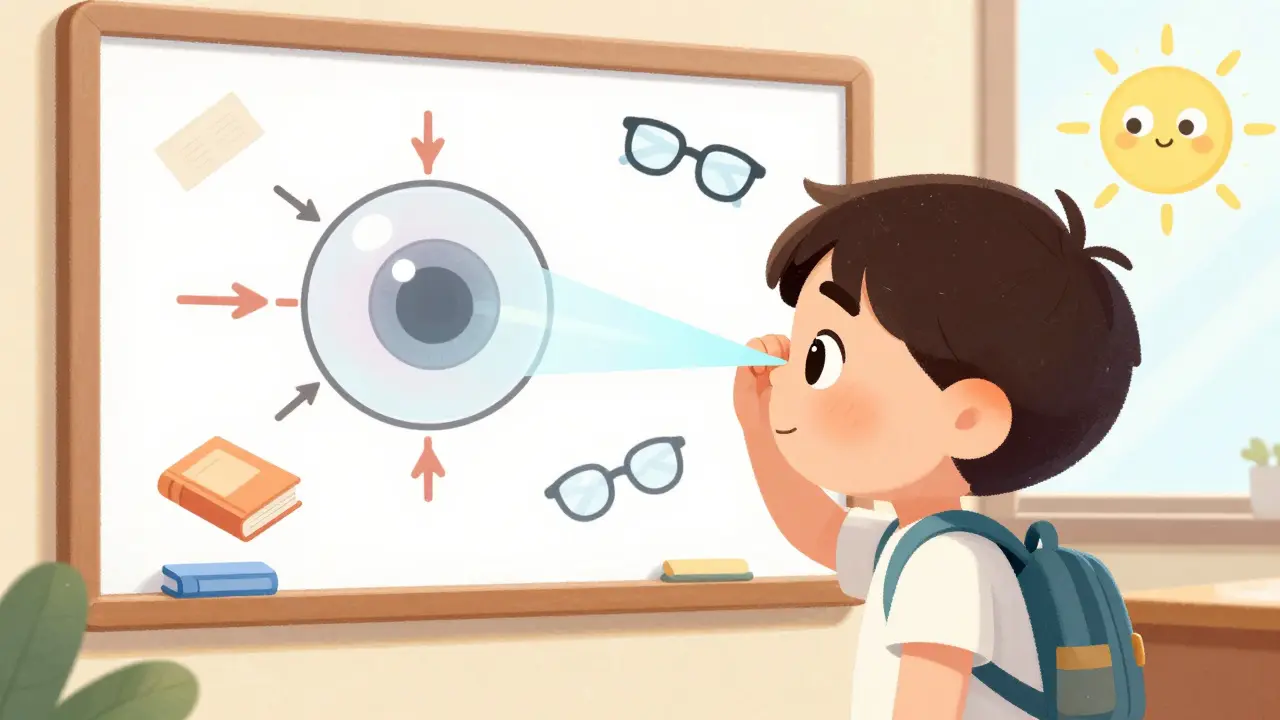
Refractive errors happen when your eye can’t focus light properly on the retina-the part at the back of your eye that turns light into signals your brain understands. Instead of landing in one sharp spot, the light focuses in front of, behind, or across multiple points on the retina. That’s why things look blurry. These aren’t diseases. They’re just mismatches between the shape of your eye and how light travels through it.
Three types make up nearly all cases: myopia (nearsightedness), hyperopia (farsightedness), and astigmatism. Together, they affect more than half of adults aged 40 to 69, according to data from the UK Biobank. Even kids aren’t safe-about 20% of eye problems in children are due to these errors. And it’s getting worse. By 2050, nearly half the world’s population could be myopic, especially in East Asia, where up to 90% of young adults need glasses or contacts.
Myopia: Why Distant Objects Look Blurry
Myopia means you see close things clearly but struggle with distance. A child might squint to read the whiteboard or sit closer to the TV. This happens because the eyeball is too long-or the cornea too curved-so light focuses in front of the retina instead of on it. In adults, an axial length over 24mm is a telltale sign.
It usually starts around age 10 and gets worse each year until the late teens or early 20s. Genetics play a role-if both parents are nearsighted, the child’s risk jumps. But environment matters too. Kids who spend less time outdoors and more time on screens are more likely to develop it. The National Eye Institute says sunlight exposure helps regulate eye growth. Just two hours a day outside can slow progression.
Correction is simple: minus (-) lenses in glasses or contacts. These bend light outward so it lands correctly on the retina. But high myopia-over -6.00 diopters-isn’t just about needing stronger glasses. It raises your risk of retinal detachment and degeneration by 5 to 10 times. That’s why regular eye checks are critical, especially during growth years.
Hyperopia: When Near Vision Gets Tough
Hyperopia is the opposite. You see distant objects fine, but close-up tasks like reading or sewing cause strain. The eye is too short-or the cornea too flat-so light focuses behind the retina. Adults with hyperopia often have axial lengths under 22mm.
Many people are born with mild hyperopia and don’t notice it until later. That’s because young eyes can compensate by flexing the lens. But as you age and that lens stiffens (usually after 40), the strain becomes obvious. You might get headaches after reading, or feel like your eyes are tired by midday.
Correction uses plus (+) lenses. These bend light inward, helping it focus properly on the retina. Unlike myopia, hyperopia doesn’t always get worse with age-it just becomes harder to hide. People over 40 often need reading glasses for the first time because of this, even if they never needed glasses before.

Astigmatism: The Irregular Curve Problem
Astigmatism isn’t about length or shape-it’s about curvature. Instead of being round like a basketball, the cornea or lens is more oval, like a football. This causes light to focus on more than one point, making everything blurry or distorted, whether near or far.
It affects 30 to 60% of people, often alongside myopia or hyperopia. You might not realize you have it until you get a detailed eye exam. Common complaints include seeing halos around lights at night, double images, or a feeling like you’re looking through water. One Reddit user said it took three weeks to adjust to their new cylinder axis at 175 degrees. That’s normal. Astigmatism correction is trickier because it needs both power and a specific angle.
Glasses for astigmatism have a cylinder component and a precise axis (like 180° or 90°). Contacts can correct it too, but they need to stay perfectly aligned on the eye. Soft toric lenses are common, but some people prefer rigid gas-permeable lenses for sharper vision. LASIK can fix it by reshaping the cornea with laser precision, down to 0.25 diopters.
How Correction Works: Glasses, Contacts, and Surgery
Three main tools fix refractive errors: glasses, contacts, and surgery.
- Glasses are the most common. They’re safe, easy, and immediate. Most people adjust in 2-3 days. For complex astigmatism, it can take up to three weeks. Satisfaction rates are high-4.2 out of 5 on review sites. The key? Letting the wearer pick their frames. Kids are more likely to wear them if they feel good in them.
- Contact lenses offer a wider field of view and no frames to fog up or slide down. But they come with risks. About 3-4% of wearers get microbial keratitis-an infection that can threaten vision. Daily disposables reduce this risk. Still, many report discomfort after 8 hours. They’re great for sports or aesthetics, but not for everyone.
- Surgery like LASIK, PRK, and SMILE removes the need for glasses or contacts permanently. LASIK, approved by the FDA in 1995, creates a flap on the cornea and reshapes tissue underneath. SMILE is newer, smaller, and causes less dry eye. Both use femtosecond lasers for precision. Success rates are high-4.5 out of 5 satisfaction on review platforms. But not everyone qualifies. You need a stable prescription for at least a year, corneas thicker than 500 microns, and to be 18 or older.
What About Myopia Control in Kids?
It’s not just about correcting vision anymore. For kids with rapidly progressing myopia, doctors now use strategies to slow it down.
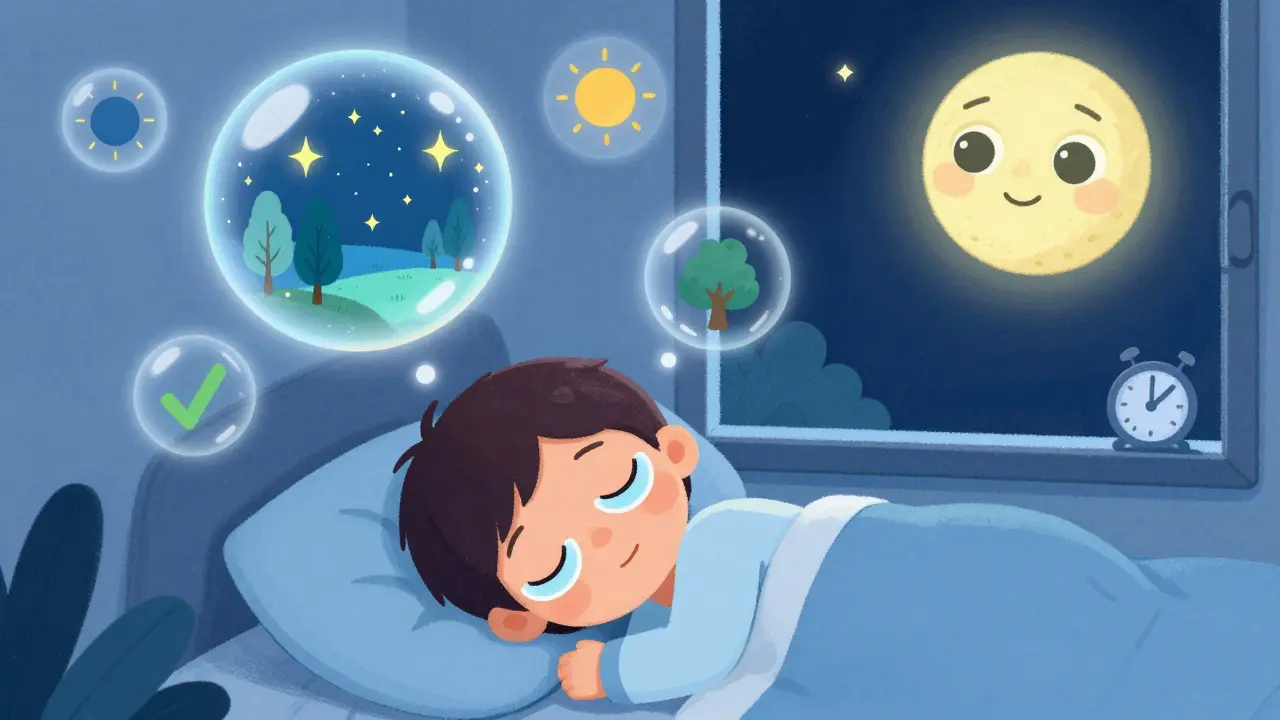
Orthokeratology (Ortho-K) involves wearing special rigid lenses overnight. They gently reshape the cornea while you sleep, giving clear vision during the day without glasses. Studies show it reduces myopia progression by 36-56%.
Low-dose atropine eye drops (0.01% to 0.05%) are another option. Used nightly for two years, they can cut progression by 50-80%. They’re mild, with minimal side effects like light sensitivity. Many parents prefer this over lenses because it’s easier to stick with.
Neither reverses myopia. But they stop it from getting worse fast. That’s huge-because higher prescriptions mean higher risks later in life.
When to See a Doctor
You don’t need to wait for symptoms. Kids should have their first eye exam by age 3, then again before starting school. If they squint, sit too close to screens, or complain of headaches after reading, get them checked.
Adults should get checked every two years, or annually if over 40, diabetic, or have a family history of eye disease. If you suddenly see flashes, floaters, or a shadow over your vision, go immediately. That could mean retinal detachment-a medical emergency.
Don’t rely on online vision tests. They can’t measure astigmatism axis, corneal thickness, or eye pressure. Only a professional exam with dilation gives the full picture.
What Doesn’t Work
There are a lot of myths. Eye exercises won’t fix myopia. Reading in dim light won’t cause it. Wearing glasses too much won’t make your eyes weaker. These are false beliefs that delay proper care.
Also, cheap online glasses often get the axis wrong for astigmatism. A 10-degree error can mean blurry vision for months. Always get a prescription from an optometrist and fill it at a trusted provider.
Looking Ahead
The global eyewear market is worth over $140 billion and growing. But the real challenge isn’t making more glasses-it’s preventing the epidemic. With half the world projected to be myopic by 2050, public health efforts are shifting. Schools in Singapore now mandate outdoor time. Australia’s guidelines recommend two hours of daylight exposure daily for kids.
Future tech will help. Wavefront-guided LASIK maps your eye’s unique flaws for better outcomes. Smart contact lenses are being tested to monitor eye pressure or glucose levels. But the most powerful tool remains: early detection and consistent correction.
Refractive errors are common. They’re not dangerous on their own. But left uncorrected, they can cost you quality of life-blurry driving, headaches, missed moments. The good news? We know how to fix them. And we’re getting better at stopping them before they get worse.


14 Comments
Sazzy De
I never realized how much time I spent squinting at the board as a kid. My mom used to yell at me to sit farther back but I thought it was just laziness. Turns out I was already myopic. Glad I got checked before college.
Lily Steele
My dad got his first reading glasses at 42 and swore he’d never need them. Now he’s got three pairs scattered around the house. Funny how your eyes just decide to quit one day.
Beth Beltway
People still think eye exercises work? That’s like doing pushups to fix a broken leg. If you have astigmatism, no amount of rolling your eyes is going to make your cornea symmetrical. Stop wasting time and get a real prescription.
Kelly Weinhold
I love how we’ve gone from just giving people glasses to actually slowing down myopia progression in kids. Ortho-K and low-dose atropine? That’s science becoming magic. My niece started atropine at 8 and her prescription hasn’t jumped in two years. It’s not a cure but it’s hope. And hope matters.
Rob Webber
The 2050 myopia projection isn’t just a statistic. It’s a public health crisis waiting to happen. We’re talking about a generation with higher risks of retinal detachment, glaucoma, macular degeneration. This isn’t about convenience anymore. It’s about preventing blindness at scale.
Lisa McCluskey
I had astigmatism for years and didn’t know. Thought my night driving was just bad luck. Then my optometrist said the axis was off by 20 degrees. I cried. It wasn’t me being clumsy-it was a 10-degree error in a $30 pair from Amazon. Don’t do that to yourself.
owori patrick
In Nigeria, many kids go without glasses because they think it’s a curse or that glasses make you look weak. My cousin couldn’t see the board until age 14. Now she’s studying engineering. A simple pair of glasses changed her life. We need more awareness, not just tech.
Claire Wiltshire
The data on outdoor exposure is compelling. Two hours of daylight per day reduces myopia progression by up to 50%. This isn’t anecdotal-it’s replicated across longitudinal studies in Australia, Singapore, and China. Schools should treat this like physical education.
April Allen
Refractive error correction is essentially optical engineering applied to biological tissue. The cornea is a gradient index lens, and its asphericity determines aberration profiles. When you correct astigmatism with a toric lens, you’re compensating for a non-spherical wavefront error. LASIK doesn’t just reshape-it recalibrates the optical system. It’s elegant.
Sheila Garfield
I got my first pair of glasses at 12. My classmates called me Four Eyes. Now I wear contacts and they’re invisible. But I still keep those old frames. They remind me how much I’ve learned about my own body. It’s not just vision-it’s identity.
Shawn Peck
LASIK is a scam. I had it done. My eyes are drier than the Sahara and I still can’t read my phone without squinting. You think you’re getting freedom but you’re just trading glasses for a lifetime of drops and discomfort.
Jason Xin
Funny how people panic about screen time but don’t blink for hours staring at a laptop. Your eyes aren’t broken because of phones. They’re broken because you forgot how to look at something farther than 18 inches away.
Kathleen Riley
The human eye evolved under natural light cycles. Our modern environment imposes a chronic visual stressor-proximal, monochromatic, static. Refractive errors are not anomalies. They are adaptations to an unnatural visual ecology.
calanha nevin
If you’re reading this and you’ve never had a dilated eye exam, stop. Right now. Go schedule one. Your retina doesn’t send reminders. By the time you notice something’s wrong, it might already be too late.