
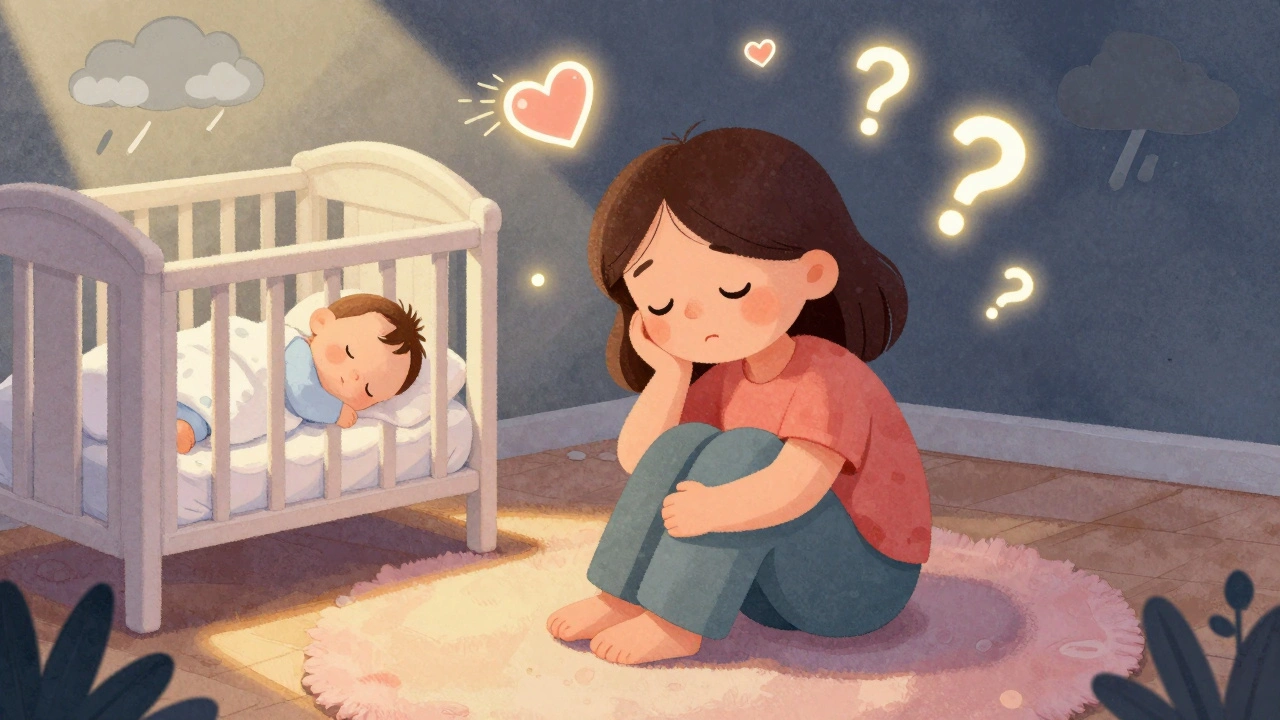
One in five new mothers experiences postpartum anxiety - and most don’t realize it’s not just "being tired" or "overwhelmed." It’s a real, clinical condition that can last up to a year after birth or adoption. Unlike the baby blues, which fade after a couple of weeks, postpartum anxiety sticks around. It doesn’t go away with sleep or a good cup of coffee. It grows louder with every cry, every missed feed, every silent night. And too often, it’s mistaken for normal stress - delaying help by more than 11 weeks on average.
What Postpartum Anxiety Actually Feels Like
Postpartum anxiety isn’t just worrying about whether the baby is breathing. It’s the heart racing at 3 a.m. even when the baby is sound asleep. It’s nausea when you hear a door slam. It’s losing your appetite because your body is stuck in fight-or-flight mode. You might feel irritable, on edge, or like you’re losing control - even if you’re smiling and saying everything’s fine.
Physical symptoms are common: 62% of women report a racing heart, 47% get frequent nausea, and 39% lose interest in food. Panic attacks hit 28-35% of those affected. These aren’t "bad days." They’re persistent, disabling, and deeply isolating. Many women feel guilty for feeling this way - especially when everyone else says, "You should be so happy!"
The thoughts can be intrusive: images of something happening to the baby, replaying every mistake, obsessing over germs or safety. These aren’t signs of being a bad mom. They’re signs of anxiety. And they’re more common than you think.
How It’s Different from Baby Blues and Postpartum Depression
Baby blues are normal. Up to 80% of new mothers feel tearful, tired, or moody in the first week. But those feelings lift within two weeks. Postpartum anxiety doesn’t. It lasts. And it’s not the same as postpartum depression - even though they often show up together.
Depression usually means low mood, hopelessness, crying for no reason. Anxiety means constant worry, physical tension, and fear. In fact, 85% of postpartum anxiety cases are dominated by obsessive thoughts, while only 31% of depression cases have them. Physical symptoms like heart palpitations and dizziness are 76% more common in anxiety than in depression.
And here’s the catch: 47% of women with postpartum anxiety also have depression. That means the symptoms overlap - and that’s why screening tools need to be precise. The Edinburgh Postnatal Depression Scale (EPDS), the most common tool, isn’t enough on its own. A score of 9.8 is typical for anxiety-only cases. For depression-only, it’s 11.3. When both are present? The score jumps to 14.7.
Screening: The Right Tools for the Job
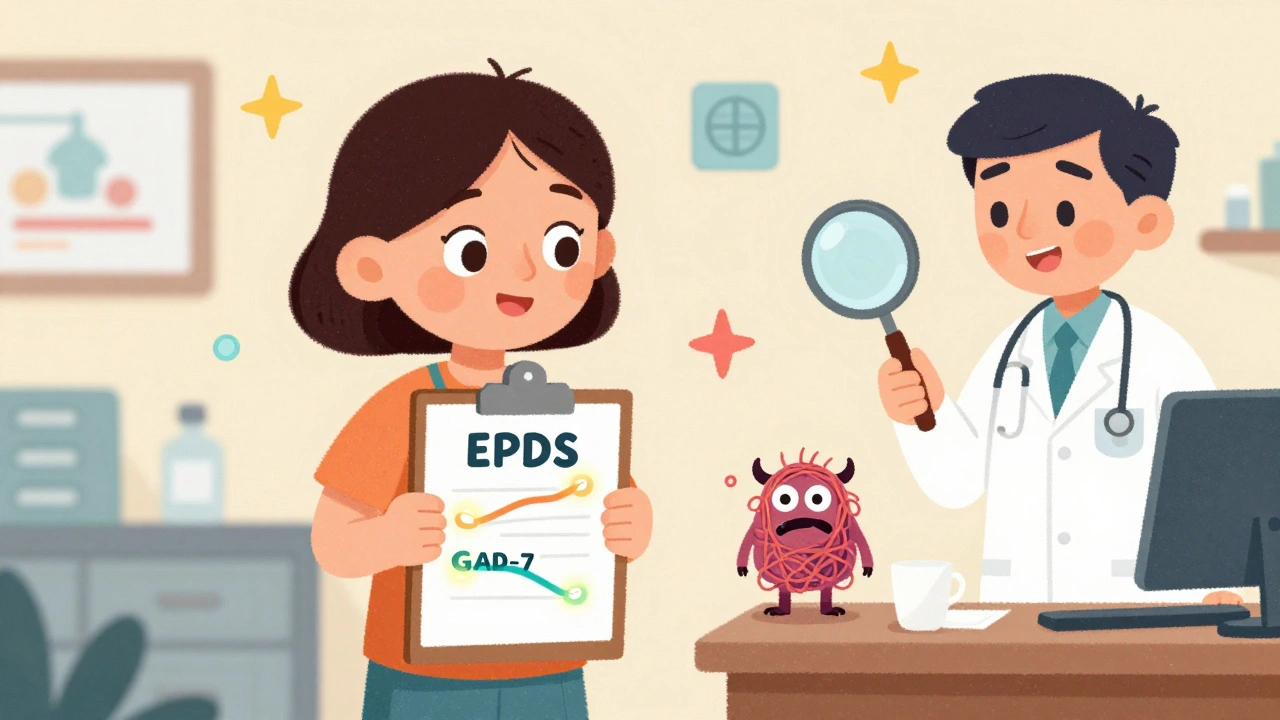
Doctors used to rely only on the EPDS - but it wasn’t built to catch anxiety. In 2023, it was updated with a new anxiety subscale. Now it can distinguish between anxiety and depression with 89% accuracy in large studies. That’s a big step forward.
But the best tool for spotting pure anxiety is the GAD-7. It’s short, simple, and scores 89% sensitivity and 84% specificity. That means it catches nearly all cases and rarely gives false alarms. Still, many clinics don’t use it. Only 67% of U.S. obstetric practices screen for postpartum mental health in 2025 - up from 12% in 2015, thanks to ACOG guidelines. But that still leaves over a third of new moms slipping through.
Screening should happen at the 2-week and 6-week checkups - not just the 6-week visit. And it should be routine, not optional. If your provider doesn’t ask, ask them. You’re not being difficult. You’re protecting your health.
What Causes It? The Real Risk Factors
It’s not your fault. Postpartum anxiety isn’t caused by being "too sensitive" or "not coping well." It’s biology, history, and stress combined.
Women with a prior anxiety disorder are 3.2 times more likely to develop it. A history of pregnancy loss? That raises the risk by 2.7 times. Previous infant medical problems? 2.4 times higher. And if you’ve had postpartum depression before? Your risk jumps to 3.8 times higher.
It’s not just mental health history. Sleep deprivation, lack of support, financial stress, and isolation all pile on. And if you’re in a rural area, access to care is even harder. Only 17% of rural U.S. hospitals offer specialized perinatal mental health programs. That’s not a personal failure - it’s a system failure.
How It’s Treated: From Therapy to Medication
Treatment isn’t one-size-fits-all. It depends on severity.
Mild cases (EPDS 10-12): Therapy and lifestyle changes. Daily 30-minute walks reduce anxiety scores by 28% in eight weeks. Yoga cuts symptoms by 33% in clinical trials. Mindfulness practices - even just 10 minutes a day - can lower anxiety by 41% in two weeks.
Moderate cases (EPDS 13-14): Cognitive Behavioral Therapy (CBT). It’s the gold standard. Twelve to sixteen structured sessions help 57% of women. CBT teaches you to spot anxious thoughts, challenge them, and replace them with calmer responses. It’s not about "thinking positive." It’s about rewiring how you react.
Severe cases (EPDS 15+): Medication + therapy. SSRIs like sertraline are first-line. They’re not FDA-approved specifically for postpartum anxiety - but they’re the best-studied and safest option. Sertraline transfers only 0.3% of the dose into breastmilk. Studies show a 64% response rate within eight weeks. And yes, it’s safe while breastfeeding.
Here’s the hard truth: SSRIs take 4-6 weeks to work. That’s a long time when you’re in pain. That’s why combining them with CBT or mindfulness helps. You get relief faster - and keep it longer.
What’s New in Treatment
There’s real progress happening. The FDA is reviewing brexanolone (Zulresso), a drug originally approved for postpartum depression. Early trials show a 72% response rate for anxiety symptoms in just 60 hours - compared to 43% for placebo. That’s groundbreaking.
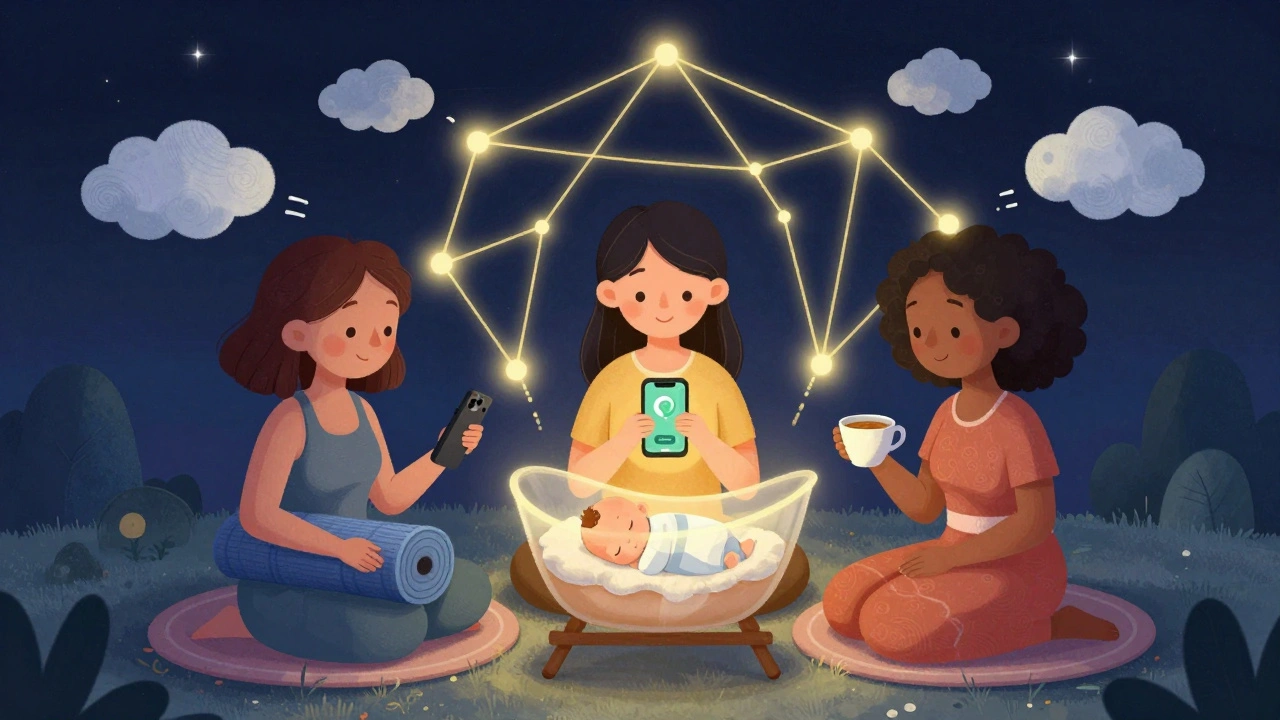
Digital tools are also helping. The app MoodMission, cleared by the FDA, uses CBT exercises. In a trial with 328 new moms, it cut anxiety symptoms by 53%. It’s not a replacement for therapy - but it’s a lifeline for women without access to a therapist.
And insurance is catching up. In 2021, new billing codes (CPT 90834 and 90837) were created specifically for postpartum anxiety. Coverage jumped from 38% to 79%. That means more women can now afford care.
Why So Many Go Untreated
Here’s the ugly truth: only 15% of women with postpartum anxiety get proper treatment. Why?
First, it’s misdiagnosed. 63% of cases are written off as "just stress." Second, there’s stigma. Many women fear being labeled "unfit" or having their baby taken away. Third, care is scattered. You might see an OB, a pediatrician, and a therapist - but no one connects the dots.
And fourth, time. You’re exhausted. You’re feeding. You’re changing diapers. You’re not thinking about your mental health - until you’re drowning.
That’s why support groups matter. Programs like The Women’s Place at Texas Children’s Pavilion for Women offer psychiatric care, medication management, and peer groups. Women in these programs are 58% more likely to stick with treatment. Connection saves lives.
Your Next Steps
If you’re reading this and thinking, "That’s me," here’s what to do now:
- Write down your symptoms: What do you feel? When? How often? Physical? Thoughts? Sleep?
- Take the EPDS and GAD-7 online (many hospitals offer free versions).
- Call your OB, midwife, or pediatrician. Say: "I think I might have postpartum anxiety. Can we screen for it?"
- If they say no, ask for a referral to a perinatal mental health specialist.
- Find a support group - even online. You’re not alone.
You don’t need to wait until you’re "bad enough" to get help. You don’t need to be crying to deserve care. You don’t need to fix it alone.
Postpartum anxiety is treatable. And getting help doesn’t make you weak - it makes you strong. It protects your baby. It protects your future. And it lets you finally breathe again.
Is postpartum anxiety the same as baby blues?
No. Baby blues are mild, temporary mood swings that usually go away within two weeks after birth. Postpartum anxiety lasts longer than two weeks, involves intense worry, physical symptoms like racing heart or nausea, and interferes with daily life. It doesn’t fade on its own.
Can I take medication for postpartum anxiety while breastfeeding?
Yes. SSRIs like sertraline are considered safe during breastfeeding. Only about 0.3% of the maternal dose passes into breastmilk - far below levels shown to affect infants. Many mothers successfully breastfeed while on these medications. Always discuss options with a perinatal psychiatrist.
How long does postpartum anxiety last?
Without treatment, it can last up to a year - sometimes longer. With proper care, most women see significant improvement within 8-12 weeks. Some need longer-term therapy or medication, and that’s okay. Recovery isn’t linear, and healing takes time.
Can postpartum anxiety affect my baby?
Yes, if untreated. High anxiety can impact bonding, reduce responsiveness to your baby’s cues, and affect early emotional development. But treating your anxiety dramatically improves outcomes. Studies show that when mothers get help, their babies develop more securely and show fewer behavioral issues later.
What if my doctor says it’s just stress?
You have the right to ask for screening. Say: "I’ve been feeling this way for more than two weeks. I’ve read that postpartum anxiety is common and treatable. Can we use the GAD-7 or EPDS to check?" If they refuse, seek a second opinion. A perinatal mental health specialist or therapist can help.
Are there free or low-cost options for therapy?
Yes. Many hospitals and nonprofits offer free or sliding-scale perinatal mental health services. Apps like MoodMission are FDA-cleared and free to download. Community groups, online forums, and peer-led programs (like Postpartum Support International) provide low-cost support. You don’t need to pay a lot - or anything - to start healing.
8 Comments
Eddie Bennett
Man, I wish I’d read this two years ago. My wife went through this and we just thought she was exhausted. We didn’t even know it had a name. Now I get why she’d sit in the shower crying - not because she was upset, but because it was the only place she felt safe to just breathe.
Monica Evan
OMG YES. I had the racing heart thing at 3am while baby slept. Thought I was losing my mind. Then I took the GAD-7 and it scored 16. My OB just said 'try yoga' like it was a spa day. I cried in the parking lot. This post? It felt like someone finally saw me. No more pretending I'm fine.
Lisa Stringfellow
So now we’re just gonna hand out apps and SSRIs like candy? What about real therapy? Or fixing the fact that moms are expected to do all the emotional labor while the system ignores them? This feels like band-aids on a hemorrhage.
Kristi Pope
Thank you for writing this. I’m 7 months postpartum and just started CBT last week. It’s not magic but I’m sleeping again. And I finally told my mom I didn’t need her to tell me to 'just relax' - I needed her to hold me while I cried. That’s the real treatment. Connection. Not just meds or apps. You’re not broken. You’re human.
Aman deep
As someone from India where postpartum mental health is still whispered about - this is gold. My sister-in-law suffered for 10 months before anyone said 'maybe it’s anxiety'. We don’t even have words for it in our language. Sharing this with my family tonight. Thank you for naming it.
Jimmy Kärnfeldt
It’s funny how society tells you to 'enjoy every moment' while simultaneously denying you the time, space, or support to actually do it. Postpartum anxiety isn’t a failure of will - it’s a failure of infrastructure. We built a world that expects mothers to be superheroes but won’t give them a cape, a team, or a break. Maybe the real cure isn’t in the pills - it’s in the village.
Vivian Amadi
Ugh. Another feel-good post that ignores the truth: therapists are expensive, insurance sucks, and your OB doesn’t care unless you’re screaming in the waiting room. Stop glorifying apps. Real help is hard to find and costs a fortune. This isn’t empowerment - it’s corporate wellness fluff wrapped in trauma.
Ariel Nichole
Just wanted to say - I’m a dad. My wife had this. I didn’t know what to do. So I started making coffee at 3am and just sitting with her. Didn’t fix it. But she didn’t feel alone. Sometimes that’s all you need. You’re not broken. You’re brave for even reading this.