
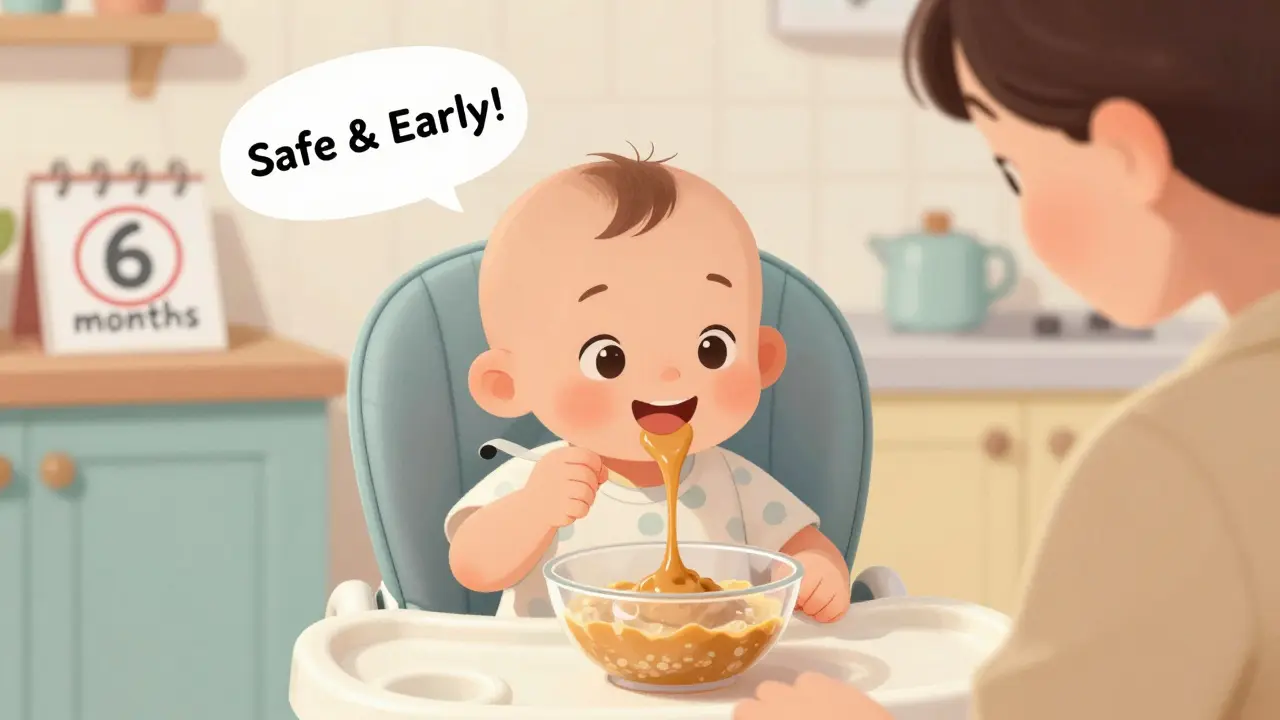
For decades, parents were told to wait until their child was two or three years old before introducing peanut butter. It seemed like a smart move-peanut allergies are scary, and avoiding the allergen felt like the safest choice. But here’s the truth: that advice made things worse. In the 1990s, peanut allergies in kids were rare-about 0.4% of children had them. By 2010, that number had more than doubled to 2%. Something was clearly wrong. The solution wasn’t more avoidance. It was the opposite: peanut allergy prevention through early exposure.
Why Early Introduction Works
The big shift came in 2015 with the LEAP study, led by researchers at King’s College London. They looked at over 600 babies who were at high risk for peanut allergy-those with severe eczema or egg allergy. Half of them were given peanut-containing foods regularly from 4 to 11 months old. The other half avoided peanuts completely. By age five, the group that ate peanut had an 86% lower rate of peanut allergy. That’s not a small change. That’s a game-changer. The science behind it is simple: your immune system learns what’s safe during early development. If you never expose a baby to peanut protein during that critical window, their body may later see it as a threat. But if you introduce it early-especially before six months-the immune system learns to accept it as harmless. It’s not magic. It’s biology.The Three Risk Levels and When to Start
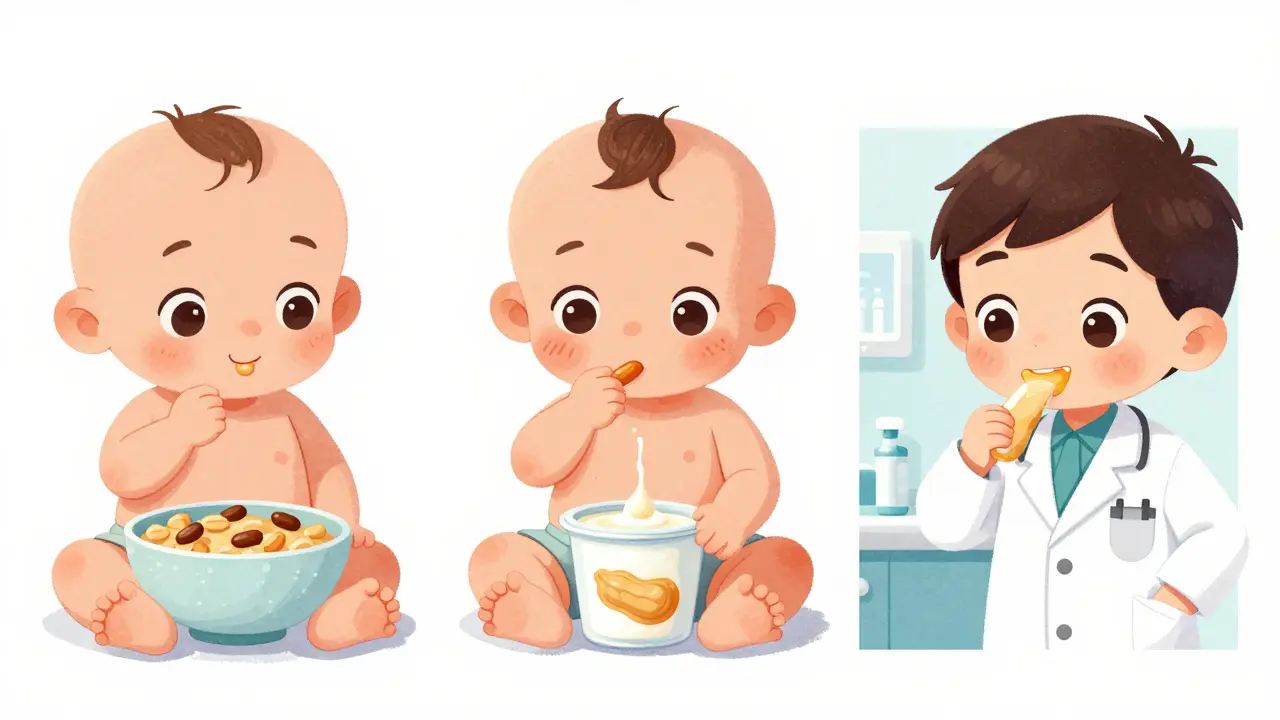
Today, guidelines from the National Institute of Allergy and Infectious Diseases (NIAID) break it down into three simple groups:- High-risk infants: Those with severe eczema or egg allergy. These babies should be evaluated by a doctor between 4 and 6 months. If testing shows no peanut allergy, they can start eating peanut protein at home-2 grams, three times a week. The first dose is often done in a clinic for safety.
- Moderate-risk infants: Those with mild to moderate eczema. No testing needed. Just introduce peanut-containing foods around 6 months, at home.
- Low-risk infants: No eczema or food allergies. You can introduce peanut anytime after starting solids, usually around 6 months. No special steps needed.
Timing matters. A 2023 analysis of the LEAP and EAT studies found that babies who started peanut before 6 months had up to a 98% reduction in allergy risk. Even babies with mild eczema saw a 100% drop in allergy rates when peanut was introduced early. Delaying past 6 months cuts the benefit significantly.
How to Safely Introduce Peanut
You can’t just hand a baby a spoonful of peanut butter. Whole peanuts are a choking hazard. Smooth peanut butter is fine-but not thick, sticky globs. Here’s how to do it right:- Take 2 teaspoons of smooth peanut butter (no added sugar or honey).
- Mix it with 2-3 tablespoons of warm water, breast milk, or formula until it’s thin and runny.
- Stir it into infant cereal, pureed fruits, or vegetables.
- Start with a small amount-about a quarter teaspoon-and watch for reactions over 10-15 minutes.
- If there’s no reaction, gradually increase to the full 2g (2 tsp) over the next few days.
- Continue offering peanut 2-3 times a week, even if they seem to like it or not.
Some parents use pre-made infant peanut snacks like Bamba (a puffed corn snack with peanut), which are designed for babies. These are safe and easy to use. The key is consistency. You don’t just give peanut once and call it done. You keep giving it regularly.
What About Oral Immunotherapy (OIT)?
Oral immunotherapy (OIT) is not prevention. It’s treatment. If a child already has a peanut allergy, OIT involves giving tiny, gradually increasing doses of peanut under medical supervision to reduce the chance of a severe reaction. It’s not for healthy babies. It’s for kids who already react to peanut. It doesn’t cure the allergy-it just makes them less sensitive. And it comes with risks: stomach pain, vomiting, and sometimes anaphylaxis.Prevention through early introduction is different. It stops the allergy from developing in the first place. That’s why experts say OIT has no role in prevention. It’s a completely different tool for a different problem.
Why So Many Parents Still Don’t Do It
Despite the clear evidence, only about 39% of high-risk infants in the U.S. are getting peanut introduced on time. Why?- Parents are scared. They remember stories of kids going into anaphylaxis and think, “What if this is the one?”
- Doctors aren’t consistent. A 2023 survey found only 54% of pediatricians knew the current guidelines. Some still tell parents to wait.
- Confusion about forms. Parents don’t know what’s safe. Whole peanuts? Peanut butter? Bamba? They need clear guidance.
- Disparities exist. Black and Hispanic infants are 22% less likely to get early peanut exposure, partly due to access to care and cultural beliefs.
The good news? Countries that followed these guidelines early-like Australia-have seen peanut allergy rates drop by 80% in just a few years. In the U.S., peanut allergy rates have already fallen from 2.2% in 2015 to 1.6% in 2023. That’s 300,000 fewer kids with peanut allergy.
What’s Next?
Research is still going. The PRESTO trial, funded by the U.S. government and running until 2026, is testing whether even earlier exposure-like at 3 months-works better for the highest-risk babies. Other studies are looking at combining peanut with egg or milk introduction to prevent multiple allergies at once.One thing’s clear: the era of delayed introduction is over. We now know that for most babies, the safest thing you can do is give them peanut early. Not because it’s trendy. Not because it’s convenient. But because the science is solid. And it’s saving lives.
What If My Baby Has Eczema?
Eczema is the biggest red flag. Babies with severe eczema are up to six times more likely to develop peanut allergy. That’s why the guidelines focus so much on them. But even mild eczema counts. If your baby has dry, flaky skin on their cheeks or arms, that’s enough to put them in the moderate-risk group. Don’t wait. Talk to your pediatrician by 4-5 months. Get the green light. Start introducing peanut by 6 months.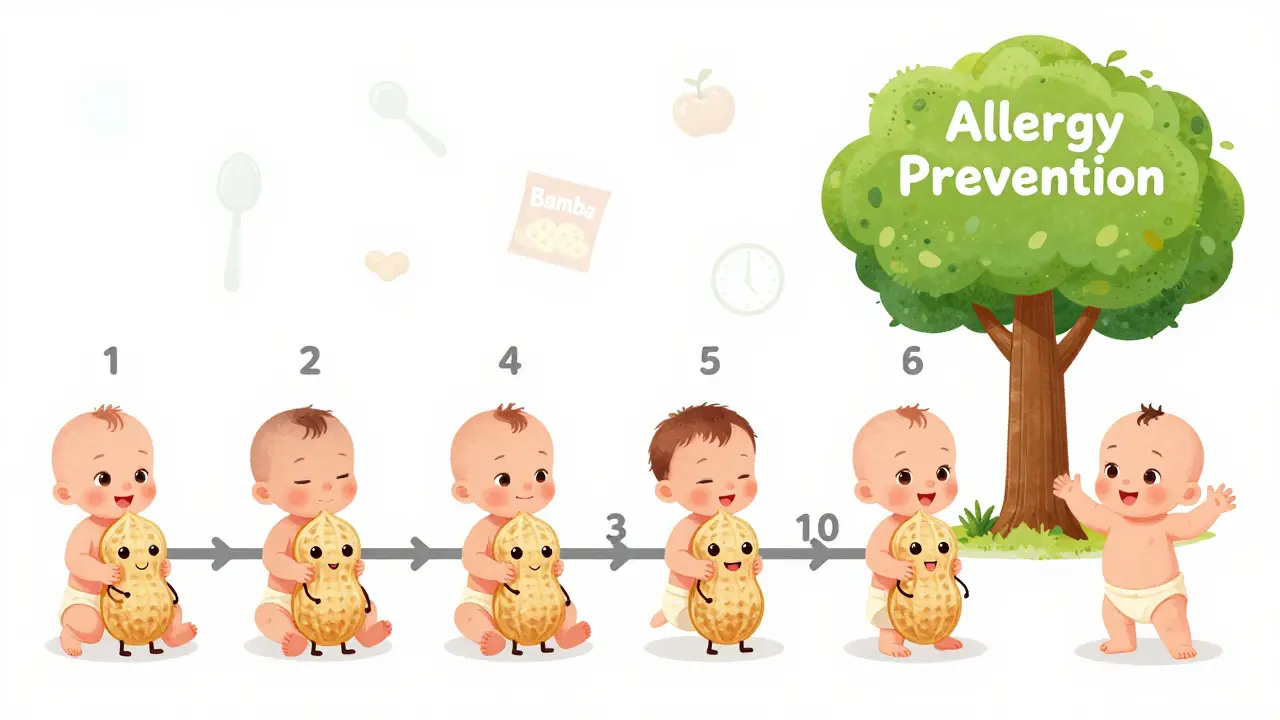
Can I Use Peanut Flour or Powder?
Yes. Some studies use peanut flour or heated peanut powder because it’s easier to measure and mix. But for home use, smooth peanut butter works just as well. Just make sure it’s 100% peanuts-no added sugar, salt, or oils. Avoid natural peanut butter with oil separation-stir it well before mixing.Is It Safe to Give Peanut at Home?
For low- and moderate-risk babies, yes. For high-risk babies, the first dose should be done under medical supervision. After that, you can continue at home. But always start with a tiny amount. Watch closely for 1-2 hours. Signs of reaction: hives, vomiting, swelling of the lips or face, coughing, or difficulty breathing. If any of these happen, stop and call your doctor.What About Breastfeeding?
Eating peanut while breastfeeding won’t prevent allergy. Studies have shown no protective effect from maternal diet. The key is direct exposure in the baby’s diet-not through breast milk.What If My Baby Already Has a Peanut Allergy?
Then you’re in a different category. Early introduction doesn’t help if the allergy is already there. Talk to an allergist about oral immunotherapy (OIT) or carrying an epinephrine auto-injector. But don’t try to introduce peanut on your own. That’s dangerous.Can I introduce peanut before 4 months?
No. The guidelines say to wait until at least 4 months. Before that, babies aren’t developmentally ready for solid foods. Their digestive and immune systems aren’t mature enough. Introducing solids too early can increase the risk of other problems, like obesity or food intolerances. Stick to 4-6 months for high-risk babies, and around 6 months for others.
Do I need to test my baby for peanut allergy before introducing it?
Only if your baby is high-risk-meaning they have severe eczema or an egg allergy. In that case, your doctor may recommend a skin prick test or blood test to check for sensitization. If the test is negative, you can proceed with introduction. For moderate- or low-risk babies, no testing is needed. Just start with a small amount at home.
How long do I need to keep giving peanut to my child?
The research shows that regular exposure for at least 6 months to a year is needed to build lasting tolerance. But experts recommend continuing peanut into childhood and beyond. Studies like the LEAP follow-up found that the protection lasted even after kids stopped eating peanut for a year. So keep offering it-once or twice a week-throughout early childhood.
Are peanut-containing snacks like Bamba safe for babies?
Yes, Bamba and similar infant peanut snacks are designed to be safe for babies. They’re soft, dissolve easily, and contain measured amounts of peanut protein. They’re a great option for parents who find mixing peanut butter difficult. Just make sure they’re labeled as peanut-containing and are appropriate for your baby’s age.
What if my child has a reaction the first time I give them peanut?
Stop immediately. If it’s mild-like a few hives or a rash-call your pediatrician. If it’s severe-swelling, vomiting, trouble breathing, or loss of consciousness-use an epinephrine auto-injector if you have one and call emergency services right away. Don’t try again at home. You’ll need to see an allergist to confirm whether it’s a true allergy or a one-time reaction.

8 Comments
Denise Jordan
I get it, science says early exposure = less allergies. But my cousin’s kid had a full-on anaphylactic reaction at 5 months from a tiny smear of peanut butter on a spoon. Now he’s on a feeding tube. So yeah, maybe the stats are good-but what about the one in a hundred who go sideways? I’m not risking my kid for a statistic.
Gene Forte
This is one of those rare moments where science actually listened to logic instead of fear. For decades, we treated food like a bomb to be defused. But the body isn’t a bomb-it’s a teacher. If you never let a child meet peanut, how can it learn peanut isn’t the enemy? Early exposure isn’t reckless. It’s respectful. It trusts biology. And that’s the kind of wisdom we need more of.
Kenneth Zieden-Weber
Oh so now we’re doing ‘scientific parenting’? Let me guess-you also sterilize the baby’s pacifier with UV light and feed them organic kale puree at 3 months. Look, I get the data. But let’s not pretend this is some revolutionary breakthrough. My dad fed me peanut butter on toast at 8 months in 1987. I’m 42. No allergies. The real story? Most kids were fine all along. The ‘epidemic’ was manufactured by over-medicalizing normal development.
Chris Bird
This whole thing is a Western luxury. In Nigeria, we give babies groundnut paste at 3 months. No hospitals. No tests. No panic. And guess what? Peanut allergies are almost nonexistent here. The real problem isn’t the peanut-it’s the fear. You Americans turn every meal into a clinical trial. Just feed them. Stop overthinking.
David L. Thomas
The LEAP trial’s effect size (OR 0.14) is clinically transformative, especially when contextualized within the NIAID risk stratification model. The number needed to treat (NNT) to prevent one case of peanut allergy in high-risk infants is approximately 7. That’s stronger than most primary prevention interventions in pediatrics. And the durability of tolerance post-elimination? That’s immunological memory in action. This isn’t anecdotal-it’s mechanistic.
LiV Beau
I introduced peanut to my 5-month-old last week 😊✨ Started with 1/4 tsp mixed into oatmeal and she loved it! No reaction, just happy gummy smiles. I cried a little-this feels like giving her a gift of safety. If you’re scared, start small. One tiny spoon. Watch. Breathe. You got this. 🌈💖
Adam Kleinberg
They say early exposure prevents allergies but what they don’t tell you is that Big Pharma pushed this because now we have to buy Bamba and peanut powder and special infant tests and then if your kid reacts you have to go to an allergist and get epinephrine pens which cost 300 dollars and insurance won’t cover it so now you’re broke and scared and the whole thing is just a profit scheme disguised as science
Bridgette Pulliam
I appreciate the thoroughness of the guidelines. However, I must emphasize that cultural context and socioeconomic accessibility must be integrated into implementation strategies. For example, in communities where refrigeration is inconsistent, smooth peanut butter may spoil before it can be used. Alternative delivery mechanisms-such as pre-portioned, shelf-stable infant peanut snacks-should be subsidized and distributed through WIC and community health centers. Equity in prevention is not an add-on-it is the foundation.