
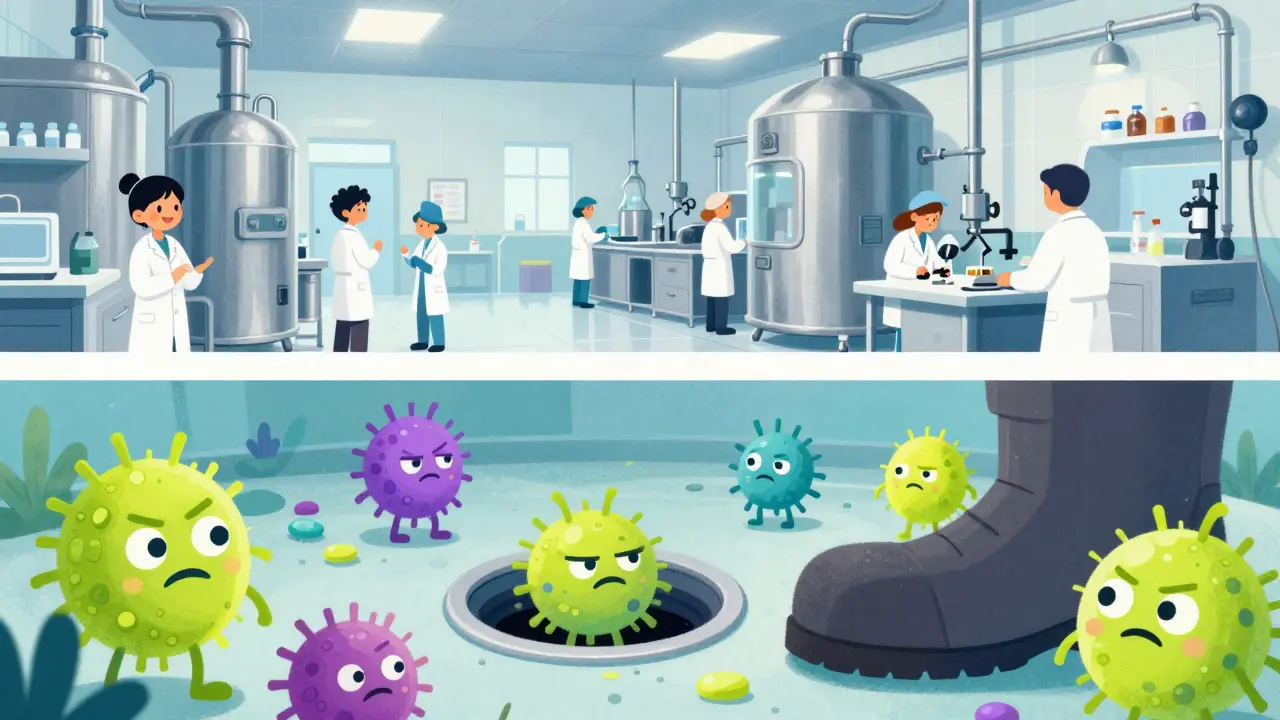
Imagine a high-end pharmaceutical plant or a massive food processing center. To the naked eye, everything looks sterile-stainless steel surfaces gleaming under bright lights. But on a microscopic level, a hidden battle is raging. A single leak in an overhead pipe or a slightly missed spot on a floor drain can harbor pathogens like Listeria or Salmonella, which can then hitch a ride on a worker's boot or a gust of air to contaminate an entire batch of product. This is why environmental monitoring isn't just a regulatory chore; it's the only way to see the invisible threats before they become a public health crisis.
Quick Takeaways for Facility Managers
- The Zone System: Focus your most intense resources on Zone 1 (direct contact surfaces) and Zone 2 (immediate vicinity).
- Hidden Risks: Don't ignore the floors. In some labs, 62% of contamination alerts started from the ground up.
- Speed Matters: Use ATP testing for instant sanitation checks, but keep microbiological tests for deep-dive validation.
- Air Quality: Use impactor samplers to measure CFU/m³ to ensure airborne particles aren't compromising your cleanrooms.
What Exactly is Environmental Monitoring?
Environmental Monitoring is a systematic approach to detecting and controlling contamination in production facilities through the regular sampling and testing of environmental surfaces, air, and water. It acts as a verification mechanism to ensure that microbial hazards are actually under control. Whether you are producing life-saving medicine or ready-to-eat salads, the goal is to find the contamination source and kill it before it touches the product.
The stakes are incredibly high. According to USDA data, foodborne illness outbreaks cost the U.S. economy nearly $78 billion annually. By implementing a formal Environmental Monitoring Program (EMP), companies move from a reactive state (recalling products) to a proactive state (fixing a leaky seal in a refrigeration unit before it breeds bacteria).
The Zone Classification System: Mapping Your Risk
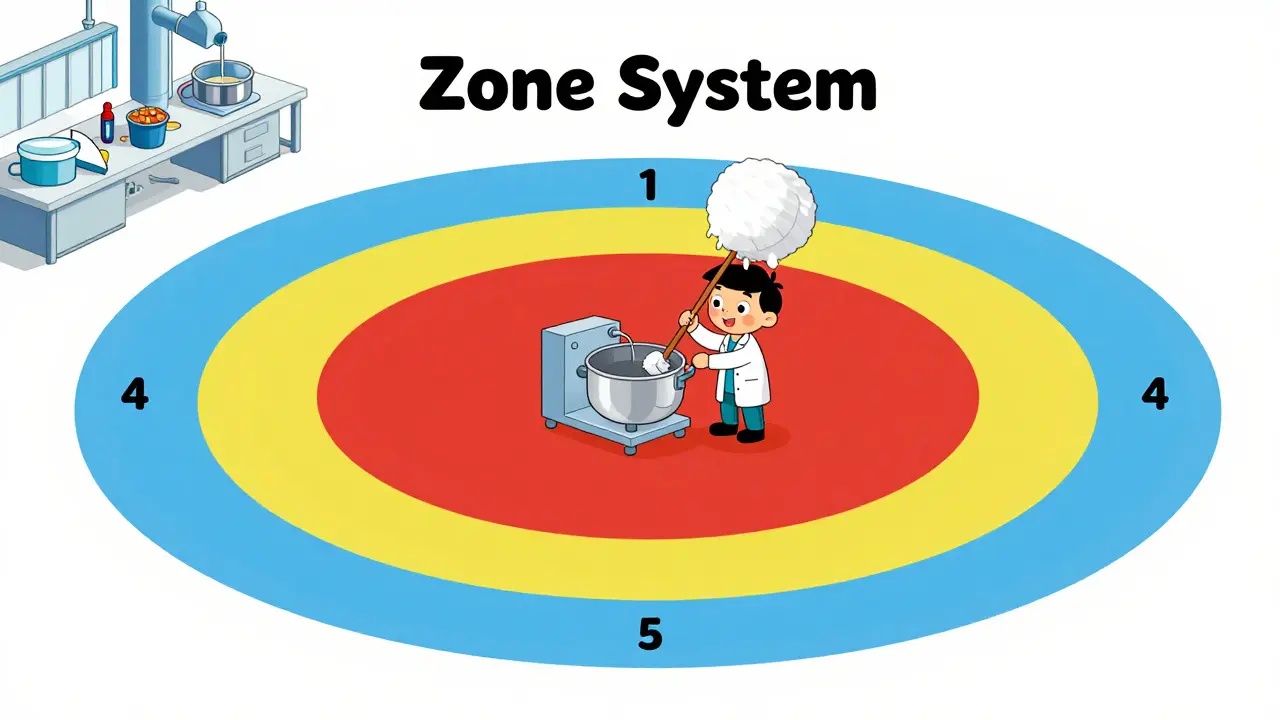
You can't test every square inch of a factory every day-it's too expensive and time-consuming. Instead, industry standards use a zone system to prioritize efforts. Think of it as concentric circles of risk radiating outward from the product.
| Zone | Description | Examples | Sampling Frequency |
|---|---|---|---|
| Zone 1 | Direct Food/Product Contact | Slicers, mixers, conveyors, utensils | Daily to Weekly |
| Zone 2 | Near Product Contact | Equipment housing, refrigeration exteriors | Weekly to Monthly |
| Zone 3 | Remote Production Areas | Forklifts, walls, drains | Monthly to Quarterly |
| Zone 4 | Outside Processing Areas | Loading docks, hallways, locker rooms | Quarterly |
A common mistake is underestimating Zone 3 and 4. A PPD Laboratories study found that laboratory floors were actually the source of 62% of all alert and action limit events. This proves that contamination often "migrates" from the floor, up the legs of equipment, and eventually into the product zone.
Technical Testing Methodologies
Depending on what you're looking for-bacteria, heavy metals, or chemical residues-you'll need different tools. One size does not fit all here.
- Microbiological Methods: These are used to find specific pathogens, molds, and yeasts. Sterile sponges or swabs are the gold standard for surface sampling.
- Air Sampling: To monitor air quality, facilities use liquid impinger and solid impactor samplers . These devices pull large volumes of air through a sterile medium to count Colony Forming Units (CFU) per cubic meter.
- Water Quality: In pharmaceutical settings, Total Organic Carbon (TOC) and conductivity measurements are used to meet strict USP <645> standards, ensuring purified water is truly pure.
- Chemical Analysis: Inductively Coupled Plasma (ICP) is used for metals, while High-Performance Liquid Chromatography (HPLC) identifies specific chemical compounds.
Industry Differences: Pharma vs. Food
While the basic logic is the same, the execution differs wildly between a pill factory and a deli meat plant.
Pharmaceutical facilities follow extremely rigid guidelines, such as EU GMP Annex 1 . They focus heavily on non-viable particulate monitoring in ISO Class 5 cleanrooms. In these environments, even a tiny flake of skin or a piece of fabric can be a critical failure. They also monitor temperature and humidity in real-time to prevent any degradation of sensitive compounds.
Food facilities, particularly those producing Ready-to-Eat (RTE) products, are more focused on specific "search and destroy" missions for pathogens. Under the USDA's "Listeria Rule," these facilities must aggressively test for Listeria spp. across all four zones. For them, the priority is preventing an outbreak that could lead to a massive product recall.
Common Pitfalls and Implementation Gaps
Even the best-funded programs can fail if the execution is sloppy. One of the biggest headaches for managers is inconsistent zone classification. For example, one manager might see an overhead pipe with condensation as a Zone 1 risk (because it could drip into a vat), while another might categorize it as Zone 3. This inconsistency creates blind spots in the monitoring web.
Then there's the human element. The CDC has noted that many facilities struggle with basic sampling techniques-like failing to properly sterilize the interior of a sampler device. If your tool is contaminated before you even start, your results are meaningless.
Finally, there is a data gap. Many companies use ATP (adenosine triphosphate) testing for a quick "pass/fail" on cleanliness. While ATP gives results in seconds and can speed up production turnaround by 32%, it doesn't tell you what the contaminant is. Some facilities fail to integrate these quick ATP results with the slower, more detailed microbiological data, leaving them with a fragmented view of their facility's health.
The Future of Contamination Control
We are moving away from "swab and wait" and toward real-time intelligence. The FDA is currently encouraging the adoption of Next-Generation Sequencing (NGS) and metagenomics. These technologies can slash the time it takes to identify a pathogen from three days down to less than 24 hours.
AI is also entering the fray. By 2027, analysts expect AI-integrated monitoring systems to hit nearly 40% market penetration. These systems don't just report a positive sample; they analyze trends to predict where the next contamination event is likely to occur based on humidity shifts, foot traffic, and historical data.
How often should I sample Zone 1 surfaces?
For high-risk areas, especially Ready-to-Eat (RTE) food facilities, Zone 1 surfaces should be tested at least weekly. Some facilities opt for daily sampling depending on their specific risk assessment and the nature of the product.
What is the difference between ATP testing and microbiological testing?
ATP testing measures adenosine triphosphate, a molecule found in all living cells, providing a near-instant snapshot of general cleanliness. Microbiological testing, however, identifies specific organisms (like Salmonella) but takes 24-72 hours to yield results.
Why is the floor considered a risk if it doesn't touch the product?
Contamination travels. Bacteria on the floor can be picked up by cleaning tools, employee footwear, or carts, and then transferred to equipment legs and eventually to the product contact surfaces. Studies show floors are a major source of alert-limit events.
What are the training requirements for sampling personnel?
The FDA recommends that personnel conducting official environmental monitoring complete at least 40 hours of hands-on training to ensure proper sampling techniques and avoid cross-contamination.
Which air sampler is best for bacteria and fungal spores?
Liquid impinger and solid impactor samplers are the most practical because they can process large volumes of air quickly. Solid impactors are available in slit or sieve designs and must be sterilized before every use.
Next Steps for Your Facility
If you're just starting or refining your program, begin with a thorough risk assessment. Don't just follow a generic checklist; look at your specific layout. Are there condensation points on the ceiling? Are there drains that are hard to reach? Map these as high-risk zones.
For those already monitoring, try integrating your data. If your ATP tests are consistently failing in one area, but your weekly micro-swabs are clean, you might have a bio-film problem that requires a different cleaning agent. Move toward a data-driven approach where every sample informs a specific corrective action.



Write a comment