
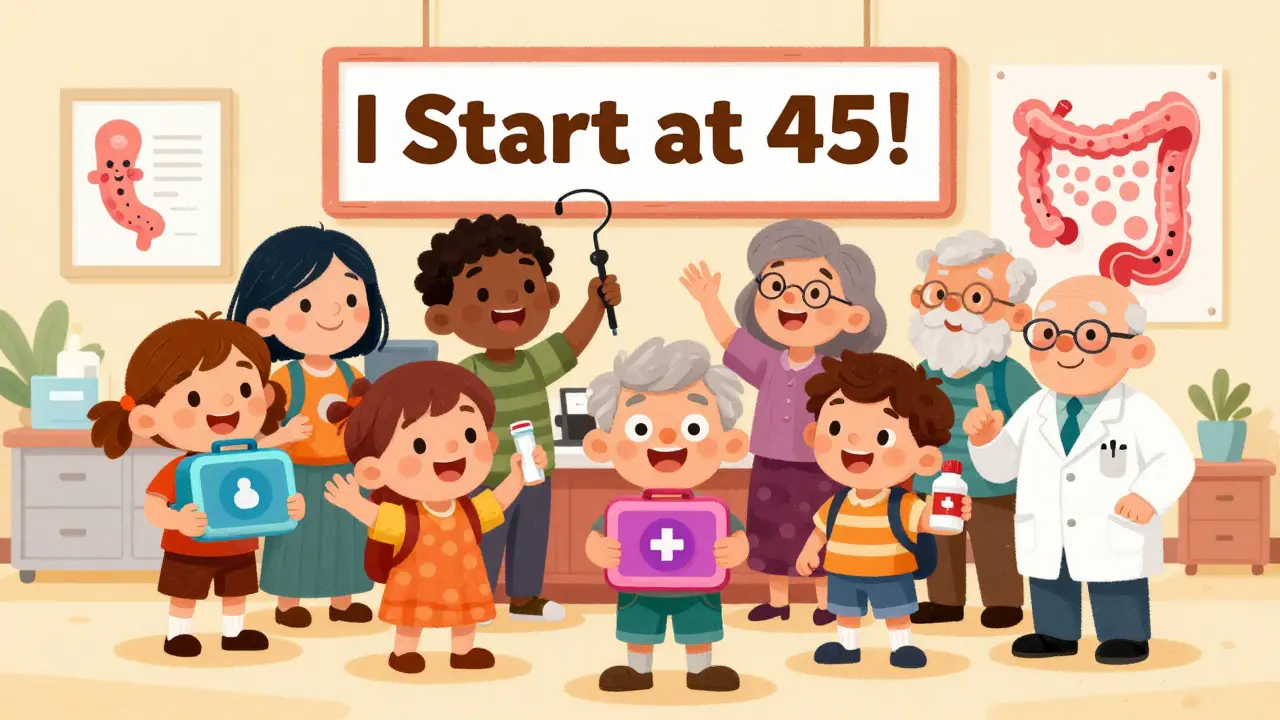
Colorectal Cancer Screening: Why Starting at 45 Matters Now
Colorectal cancer doesn’t wait for you to turn 50. In fact, it’s hitting younger people harder than ever. Since the mid-1990s, the rate of colorectal cancer in adults under 50 has been climbing by about 2.2% every year. That’s why major health groups - the U.S. Preventive Services Task Force, the American Cancer Society, and the American College of Gastroenterology - all now agree: if you’re 45 or older and at average risk, it’s time to get screened.
Screening isn’t just about finding cancer early. It’s about stopping it before it starts. During a colonoscopy, doctors don’t just look for tumors - they remove precancerous polyps. Studies show this cuts your risk of developing colorectal cancer by 67% and lowers your chance of dying from it by 65%. That’s not a small win. That’s life-saving.
What Screening Options Are Actually Available?
You’ve got choices. But not all are created equal.
- Colonoscopy - Every 10 years. This is the gold standard. You prep, you get sedated, and a scope checks your whole colon. If they find a polyp, they take it out right then. No second trip needed. The catch? It’s invasive. About 1 in every 1,000 procedures carries a risk of perforation. But for most people, the benefits far outweigh the risks.
- Fecal Immunochemical Test (FIT) - Every year. This is a simple stool test you do at home. It looks for hidden blood - a possible sign of cancer or large polyps. It’s cheap, non-invasive, and works well. Sensitivity for cancer? Around 79-88%. But it misses smaller polyps. And if it comes back positive, you still need a colonoscopy.
- Stool DNA Test (sDNA-FIT) - Every 3 years. This one checks for both blood and abnormal DNA from cancer cells. It’s more sensitive than FIT - catching 92% of cancers - but it also gives more false positives. That means more people end up with unnecessary colonoscopies. Cost is higher too.
- Flexible Sigmoidoscopy - Every 5 years. Only checks the lower third of the colon. Less prep, less risk. But it misses polyps in the upper colon. Still, it cuts death from distal colorectal cancer by 28%.
- CT Colonography (Virtual Colonoscopy) - Every 5 years. Uses X-rays to create a 3D image of your colon. No sedation. But you still need a full prep. And if they see anything suspicious? You need a colonoscopy anyway. Plus, you get a small dose of radiation - about the same as a chest CT.
Here’s the bottom line: colonoscopy is the most effective. But if you’re scared of the prep or can’t get an appointment for months, FIT is better than nothing. And if you’re in a rural area or without insurance, FIT and sDNA tests can increase screening rates by 15-20% because they’re easier to access.
Who Needs to Start Even Earlier Than 45?
If you have a family history of colorectal cancer or polyps - especially if a close relative was diagnosed before 60 - you might need to start screening at 40, or even earlier. Same goes if you have:
- Lynch syndrome or familial adenomatous polyposis (FAP)
- Chronic inflammatory bowel disease (Crohn’s or ulcerative colitis) for more than 8 years
- A personal history of colorectal cancer or large polyps
African Americans have a 20% higher incidence of colorectal cancer and a 40% higher death rate than White Americans. That’s why experts recommend colonoscopy as the preferred method for this group, starting at 45 - no exceptions. Don’t wait for symptoms. Don’t assume you’re low risk. If you’re Black and 45, get screened. Period.
What Happens If Cancer Is Found?
Screening catches most cases early - when they’re easiest to treat. Stage I colorectal cancer has a 95% five-year survival rate. Stage IV? That drops to 14%. That’s why timing matters.
If cancer is found, surgery is usually the first step. For early-stage tumors, removing the affected part of the colon may be enough. But if the cancer has spread to lymph nodes or beyond, chemotherapy becomes part of the plan.
Chemotherapy Regimens: What’s Used Today?
There’s no one-size-fits-all chemo for colorectal cancer. The regimen depends on the stage, your overall health, and whether the cancer has specific genetic markers.
- FOLFOX - The most common. Combines fluorouracil (5-FU), leucovorin, and oxaliplatin. Given every two weeks. Side effects include nerve damage (tingling in hands/feet), fatigue, and nausea. Many patients tolerate it well for 6 months.
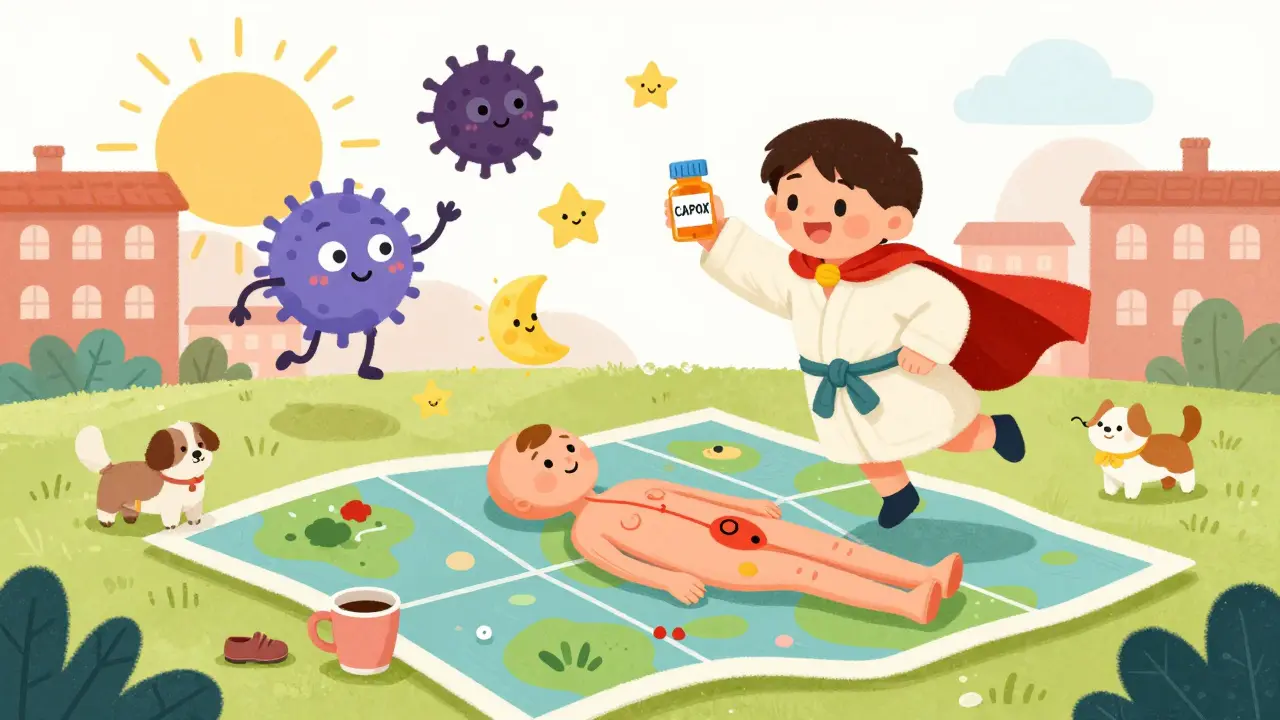
- CAPOX (XELOX) - Similar to FOLFOX, but uses capecitabine instead of 5-FU. Capecitabine is a pill you take at home, which can be more convenient. Side effects include hand-foot syndrome (redness, peeling skin on palms and soles).
- FOLFIRI - Uses 5-FU, leucovorin, and irinotecan. Often used if FOLFOX stops working. Higher risk of severe diarrhea and low white blood cell counts.
- Targeted therapies - For advanced cases, doctors may add drugs like bevacizumab (Avastin), cetuximab (Erbitux), or panitumumab (Vectibix). These target specific proteins on cancer cells. But they only work if your tumor doesn’t have mutations in the KRAS or NRAS genes. Testing for these is now standard before starting chemo.
Chemo isn’t pleasant. But it’s not the nightmare it used to be. Anti-nausea drugs today are far more effective. Many people work through treatment. Some even travel. The goal isn’t just to extend life - it’s to keep you living well while you do it.
Why So Many People Still Don’t Get Screened
Despite all the evidence, only 67.1% of adults aged 50-75 are up to date with screening. That’s not good enough. Here’s why people skip it:
- The prep - Drinking gallons of salty liquid for a day? It’s brutal. But newer low-volume prep solutions are easier. Ask your doctor about them.
- Cost - Uninsured adults are less than half as likely to get screened. Medicare and most private plans cover colonoscopy with no out-of-pocket cost. If you’re worried, call your insurer.
- Fear - Fear of pain, fear of results, fear of the unknown. But the procedure itself is painless under sedation. And the fear of not doing it? That’s what kills.
- Access - In rural areas, wait times for colonoscopy can be over 60 days. That’s why stool tests are critical. They’re a bridge until you can get an appointment.
One study found that clinics using automated reminders and patient navigators boosted screening completion by 35%. If you’re struggling to get scheduled, ask your doctor for help. You’re not alone.
What’s Next for Colorectal Cancer Screening?
The future is getting smarter. Blood tests that detect cancer DNA are already in trials. The Guardant SHIELD test, for example, found 83% of colorectal cancers in a 10,000-person study. It’s not ready for prime time yet - but it’s coming.
AI is already helping. The GI Genius system, approved by the FDA in 2021, uses artificial intelligence to highlight polyps during colonoscopy. It boosts detection rates by 14%. That means more polyps found, more cancers prevented.
Soon, we may see personalized screening. Instead of everyone getting a colonoscopy at 45, your risk score - based on genetics, diet, weight, and lifestyle - could tell you whether you need one every 5 years or every 15. That’s the goal of precision screening. Less over-testing. More targeted care.
What You Should Do Right Now
If you’re 45 or older - even if you feel fine - talk to your doctor about screening. Don’t wait for symptoms. Colorectal cancer often has none until it’s advanced.
If you’re under 45 but have a family history or other risk factors, don’t assume you’re safe. Ask about earlier screening.
If you’ve had a negative test before, don’t assume you’re off the hook. Keep up with your schedule. Colon cancer doesn’t care if you’re busy, tired, or scared. It just grows.
Screening saves lives. Not every year. Not for everyone. But for enough people - enough families - it makes all the difference.

13 Comments
Rod Wheatley
I can't believe we're still having this conversation. My dad died of colon cancer at 52 because he 'didn't have time' for a colonoscopy. I got mine at 45. Found three polyps. One was precancerous. They took 'em all out. No big deal. No pain. No drama. Just life. Do it. Seriously. Your future self will thank you. 💪
Uju Megafu
This is why I hate American healthcare. You're scared to death of a colonoscopy so you pay $500 for a stool test that misses half the stuff? And then they charge you ANOTHER $10k for the colonoscopy if it's positive? LOL. You people are so gullible. They profit off your fear. I'd rather just eat kale and pray.
Kelly McRainey Moore
I did the FIT test last year. It was weird holding my poop in a little vial for a week. But way easier than drinking that salty water. Got a negative result. Felt like I won the lottery. My mom’s been doing it yearly since 50. Still going strong. Seriously, just do the test. It’s not that bad.
Stephen Rock
Colonoscopy is a scam. The prep is torture. The sedation is overkill. The polyp removal? Most are harmless. They're just cutting money out of your pocket and scaring you into compliance. I'm 47. Never had symptoms. Never will. I'm not a lab rat.
Amber Lane
My aunt is Black and got diagnosed at 48. She didn't know she was high risk. No one told her. She didn't have insurance. Now she's in chemo. Don't wait. Ask. Demand. Advocate. This isn't optional.
Andrew Rinaldi
It's interesting how we treat screening like a moral obligation. But what if someone has severe anxiety? Or trauma from medical procedures? What if they can't afford the time off? We need systems that meet people where they are-not just shame them into compliance.
Gerard Jordan
I just did my first colonoscopy at 46. Was terrified. Ended up laughing with the nurse during prep because I spilled the liquid all over my kitchen. 😅 Got a clean bill of health. And now I'm telling everyone I know. You’re not weird for being scared. But you’re brave for doing it anyway. 🙌
Coral Bosley
I’ve been waiting for this post to come out so I could finally say it: they’re lying about the 67% reduction. It’s a placebo effect. The real reason people survive longer is because they panic and change their diet, quit drinking, start yoga. Not because some guy shoved a tube up your butt. I’ve seen it. I’ve lived it.
shubham rathee
In India we dont even have colonoscopy in villages. But we have turmeric and neem. And we dont get colon cancer. Why? Because we dont eat processed food. You americans eat too much cheese and soda. That's the real problem. No need for tests. Just stop eating garbage
Kevin Narvaes
I think the real cancer is capitalism. They want you scared so you buy their tests, their drugs, their prep kits. I stopped going to doctors after my last bill was $12k for a biopsy that turned out to be nothing. I eat raw garlic and meditate now. My colon is zen.
Dee Monroe
I remember when my grandma used to say, 'If your body's talking, listen.' She never got screened. Thought it was 'unnatural.' She passed at 69 from stage IV. I started screening at 45 because I didn't want my kids to lose me like I lost her. It’s not just about you-it’s about who’s gonna hold their coffee cup and say, 'I miss you' when you’re gone. That’s the real reason I go. Not because I'm scared. Because I love them too much to leave early.
Sangeeta Isaac
So I did the sDNA test. Got a positive. Panicked. Went to get colonoscopy. Turns out it was just a hemorrhoid. But the $2k bill? That’s the real trauma. 😭 Also, the prep tasted like regret and saltwater. Why do they make it so gross? Can’t they just give us a gummy?
Alex Carletti Gouvea
This is why America’s falling apart. You’re all scared of your own colon. We used to be tough. We didn’t need tests. We just lived. Now you need a blood test, a stool test, an AI scan, a therapist to cope with the prep. Weak. Get a grip.