
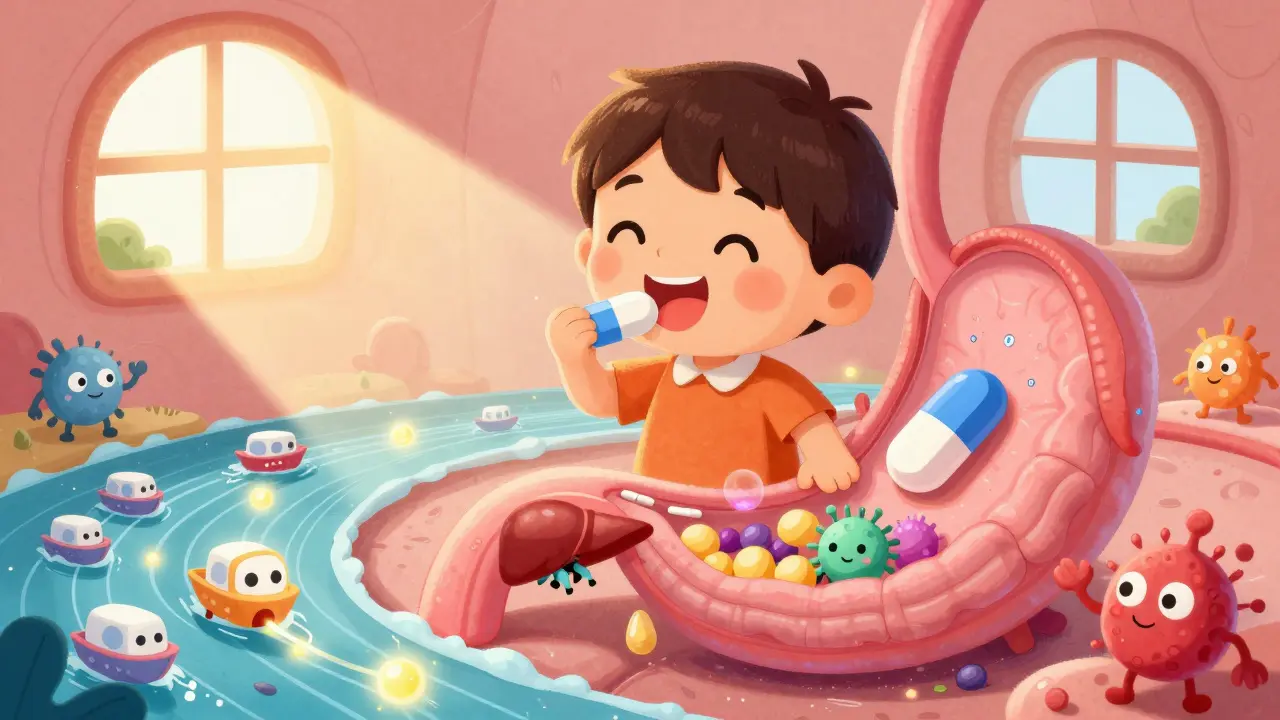
Every pill you swallow, every injection you get, every inhaler you use - it’s not magic. It’s chemistry. Medicines work because they’re designed to interact with your body at a molecular level. But knowing how medicines work isn’t just for doctors. It’s the key to using them safely - and avoiding harm.
What Happens When You Take a Pill?
When you swallow a tablet, it doesn’t just disappear. It travels through your stomach and intestines. Some drugs, like antacids or laxatives, work right there in your gut. Others need to get into your bloodstream to reach their target - like your brain, heart, or joints. But getting there isn’t easy. Your liver and gut break down a lot of it before it even gets started. That’s called the first-pass effect. For some drugs, like propranolol, up to 90% is destroyed before it circulates. That’s why some pills need to be taken in higher doses than you’d expect. Once in the blood, most drugs bind to proteins - often 95% or more. Only the small unbound portion is active. That’s why drug interactions can be dangerous. If another medication kicks your drug off those proteins, suddenly too much is floating around free. Warfarin, for example, is 99% protein-bound. Take it with a sulfonamide antibiotic, and your free warfarin can jump 20-30%. That’s when bleeding risks spike.The Lock-and-Key Principle
Your body is full of receptors - tiny protein sites on cells that respond to natural signals like hormones or neurotransmitters. Medicines mimic or block these signals. Think of it like a lock and key. The receptor is the lock. The drug is the key. Some drugs are agonists. They fit perfectly and turn the lock - like serotonin in your brain. SSRIs like fluoxetine (Prozac) don’t add more serotonin. They block the pump that recycles it back into nerve cells. That leaves more serotonin hanging around to do its job. It’s like putting a cork in the drain so the water doesn’t disappear. Others are antagonists. They jam the lock without turning it. Beta-blockers like metoprolol block adrenaline from binding to heart receptors. That slows your heart rate. It’s not magic. It’s physics. Aspirin works differently. It doesn’t just block a receptor. It permanently disables an enzyme called COX-1. That enzyme makes prostaglandins - chemicals that cause pain and swelling. By shutting it down, aspirin reduces inflammation. But it also affects stomach lining protection, which is why long-term use can cause ulcers.Why Mechanism Matters for Safety
Understanding how a drug works isn’t just academic. It’s the difference between safe use and serious harm. Take lithium, used for bipolar disorder. We don’t fully understand how it works. It affects multiple pathways in the brain. That makes it tricky. The safe range is narrow: 0.6 to 1.2 mmol/L in your blood. Go just a little over, and you get tremors, confusion, even seizures. That’s why people on lithium need regular blood tests. If you didn’t know that, you might think your dizziness is just stress - not a warning sign. Statins, like atorvastatin, lower cholesterol by blocking HMG-CoA reductase - the enzyme your liver uses to make cholesterol. Because we know exactly how they work, we can monitor their effect: check your LDL levels. If your cholesterol drops too low or you get muscle pain, we adjust. Patients who understand this are 3.2 times more likely to report muscle pain early - catching rhabdomyolysis before it becomes life-threatening. Then there’s warfarin. It blocks vitamin K, which your body needs to make clotting factors. That’s why eating a big salad with spinach or kale can throw your INR off. You’re flooding your system with vitamin K. If you don’t know that, you might think your bruising is normal. It’s not. It’s your blood thinning too much.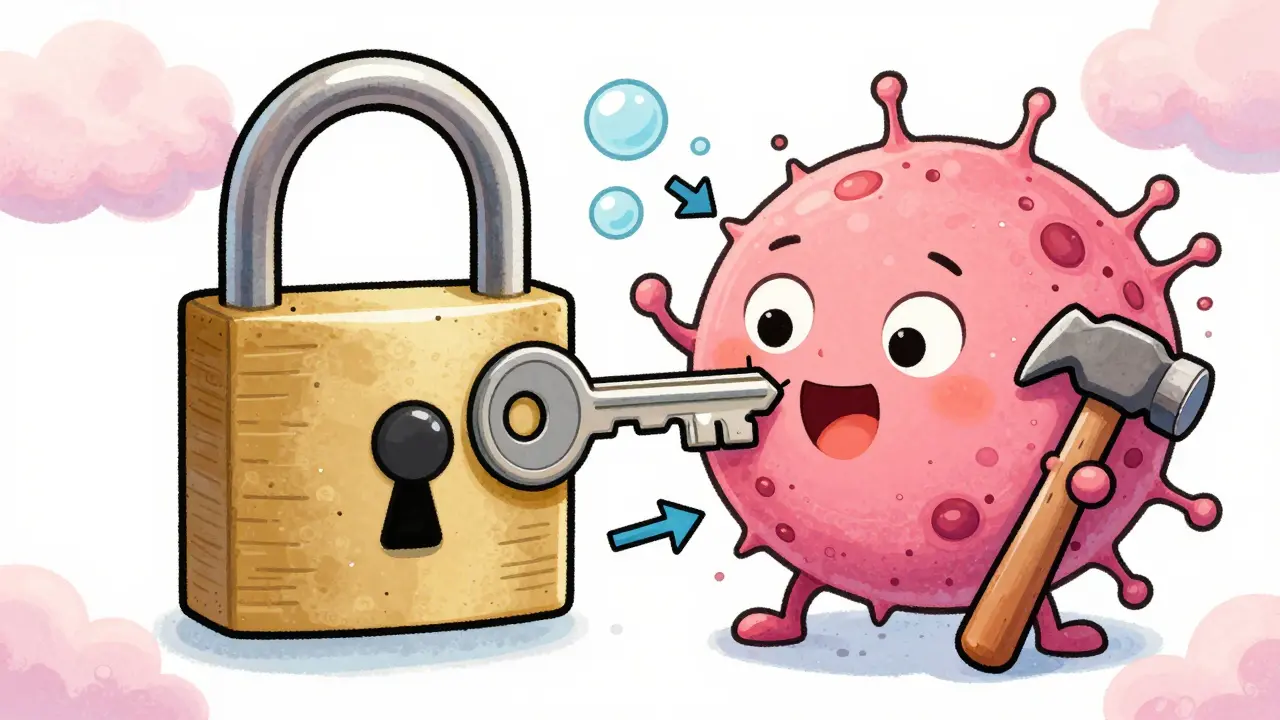
The Dark Side: When Mechanism Isn’t Understood
Not all drugs have clear mechanisms. Dimebon, an old Russian antihistamine, was tested for Alzheimer’s in the 2000s. It showed promise in small studies. But because no one knew how it worked, larger trials failed. It didn’t matter if it seemed to help - without knowing why, you couldn’t control it. The FDA rejected it. That’s the risk of using drugs without understanding their action. Thalidomide is the worst-case example. In the 1950s, it was sold as a sleep aid and morning sickness treatment. One version of the molecule (enantiomer) calmed nausea. The other caused severe birth defects. Back then, scientists didn’t know how to separate them. Thousands of babies were born with missing limbs. Today, we know better. We test every molecular twist before approval. Even now, about 30% of prescribed drugs have poorly understood mechanisms. That’s why 1.3 million people in the U.S. end up in emergency rooms each year from adverse drug reactions. Many of those cases could’ve been avoided if patients understood what their medicine was doing - and what to watch for.When Is a Medication Safe to Use?
Safety isn’t about the drug itself. It’s about the match between the drug, the person, and the situation. First, match the drug to the condition. Trastuzumab (Herceptin) only works for breast cancer patients whose tumors overexpress HER2 protein. Screen first. Treat second. That’s precision medicine. Patients who understand this feel more confident - and are more likely to spot early signs of heart problems, a known side effect. Second, consider your body. Genetic differences affect how you metabolize drugs. Some people break down codeine too fast and get dangerously high levels of morphine. Others barely break it down at all. The NIH’s All of Us program is collecting genetic data from a million people to predict these reactions before they happen. Third, know your interactions. Grapefruit juice can block enzymes that break down statins, blood pressure meds, and some anti-anxiety drugs. That sends levels soaring. Alcohol with benzodiazepines? That’s a recipe for slowed breathing. Antidepressants called MAOIs? Don’t eat aged cheese, cured meats, or tap beer - they contain tyramine. Combine that with the drug, and your blood pressure can spike to dangerous levels. Fourth, don’t stop suddenly. SSRIs aren’t addictive. But your brain adapts to the extra serotonin. Stop cold, and you get brain zaps, dizziness, nausea - withdrawal symptoms that feel like a relapse. Know why you’re taking it. Talk to your pharmacist before quitting.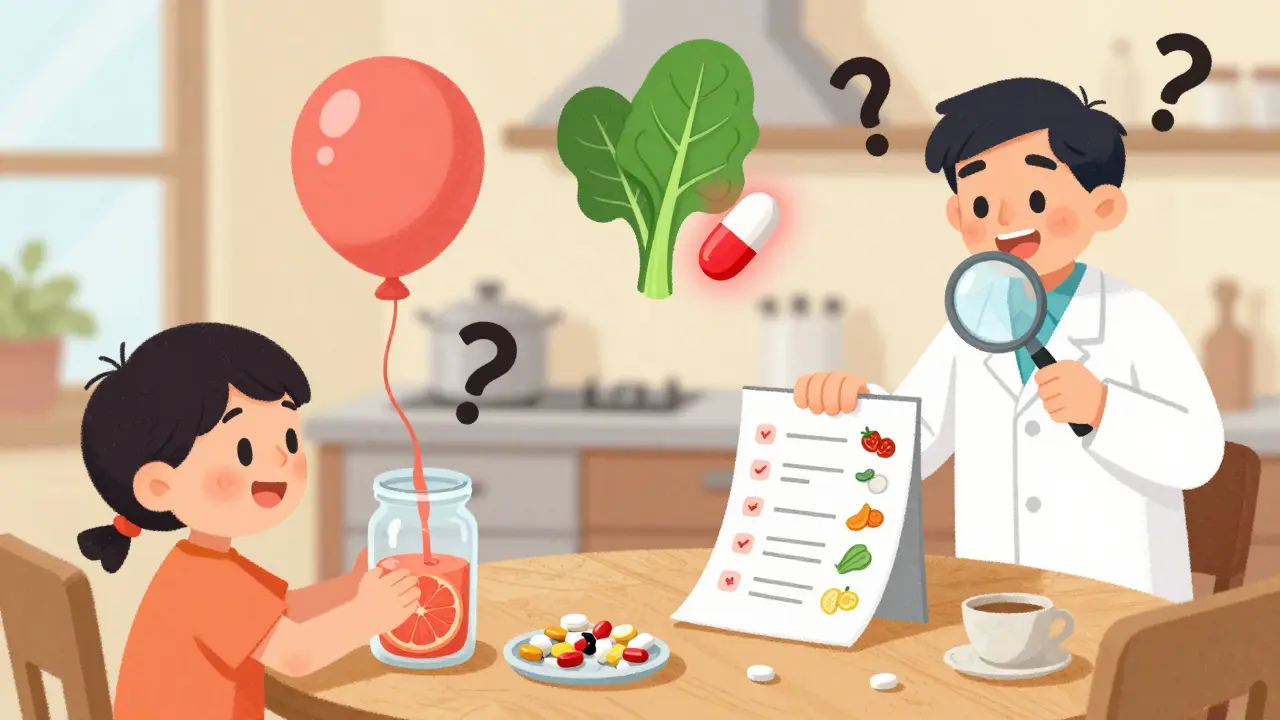
What Patients Can Do
You don’t need a medical degree to use medicines safely. You just need to ask the right questions:- What is this medicine supposed to do in my body?
- What side effects should I watch for - and why do they happen?
- What foods, drinks, or other meds should I avoid?
- What happens if I miss a dose? Or take too much?
The Future: Safer Medicines Through Better Understanding
The FDA’s “Pharmacology 2030” initiative is pushing for full mechanism characterization on every new drug. By 2025, they’ll have 15 new biomarker tests to monitor drug effects in real time. For example, with EGFR inhibitors for lung cancer, a skin rash isn’t just a side effect - it’s a sign the drug is working. Doctors now use it to guide dosing. Soon, digital twins - computer models of your body - could predict how you’ll react to a drug before you even take it. Early tests at Mayo Clinic show this could cut adverse events by 40-60%. But none of this matters if patients don’t understand the basics. The most powerful tool isn’t a new drug. It’s knowledge.Frequently Asked Questions
How do I know if my medicine is working?
It depends on the drug. For blood pressure meds, you’ll check your numbers. For statins, your cholesterol levels. For antidepressants, you’ll notice changes in mood, sleep, or energy over weeks. If you’re unsure, ask your doctor what specific sign to look for - and how long to wait. Don’t assume no side effects means no effect. Some drugs work silently.
Can natural supplements interact with my prescription meds?
Yes - often more than you think. St. John’s Wort can reduce the effectiveness of birth control, antidepressants, and even some cancer drugs. Garlic and ginkgo can thin your blood, which is dangerous if you’re on warfarin. Turmeric can interfere with blood sugar control. Always tell your pharmacist what supplements you take - even if you think they’re "natural" or "safe."
Why do some drugs need blood tests?
Because their safe range is narrow. Lithium, warfarin, digoxin, and some epilepsy drugs have a small window between helpful and toxic. Too little, and they don’t work. Too much, and you get poisoning. Blood tests measure the active amount in your system. It’s not routine - it’s lifesaving.
Is it safe to split pills or crush them?
Only if the label or your pharmacist says so. Extended-release pills are designed to release slowly. Crush them, and you get a full dose all at once - that can be deadly. Coated pills protect your stomach or ensure absorption in the right part of the gut. Breaking them ruins that. Always ask before changing how you take a pill.
What should I do if I think I’m having a side effect?
Don’t ignore it. Don’t assume it’s "normal." Write down what happened, when, and how bad it was. Call your doctor or pharmacist. For serious symptoms - chest pain, trouble breathing, swelling, confusion - go to urgent care or emergency. Many side effects are mild and go away. But some are warning signs. Knowing your drug’s mechanism helps you recognize which is which.

8 Comments
Sumit Sharma
The first-pass effect isn't just a footnote-it's the reason why oral bioavailability is a goddamn engineering problem. Propranolol gets 90% gut-liver destroyed? That's not inefficiency, that's evolutionary sabotage. We design drugs to survive that gauntlet, and when they don't, we compensate with dose escalation or prodrugs. But most patients think 'more pill = more effect'. They don't get that the body is a hostile environment for foreign molecules. This isn't pharmacology-it's biochemical warfare.
Jay Powers
I love how this breaks it down without jargon overload. I used to think meds just magically worked until my dad started on warfarin and I saw how one spinach salad could mess with his INR. The lock and key analogy actually stuck with me. People need to know this stuff isn't magic-it's biology with consequences. Thanks for writing this
Lawrence Jung
Medicines are just chemical illusions designed by men who think they can outsmart evolution. The body doesn't want your pills. It sees them as invaders. The fact that any drug works at all is a statistical fluke. We're just lucky some of them accidentally fit the locks. And yet we treat them like divine artifacts. We don't understand the mechanisms. We just pray they work. That's not science. That's superstition with a pharmacy label
George Bridges
As someone who's had to explain statin side effects to elderly patients in rural clinics, I can tell you-when you give them the receptor analogy, they get it. They start asking about grapefruit. They start writing down their meds. Knowledge isn't power here. It's safety. This post should be mandatory reading before any script is filled
Faith Wright
Oh wow. So now we're teaching people chemistry so they don't die? What a radical idea. Next you'll tell us to wash our hands before surgery or wear seatbelts. Who knew understanding how things work could prevent disaster? I'm shocked. Absolutely shocked. /s
Rebekah Cobbson
One thing I always tell my clients: if you don’t know why you’re taking something, ask. Not ‘what does it do?’ but ‘how does it do it?’ That’s the magic question. Once you understand the cork-in-the-drain thing with SSRIs, you stop panicking when you feel weird for two weeks. It’s not failing-it’s adjusting. And if your pharmacist gives you a 30-second answer? Find a better one. Your life’s worth more than that
Audu ikhlas
USA think they own medicine. We in Nigeria use herbs that work better. You think your lab drugs know your body? Our grandmas knew your liver before you were born. Thalidomide? That's what happens when you trust white scientists. We don't need your pills. We need our roots. This post is just propaganda for Big Pharma. You think your enzymes are better than our ancestors? LOL
Sonal Guha
The protein binding thing is the real killer. 99% bound means 1% free. One percent. That's all it takes. And you think your 5mg dose is safe? Maybe. Until you take ibuprofen. Then suddenly that 1% becomes 1.3%. Boom. Bleeding. No warning. No panic. Just a quiet clotting cascade failure. You think you're safe because you don't feel anything? You're already halfway to the ER.