
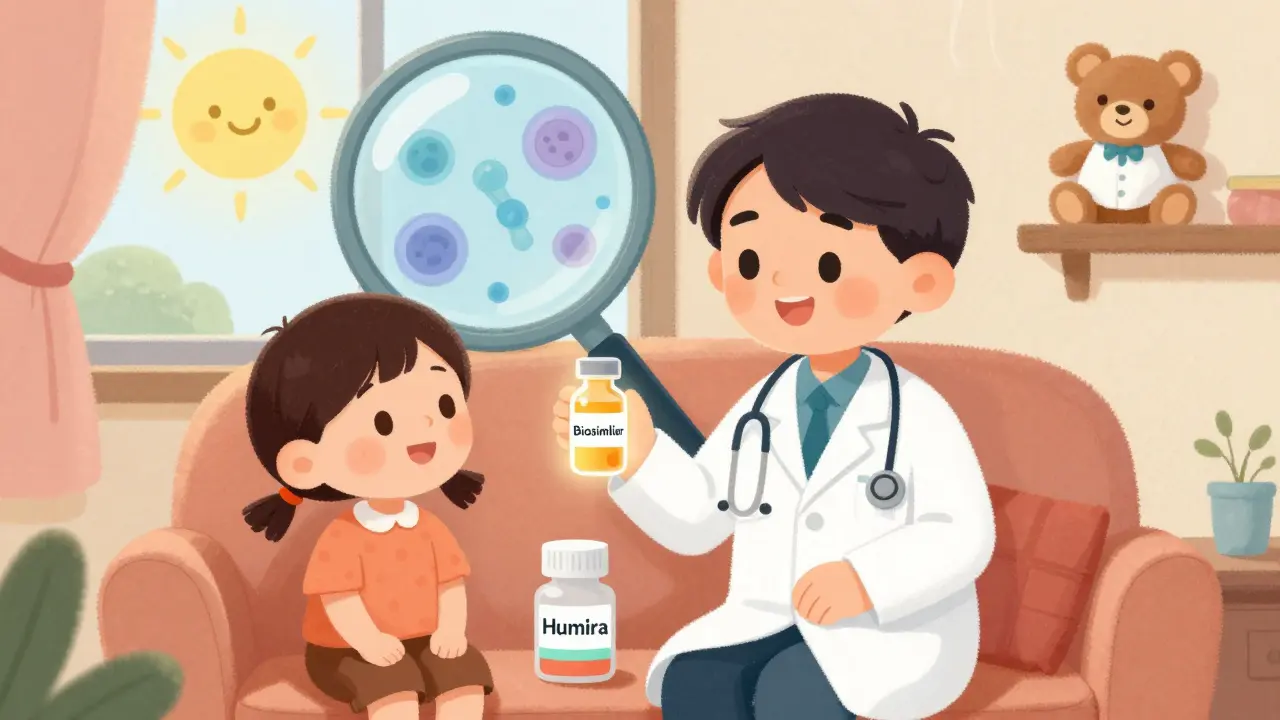
When your doctor suggests switching from Humira to a biosimilar, it’s normal to feel uneasy. You’ve been on the same medication for years. It works. You know how your body reacts to it. Now, someone is asking you to try something new-something called a biosimilar. But what does that even mean? Is it just a cheaper version? Is it safe? What if it doesn’t work as well?
You’re not alone. Nearly 8 out of 10 patients with chronic conditions like rheumatoid arthritis, Crohn’s disease, or psoriasis worry about switching to biosimilars. Many fear side effects, reduced effectiveness, or even a flare-up of their condition. And here’s the real problem: even though biosimilars save the system billions, most patients don’t see those savings in their own pockets. That makes trust even harder to earn.
What Exactly Is a Biosimilar?
A biosimilar isn’t a generic. That’s the first thing to understand. Generics are exact chemical copies of small-molecule drugs-like aspirin or metformin. They’re made in labs using predictable chemical reactions. Biosimilars, on the other hand, are made from living cells-like yeast or hamster ovary cells. They’re complex proteins, often as big as a virus. No two batches are perfectly identical, even from the same manufacturer.
But here’s the key: the FDA doesn’t approve a biosimilar unless it shows no clinically meaningful differences from the original biologic. That means the same effectiveness, the same safety profile, the same risk of side effects. The only differences are in tiny, non-active parts of the molecule-like the packaging of a car might change, but the engine stays the same.
Since 2015, the FDA has approved 74 biosimilars as of April 2025. These cover major drugs used for cancer, autoimmune diseases, and diabetes. For example, the biosimilar for infliximab (Remicade) is now used by over 150,000 patients in the U.S. with no new safety signals. Real-world data from hospitals and clinics shows the same response rates and similar rates of adverse events.
Why Do Patients Hesitate?
It’s not just about science. It’s about experience.
A Reddit user named ChronicPainPatient87 shared their story: their doctor switched them to a biosimilar without explanation. Within weeks, they had a flare-up. They didn’t know if it was the drug, stress, or coincidence-but they blamed the biosimilar. That’s the nocebo effect in action: expecting something to go wrong makes it more likely you’ll feel it.
Surveys show 79% of patients worry biosimilars won’t work as well. 63% fear new or worse side effects. Only 31% of patients with chronic illness have even heard of biosimilars. Meanwhile, 64% of doctors have. That gap is dangerous. When patients aren’t involved in the decision, they feel like a number-not a person.
Another issue: cost savings aren’t reaching patients. Even though biosimilars cost 35% less for insurers, out-of-pocket prices often stay the same. For pegfilgrastim, a drug used after chemotherapy, biosimilars cut the cost of the first treatment cycle by nearly half-but patients still paid the same copay. Why? Pharmacy benefit managers (PBMs) and drug pricing structures haven’t changed. If your copay is $50, it stays $50-even if the drug now costs $100 less to make.
Biosimilars vs Generics: The Big Differences
People hear “similar to generic” and assume they’re the same. They’re not.
- Generics are chemically identical. A pill of generic metformin has the exact same atoms in the exact same arrangement as the brand name. Development takes 3-4 years and costs $2-3 million.
- Biosimilars are highly similar but not identical. They’re made from living cells, so small variations happen naturally. To prove they’re safe, manufacturers run dozens of lab tests, animal studies, and at least one small clinical trial. This takes 8-10 years and costs $100-250 million.
- Market uptake: Generics take over 90% of the market within a year. Biosimilars? Less than 10% for most drugs-even after years on the market.
That’s why you won’t find a biosimilar for every biologic. Only 21% of high-value biologics (those making over $500 million a year) have biosimilars in development. The rest sit untouched because the cost to prove similarity is so high-and the payoff uncertain.
How Do We Build Trust?
Education isn’t enough. You need transparency, involvement, and proof.
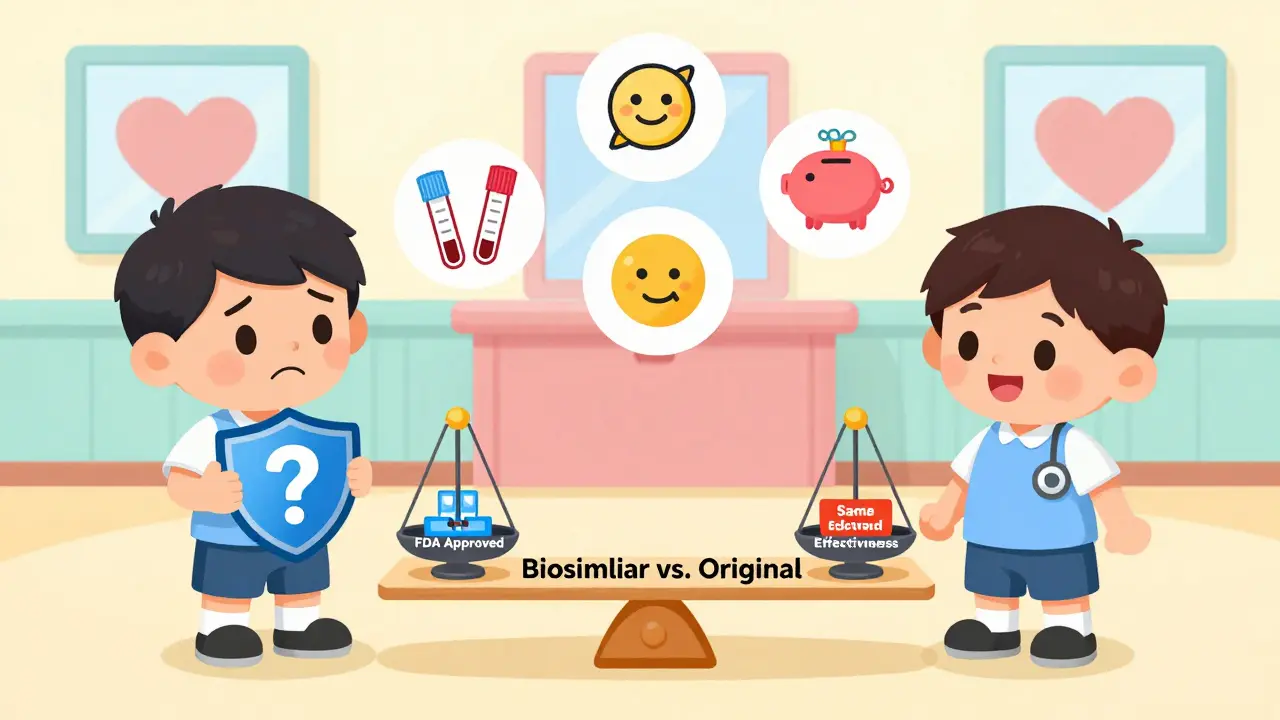
Start with the conversation. If your doctor wants to switch you, they should say: “We’re moving you to a biosimilar because it’s been approved by the FDA as just as safe and effective as your current drug. It’s not a cheaper copy-it’s a scientifically proven alternative. We’ll monitor your response closely.”
Patients who receive this kind of clear, honest explanation are far more likely to agree. One study found that when patients were given a detailed, visual explanation of how biosimilars are tested, their confidence rose by 40%.
Another key step: track your response. If you’re on a biosimilar for rheumatoid arthritis, your doctor can check your CRP and ESR blood markers before and after the switch. If your inflammation levels stay stable, that’s real evidence it’s working. Same for Crohn’s-fecal calprotectin levels can show if the drug is still controlling gut inflammation.
Some clinics now use “Clinical Trial Educators”-staff trained to walk patients through the science, answer questions, and even connect them with others who’ve switched successfully. One program in Texas saw patient enrollment in biosimilar programs jump from 12% to 58% in six months.
What’s Changing in 2025 and Beyond?
The FDA just released new draft guidance in 2024 that could speed up biosimilar approvals. Instead of requiring full clinical trials for every new biosimilar, they’ll now accept strong analytical data-like detailed protein mapping and binding tests-as proof of similarity. This could cut development time by years and lower costs.
Pharmacy benefit managers are also changing tactics. CVS stopped covering Humira in most commercial plans in April 2024. ESI and OptumRx followed in 2025. That forced prescribers to choose biosimilars-or justify why they wouldn’t. The result? The average cost of biologic drugs dropped by 2.3 percentage points in just four months.
But here’s the catch: patient satisfaction dropped 15% in that same period. Why? Because many weren’t prepared. They felt blindsided. That’s not a failure of biosimilars-it’s a failure of communication.
By 2030, over 100 biologics will lose patent protection. That’s $232 billion in potential savings. If we get this right, biosimilars could cut drug spending by $300 billion between now and 2030. But only if patients are part of the decision-not just the target.
What You Can Do Right Now
If you’re on a biologic and hear about a biosimilar:
- Ask your doctor: “Is there a biosimilar for my drug? Has it been approved by the FDA?”
- Ask: “Will my out-of-pocket cost go down? If not, why?”
- Ask: “Can we monitor my response with blood tests or symptoms?”
- Ask: “Can I talk to someone who’s switched?”
- Don’t be afraid to say no-if you’re not ready, you don’t have to switch yet.
And if you’ve already switched? Share your story. If it worked, tell others. If it didn’t, report it to your doctor and the FDA’s MedWatch program. Real-world feedback is what makes these drugs safer for everyone.
Biosimilars aren’t a gamble. They’re science-backed alternatives that have already helped hundreds of thousands of people. But they won’t reach their potential until patients are treated like partners-not passive recipients of a cost-cutting strategy.
Why This Matters for You
Chronic illness is expensive. Biologics can cost $20,000 to $50,000 a year. Many people skip doses or stop treatment because they can’t afford it. Biosimilars offer a real chance to change that.
But savings only matter if they’re shared. And trust only grows when patients are heard.
The goal isn’t just to replace one drug with another. It’s to give people access to life-changing treatments without fear, without surprise, and without financial shock.
It’s not about lowering costs. It’s about lowering barriers.



13 Comments
Katelyn Slack
i switched to the biosimilar last year and honestly? no issues. my joints still don't scream at 5am. i'm not some lab rat, i'm just someone who wants to not go broke.
Melanie Clark
you think theyre safe but theyre not theyre testing on people like us to see if we die quietly and the pharma giants laugh all the way to the bank theyre not even real drugs theyre lab experiments disguised as medicine and dont tell me about the fda theyre bought and paid for by big pharma dont you see the pattern
Harshit Kansal
bro i was on humira for 4 years then switched to biosimilar and my bills dropped from 800 to 50 a month. no flare ups no drama just cheaper medicine that works. why is this even a thing
Brian Anaz
why are we letting foreign labs make our medicine this is american healthcare not some global experiment. if it works why not just make it here
Vinayak Naik
yo biosimilars are like the cousin of the original drug not the twin. same vibe same function but made by a different crew with better equipment. the fda doesnt just rubber stamp this stuff they put it through hell. ive seen the data. it holds up. dont let fear trick you into paying 50k a year when 30k does the same job
Saylor Frye
how quaint. the average patient has the cognitive capacity to parse the molecular heterogeneity of recombinant protein therapeutics? i suppose we should also ask the cat if it’s comfortable with the new litter
Molly McLane
if you’re scared to switch, that’s valid. but don’t let fear make the decision for you. talk to your doc. ask for data. check your labs before and after. see what happens. you’re not a guinea pig-you’re someone who deserves to live without bankruptcy
Wesley Pereira
oh so now the fda is the villain? and the 150k people on infliximab biosimilars are just… what? delusional? let me guess you also think insulin is a government plot. wow. the science is solid. the data is out there. you just don’t wanna do the work to read it. sad
Isaac Jules
you people are pathetic. you’d rather pay 50k a year so some ceo can buy a third yacht than take a 35% cheaper drug that’s been tested on thousands. you’re not sick-you’re selfish. and yes i said it. get over it
Pavan Vora
....I must say, that the concept of biosimilars, as it pertains to the intricate biological constructs derived from living cellular systems, is, in my humble opinion, a marvel of modern pharmaceutical science, yet, the lack of patient-centric communication, and the absence of transparent cost-sharing mechanisms, creates a chasm between scientific progress and human trust... which is, frankly, tragic.
Stuart Shield
my mate switched last year after his knee gave out again on humira. same results, half the cost. he didn’t even notice until he checked his bank account. sometimes the best medicine is the one that doesn’t empty your wallet
Indra Triawan
isn’t it ironic that we seek to extend life through science, yet fear the very tools that could make it accessible? we worship the god of originality, yet forget that healing doesn’t care about the label on the vial
Joann Absi
THEY’RE TRYING TO SWITCH US TO FOREIGN DRUGS 😱 I’M NOT A LAB RAT FOR BIG PHARMA AND THE GOVERNMENT IS IN ON IT 🇺🇸💀 I’M KEEPING MY HUMIRA EVEN IF I HAVE TO SELL MY KIDNEY 😤💊 #BiosimilarScam #AmericaFirst