
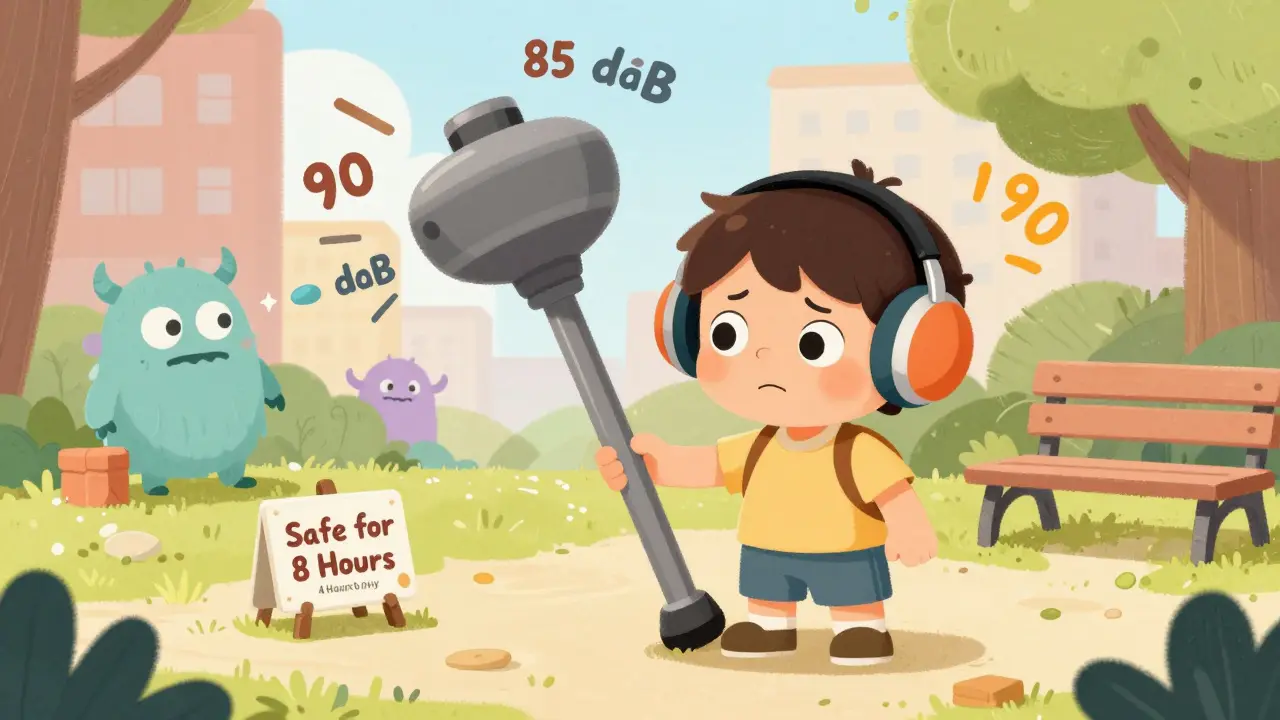
Why Your Ears Are Under Silent Attack
You don’t need to be a construction worker or a rock star to risk your hearing. Every day, millions of people are exposed to dangerous noise levels-whether it’s the hum of a jackhammer at work, the thump of bass at a concert, or headphones turned up too loud on the commute. The problem? Most of us think hearing loss is something that happens slowly, to older people. But noise-induced hearing loss can start in your 20s, and it’s completely preventable.
The science is clear: continuous exposure to sounds above 85 decibels (dBA) over time damages the delicate hair cells in your inner ear. Once those cells die, they don’t grow back. That’s permanent. And it’s not just about loudness-it’s about duration. A chainsaw at 110 dBA can hurt your ears in under a minute. A rock concert at 120 dBA? You’re at risk after just 7.5 seconds.
Workplace Noise Rules: What’s Legal vs. What’s Safe
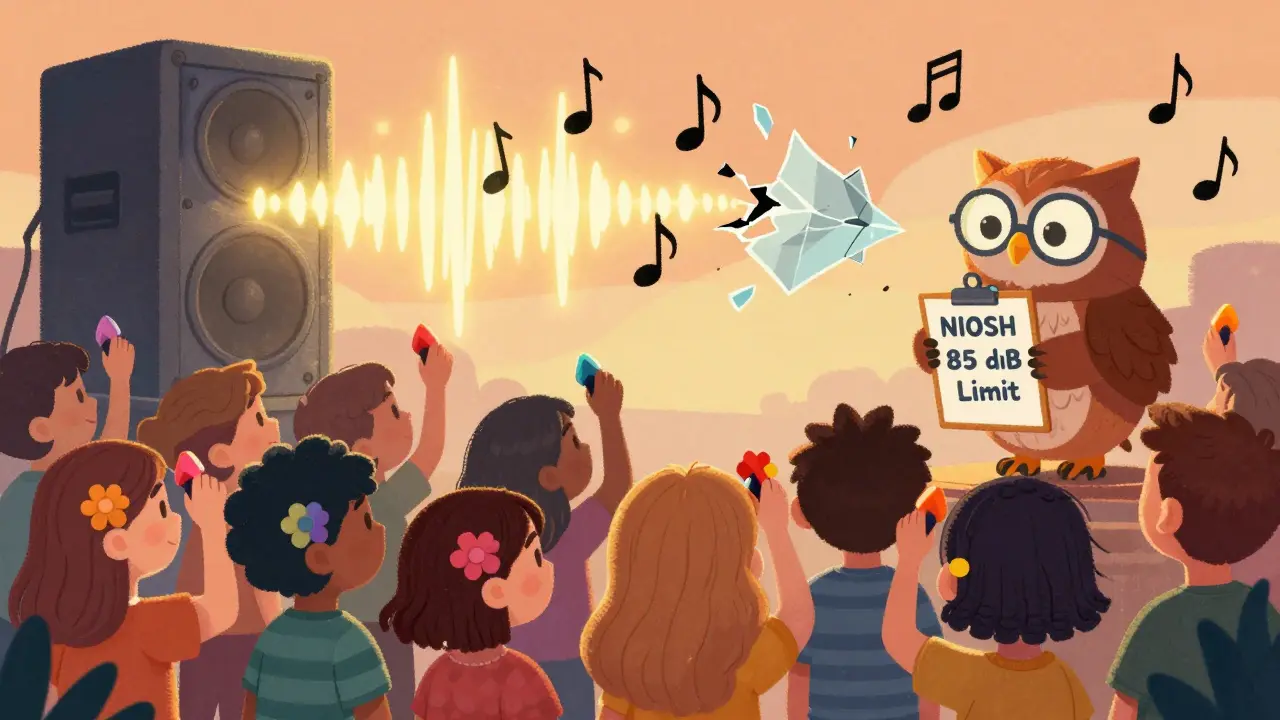
In the U.S., there’s a big gap between what the law says and what experts say is safe. The Occupational Safety and Health Administration (OSHA) sets the legal limit at 90 dBA over an 8-hour shift. That’s the maximum noise level employers can legally allow without taking action. But here’s the catch: NIOSH, the federal agency that actually studies health risks, says 85 dBA is the real danger line. That 5-decibel difference isn’t small-it’s a 50% increase in noise energy.
Think of it like this: if you’re exposed to 85 dBA for 8 hours, your ears are absorbing a certain amount of damage. At 90 dBA, under OSHA’s rules, you can still work 8 hours. But under NIOSH’s science-based standard, that same 90 dBA noise should only last 4 hours. At 95 dBA? Just 2 hours. And at 100 dBA? Only 15 minutes. That’s because NIOSH uses a 3-decibel exchange rate: every 3 dB increase cuts your safe exposure time in half. OSHA uses a 5-dB rate, which gives workers way more time at dangerous levels.
Australia follows NIOSH’s lead. Safe Work Australia sets the exposure standard at 85 dBA over 8 hours, with a peak limit of 140 dB(C). The European Union is even stricter-87 dBA is the absolute maximum, even with hearing protection. And in places like California, employers are already required to follow the 85 dBA, 3-dB rule. The trend is clear: the science is winning.
How Noise Adds Up: The Math Behind the Damage
Decibels don’t add up like regular numbers. They’re logarithmic. That means 90 dBA isn’t just a little louder than 85 dBA-it’s more than twice as intense. If you work 4 hours at 85 dBA and 4 hours at 90 dBA, your total exposure isn’t just 85 dBA. It’s equivalent to 8 hours at 88 dBA. That’s over the NIOSH limit.
The formula used by NIOSH to calculate safe exposure time is simple: T = 8 / 2^((L-85)/3), where T is hours and L is the noise level in dBA. Plug in 100 dBA, and you get 15 minutes. Plug in 110 dBA, and it’s under 4 minutes. That’s why factory workers near punch presses, airport ground crews, and even baristas near espresso machines need to track their exposure.
Even short bursts matter. Impact noises like gunshots or hammer strikes can hit 140 dBA in milliseconds. OSHA says 140 dBA is the peak limit for impulsive noise. The EU says 137 dBA. Either way, you need protection-not just for long shifts, but for sudden, loud events.
What Employers Must Do (And What They Often Skip)
Under OSHA rules, if noise hits 85 dBA over 8 hours, employers must start a hearing conservation program. That includes: free hearing tests, training, and giving out earplugs or earmuffs. But here’s the problem: many companies just hand out foam plugs and call it done.
Real protection follows a hierarchy. First, eliminate the noise source-use quieter tools. Second, engineer controls-install sound barriers, enclose noisy machines, or add vibration dampeners. Third, reduce exposure time-rotate workers so no one spends all day near the loudest equipment. Only after those steps should you rely on personal protective equipment (PPE).
NIOSH studies show that when workers get hands-on training-actually practicing how to fit earplugs correctly-usage jumps from 40% to 85%. Most people wear them wrong. Foam plugs need to be rolled thin, inserted deep, and held for 20 seconds to expand. Earmuffs need a tight seal around the ear. If there’s a gap, you lose up to 75% of the protection.
And don’t forget audiometric testing. Baseline hearing tests must happen within 6 months of starting a noisy job. Annual tests track changes. A shift of 10 dB or more at 2000, 3000, or 4000 Hz is a red flag. It means damage is happening. Too many employers skip follow-ups. That’s how hearing loss goes unnoticed until it’s too late.
Concerts, Clubs, and Headphones: The Hidden Risks
Music venues aren’t regulated like factories. But that doesn’t mean your ears are safe. A typical rock concert hits 110-120 dBA. A DJ set in a club? Often 105-115 dBA. Even classical concerts can hit 90-95 dBA. That’s enough to cause temporary hearing loss after one night-and over time, permanent damage.
Research shows that half of concertgoers experience temporary threshold shifts after a show. That ringing in your ears? That’s your hair cells screaming. If it happens often, the damage sticks.
Some venues are changing. Lifehouse Festival gives out free earplugs-75% of attendees take them. Other festivals have “quiet zones” with ambient noise under 75 dBA, so people can rest their ears. Real-time sound level displays are popping up too, showing crowds exactly how loud it is. The World Health Organization recommends limiting personal audio device use to 40 hours a week at 80 dBA. Apple Music and Spotify now warn you when your volume hits 85 dBA equivalent. That’s progress.
Professional musicians are hit hardest. A 2022 survey found 63% report some hearing loss. Orchestral musicians average 89-94 dBA during performances. Many wear custom-molded earplugs that reduce volume evenly across frequencies-so they can still hear the music clearly, just safely.
What You Can Do Right Now
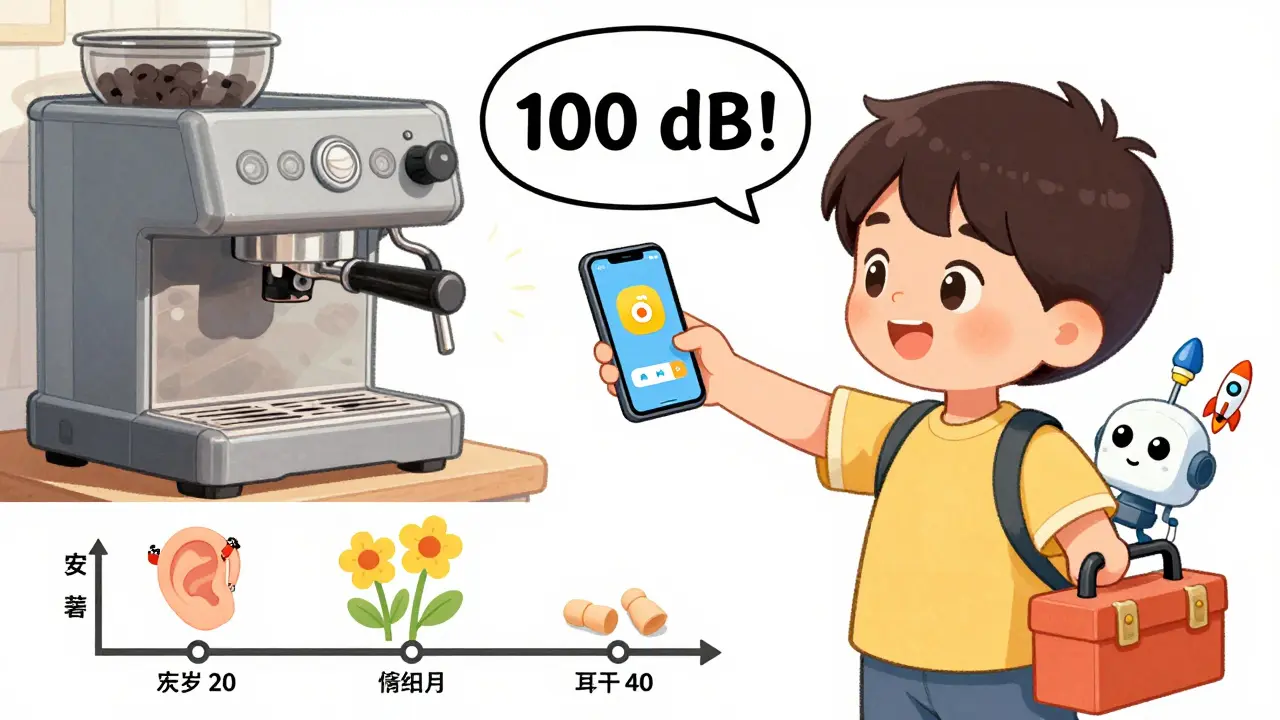
- Know your noise levels. Use a free smartphone app (like NIOSH’s SLM or Decibel X). They’re 92% accurate compared to professional meters.
- Wear protection. Keep reusable earplugs in your bag-ones with a high NRR (Noise Reduction Rating). For concerts, look for musician-grade filters (15-20 dB reduction).
- Take breaks. Every hour at a loud event, step into a quieter area for 5-10 minutes. Let your ears recover.
- Lower your headphones. If someone next to you can hear your music, it’s too loud. Set a max volume limit on your phone.
- Get tested. If you work in a noisy job or go to concerts often, get a baseline hearing test. Do it every 2 years.
There’s no cure for noise-induced hearing loss. But every time you protect your ears, you’re buying yourself years of clear hearing. It’s not about being paranoid-it’s about being smart.
What’s Coming Next
The European Commission is pushing to extend workplace noise rules to concert venues and nightclubs where staff are exposed to over 80 dBA. That means venues may soon be required to monitor sound levels, limit peak volumes, and provide hearing protection. In the U.S., OSHA’s 2023-2024 enforcement priorities now include music venues after a 40% spike in hearing complaints from musicians between 2019 and 2022.
Meanwhile, the “Buy Quiet” initiative is gaining steam. More companies are choosing tools and machinery with lower noise ratings. NIOSH now lists safe decibel limits for 150 common tools-from leaf blowers to saws. It’s not just about compliance anymore. It’s about creating quieter workplaces, safer concerts, and a future where hearing loss isn’t just common-it’s rare.
By 2040, if we adopt 85 dBA standards everywhere, we could prevent 240,000 cases of hearing loss every year in the U.S. alone. That’s not a distant dream. It’s a choice we make every day-when we reach for earplugs, when we turn down the volume, when we speak up about noise.
Is 85 decibels really that loud?
Yes. 85 dBA is about the noise level of heavy city traffic or a lawnmower. It’s not a scream, but it’s loud enough to damage your hearing after 8 hours of continuous exposure. For every 3 dB increase, the safe time cuts in half. At 88 dBA, you’re safe for only 4 hours. At 91 dBA, just 2 hours.
Do earplugs make music sound muffled?
Not if you use the right kind. Standard foam earplugs reduce all frequencies unevenly, making music sound dull. Musician-grade earplugs use filters that lower volume evenly across all frequencies. You still hear the bass, vocals, and drums clearly-just at a safer level. Many concertgoers and musicians swear by them.
Can I rely on my phone to measure noise?
Yes, if you use a trusted app like NIOSH’s Sound Level Meter or Decibel X. These apps are calibrated and have been tested against professional equipment. They’re 92% accurate. They won’t replace lab tools, but they’re perfect for checking if your workplace or concert is dangerously loud.
Why do some workplaces allow 90 dBA if 85 is safer?
Because OSHA’s 90 dBA limit is a legal standard, not a health recommendation. It was set decades ago based on economic and technical feasibility, not science. NIOSH’s 85 dBA limit is based on decades of research showing hearing loss starts at that level. Many states and countries are moving toward the safer standard, but federal law hasn’t caught up yet.
Is hearing loss from noise reversible?
No. Once the hair cells in your inner ear are damaged by loud noise, they don’t regenerate. Temporary ringing or muffled hearing after a concert is a warning sign-it means damage has already occurred. Repeated exposure leads to permanent hearing loss. Protection is the only defense.
How often should I get my hearing tested?
If you’re regularly exposed to noise above 80 dBA-whether at work, concerts, or through headphones-you should get a baseline test by age 25. After that, get tested every 2 years. If you work in a high-risk job (construction, manufacturing, music), annual tests are recommended. Early detection means you can take action before the damage gets worse.
Next Steps: Protect Your Hearing Before It’s Too Late
If you’re in a noisy job, ask your employer if they follow NIOSH guidelines-not just OSHA’s minimum. If you go to concerts, carry earplugs. If you use headphones, set a volume limit. Don’t wait for ringing in your ears to be your wake-up call. Hearing loss creeps in slowly. By the time you notice, it’s too late. But if you act now, you can keep your hearing sharp for decades to come.


14 Comments
Chris & Kara Cutler
I just bought these musician earplugs after reading this and wow. Went to a concert last night and actually enjoyed the music without my ears ringing for hours. 🎧💖
Rachel Liew
i never thought about how loud my headphones are... i think i need to check my volume. my ears feel weird after subway rides. 🙏
Melissa Melville
So let me get this straight... we have laws that let factories blast workers with noise that would get you arrested at a rave? 🤡 Welcome to America, where profit > your eardrums.
Bryan Coleman
used to work in a factory. they gave us foam plugs but never trained us. i wore them wrong for 3 years. my hearing is shot now. learn how to fit them right.
franklin hillary
Hearing is the last sense we notice we’ve lost. By the time you realize your wife’s voice sounds muffled, it’s too late. Protect it like your eyes. It’s not optional. It’s survival.
Ishmael brown
I mean... what if I like loud music? 🤷♂️ My ears are my business. If I wanna go deaf at 30, that’s my vibe. #Freedom
June Richards
This post is so basic. Everyone knows this. Why are we still talking about earplugs like they’re magic? And why is no one talking about the fact that most people can’t even afford proper hearing protection?
Lu Gao
Actually, the WHO recommends 75 dBA for personal audio devices, not 80. And 40 hours a week is way too high. You’re supposed to limit it to 1 hour a day at 80. This article is misleading.
vivian papadatu
I work in a call center with constant AC hum and keyboard clatter. It’s not loud, but it’s constant. I started using noise-canceling headphones with white noise at 45 dBA and my brain finally stops screaming. Thank you for reminding us that noise isn’t always a boom-it’s a grind.
Deep Rank
You know what’s worse than noise? People who think they’re being ‘responsible’ by using earplugs while still blasting their Spotify at 90% and going to raves every weekend. You can’t protect yourself with one earplug and destroy yourself with the other. It’s not a badge of honor, it’s a tragedy in slow motion. And don’t even get me started on people who think ‘I’m young, I’ll be fine.’ You’re not fine. You’re already damaged.
Naresh L
It’s funny how we regulate car emissions but not sound emissions. We care more about the planet’s lungs than our own. Maybe if hearing loss was visible, like lung cancer from smoking, we’d take it seriously.
Sami Sahil
bro i started using those music earplugs at gigs and now my friends say i’m the only one who can actually talk to them after the show 😎 no more screaming into ears. game changer.
Aditya Gupta
My dad’s a welder. He’s 62 and can’t hear his grandkids unless they yell. He says he didn’t know it was a problem until it was too late. Don’t be him.
Nancy Nino
It is truly remarkable how society continues to normalize auditory degradation as an inevitable consequence of modern life. One must, with the utmost gravitas, advocate for the preservation of sensory integrity as a fundamental human right.