
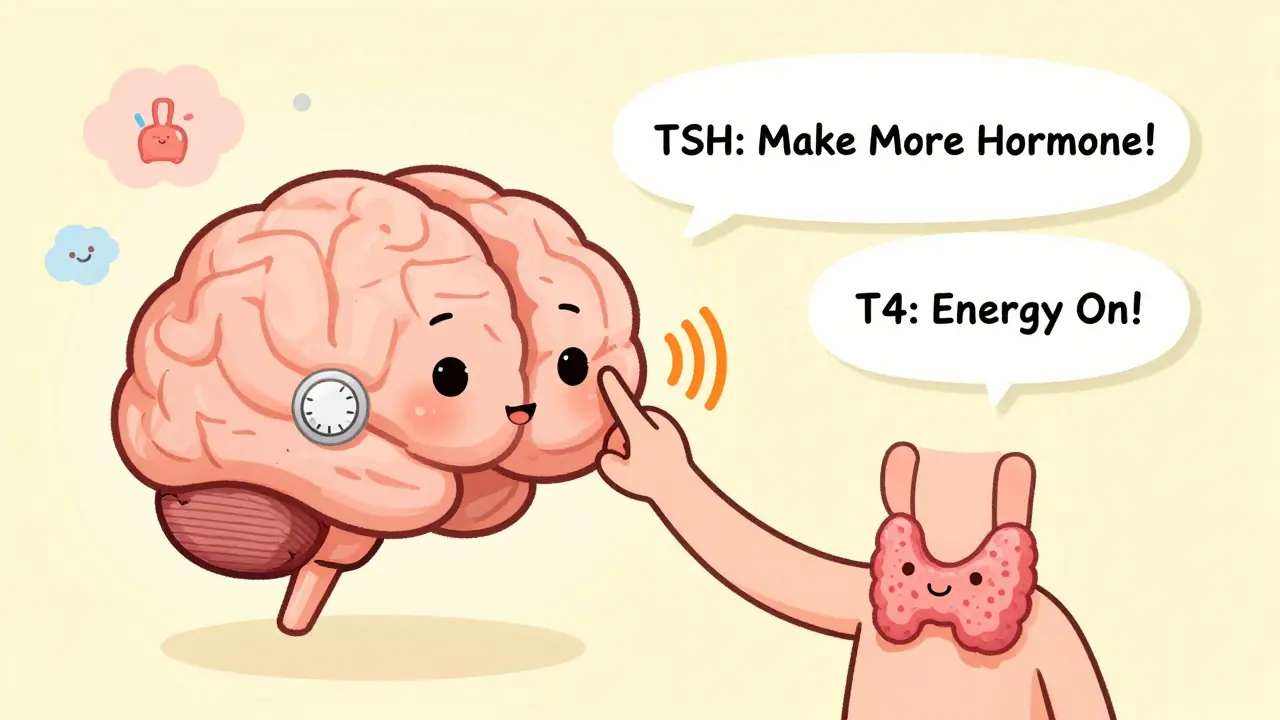
When your doctor orders a thyroid test, they're not just checking one number-they're reading a story. The story of how your brain talks to your thyroid, how your body uses energy, and whether something's gone quiet or too loud down there. At the heart of that story are two simple blood markers: TSH and T4. But what do they really mean? And why does one number sometimes look fine while you still feel exhausted, cold, or anxious? Let’s cut through the noise.
What TSH Really Tells You
TSH stands for thyroid-stimulating hormone. It’s not made by your thyroid at all. It’s made by your pituitary gland-right at the base of your brain-and it’s essentially a messenger. Think of it like a thermostat in your house. When the temperature drops, the thermostat turns the heater on. When it gets too warm, it turns it off. TSH works the same way. If your thyroid isn’t making enough hormone, your pituitary says, "Hey, make more!" and pumps out more TSH. If you’re making too much, it says, "Slow down," and TSH drops.
Normal TSH levels for most adults fall between 0.5 and 5.0 mIU/L. But here’s where things get messy. That range was set decades ago based on populations that included people with undiagnosed thyroid problems. Modern labs now use more precise tests, and experts agree the ideal range for most healthy adults is actually 0.5 to 2.5 mIU/L. Why? Because people with TSH levels above 2.5 often have early signs of thyroid trouble-even if their T4 looks normal.
And don’t forget pregnancy. During pregnancy, your body’s demand for thyroid hormone jumps. The American Thyroid Association recommends TSH stay below 2.5 mIU/L in the first trimester, and under 3.0 mIU/L in the second and third. If you’re pregnant and your TSH is 3.8, that’s not "normal." It’s a red flag.
Why T4 Alone Can Mislead You
T4, or thyroxine, is the main hormone your thyroid produces. But there are two kinds of T4 you might see on a lab report: total T4 and free T4. Total T4 measures all the T4 in your blood-bound to proteins and floating free. Free T4 measures only the unbound, active portion your cells can actually use. That’s the one that matters.
Here’s the problem: proteins that carry T4 can change. Pregnancy, birth control pills, liver disease, even severe illness can throw off total T4. A woman on estrogen therapy might have a total T4 of 14 μg/dL-way above normal-but her free T4 could be perfectly fine. If you only looked at total T4, you’d think she had hyperthyroidism. She doesn’t. That’s why nearly 90% of endocrinologists now rely on free T4 instead.
Free T4 normal range is 0.7 to 1.9 ng/dL. But even that’s not universal. Different labs use different machines. Roche’s test might say your free T4 is 1.2, while Siemens says 1.35. That 12% difference can make a doctor think you need more medication-or less-when you don’t. This is why so many patients get their dose changed twice in one year: not because their thyroid changed, but because the lab did.
How TSH and T4 Work Together
Here’s the golden rule: TSH is your first check. If it’s abnormal, you check free T4. If TSH is high and free T4 is low, you have primary hypothyroidism. If TSH is low and free T4 is high, you have hyperthyroidism. Simple.
But the real-world mess is in the gray zone. What if your TSH is 4.8 and your free T4 is 0.9? That’s borderline. You’re not in classic hypothyroidism, but you’re not fine either. This is subclinical hypothyroidism. Studies show about 4.3% of Americans have this. Some people feel fine. Others are tired, gaining weight, or struggling with brain fog. The decision to treat? It’s not just numbers. It’s symptoms. It’s age. It’s cholesterol. It’s whether you have thyroid antibodies.
And then there’s the reverse: low TSH with normal free T4. That’s subclinical hyperthyroidism. It’s common in older adults on levothyroxine. Long-term, it can raise your risk of atrial fibrillation and bone loss. So even if you feel fine, your doctor might still lower your dose.
What about central hypothyroidism? That’s rare-1 in 20,000 people. It happens when your pituitary stops making TSH. You’ll have low TSH and low free T4. It’s easy to miss because most doctors assume low TSH means overactive thyroid. But if your free T4 is also low? That’s your clue: something’s wrong upstream.
Dosing Levothyroxine: It’s Not One-Size-Fits-All
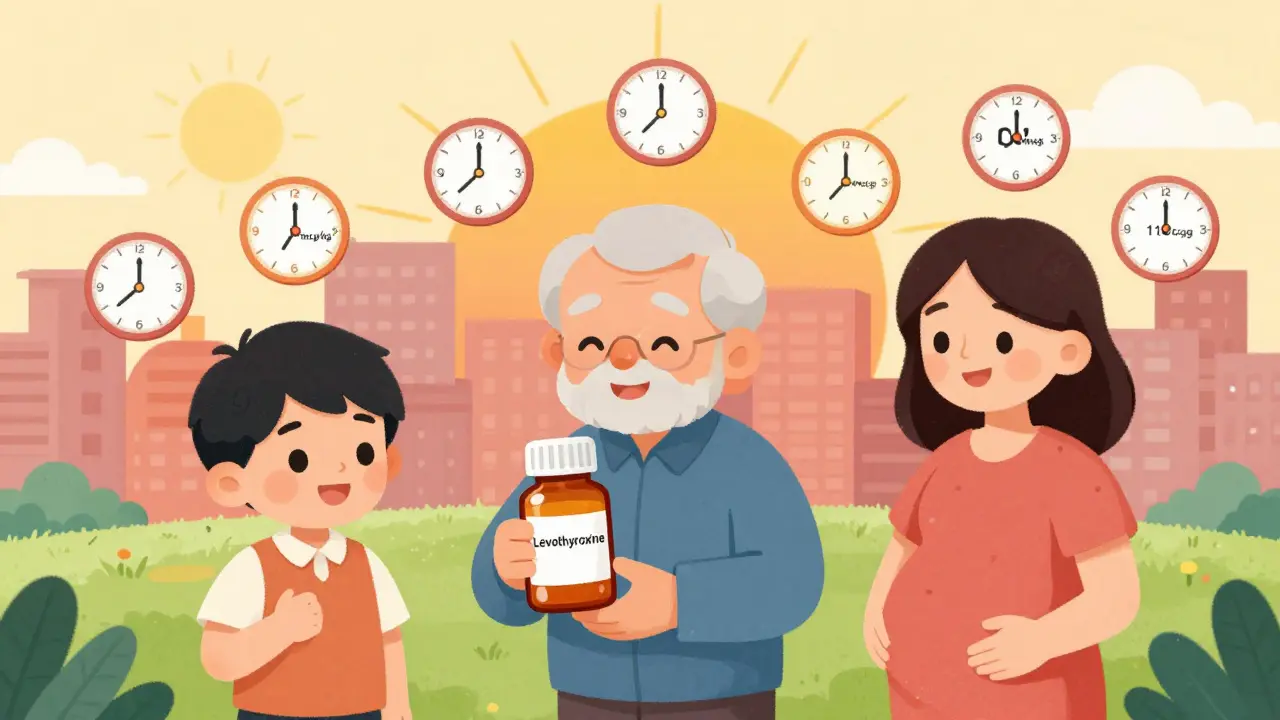
If you’re diagnosed with hypothyroidism, you’ll likely start on levothyroxine. The standard starting dose is 1.6 mcg per kilogram of body weight. For a 70 kg (154 lb) adult, that’s about 112 mcg per day. But here’s the catch: that’s just a starting point.
Older adults? Start lower. 25-50 mcg. Their metabolism slows. Their hearts are more sensitive. A full dose can trigger palpitations or even a heart attack. Pregnant women? They need more-up to 30-50% more than pre-pregnancy. Their bodies are working overtime to support the baby. And kids? Infants need 10-15 mcg/kg/day. That’s 10 times more than an elderly person. If you give a baby a 50 mcg tablet because "it’s the standard dose," you’re endangering them.
After you start, you don’t just wait. You get your TSH checked every 6 weeks. Why? Because it takes 4-6 weeks for your body to fully adjust to a new dose. Don’t rush. Don’t change doses based on how you feel that day. Symptoms lag behind blood levels. You might feel worse for two weeks after a dose increase, then suddenly feel amazing at week five. Patience is part of the treatment.
Once stable? Annual checks are usually enough. But if you’re pregnant, ill, or changing medications (like starting estrogen or iron supplements), you need to test again. Iron and calcium block levothyroxine absorption. If you take them together, your dose might as well be water.
Why So Many People Still Feel Sick
Here’s the ugly truth: 68% of patients surveyed say they waited over a year for a correct diagnosis. Why? Because their TSH was "normal"-but their free T4 was low. Or their doctor ignored symptoms because "the numbers look fine."
On Reddit’s r/Hypothyroidism, over 300 people posted cases where their TSH was 3.5-4.5 ("normal") but their free T4 was below 0.8. They had fatigue, hair loss, depression. Their doctors said, "No treatment needed." But when they switched doctors and pushed for free T4, they were diagnosed and started on medication. Within weeks, their energy came back.
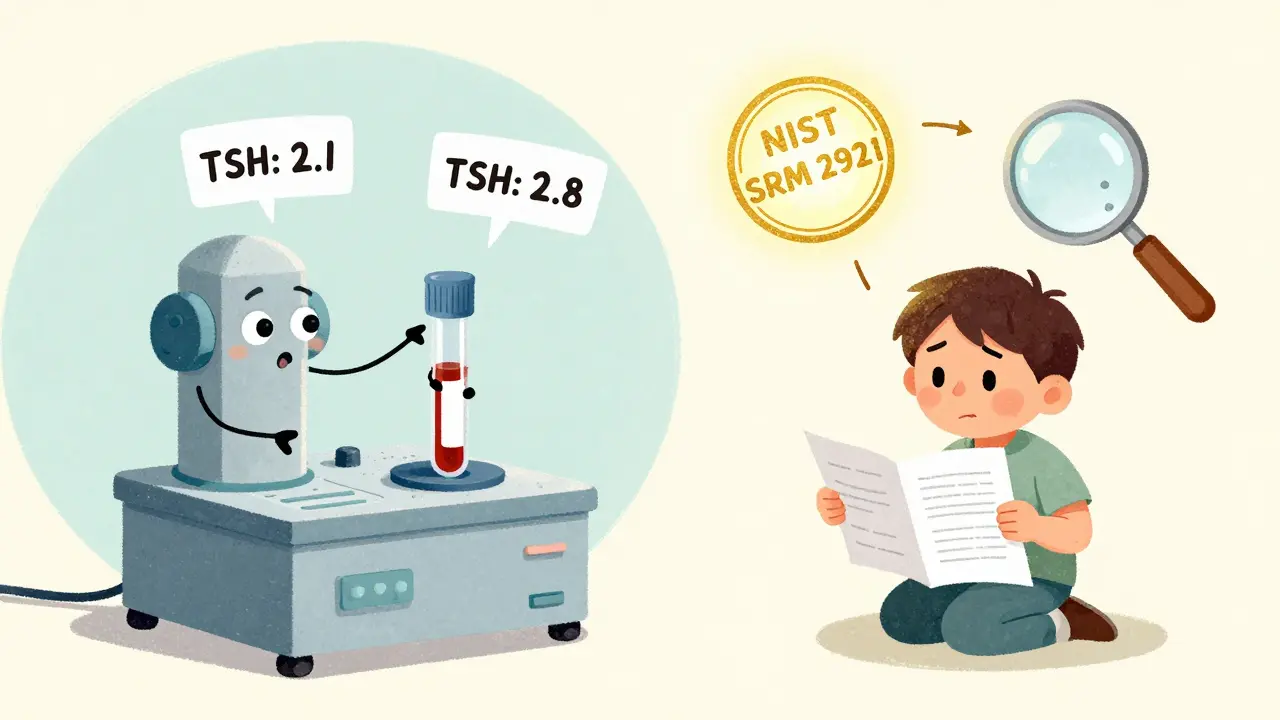
And then there’s the lab variation problem. One lab says your TSH is 2.1. Another says 2.8. You get your dose lowered. Then you move. Your new lab says your TSH is 3.9. You get your dose increased. You feel worse. You go back. The cycle repeats. That’s not your fault. That’s inconsistent reference ranges.
That’s why the FDA approved a new standard reference material in 2024. It’s called NIST SRM 2921. It’s designed to make all labs measure TSH the same way. By 2026, we should see lab variation drop from 15% to under 5%. That alone will cut down on unnecessary dose changes and misdiagnoses.
What’s Next? Beyond TSH and T4
Some patients still have symptoms even when TSH and free T4 are perfect. That’s where things get controversial. Some doctors test for reverse T3 or thyroid antibodies. But the science doesn’t support routine use. Reverse T3 can rise during stress or illness-but it’s not a cause of symptoms. Antibodies (like TPO) tell you if you have Hashimoto’s, but they don’t tell you how to dose your medication.
There’s new data though. A 2023 trial in The Lancet followed 1,200 patients on levothyroxine who still had symptoms. Half got their dose adjusted based on TSH and free T4. The other half also got their free T3 measured. The T3 group had 22% more improvement in energy and mood. It’s not a magic fix-but for a subset of people, free T3 might help.
AI is starting to help too. Mayo Clinic’s pilot program uses machine learning to combine TSH, free T4, age, BMI, and symptoms to predict who’s likely to benefit from a dose change. It cut misdiagnoses by 22%. That’s not science fiction. It’s happening now.
For now, stick with the basics: TSH first, free T4 when needed. Don’t ignore symptoms because a number looks "normal." Push for free T4 if you’re symptomatic. Get your labs done at the same lab if you can. And remember: your thyroid isn’t just a number. It’s your energy, your mood, your body’s rhythm. Treat it like it matters.
Can TSH be normal and still have hypothyroidism?
Yes. This is called subclinical hypothyroidism. TSH may be mildly elevated (4.5-10 mIU/L) while free T4 stays normal. Some people with this have symptoms like fatigue or weight gain. Treatment isn’t always needed, but if you’re symptomatic, pregnant, or have high cholesterol or thyroid antibodies, your doctor may still treat you.
Why do some labs show different TSH results?
Different labs use different machines and methods. A TSH of 3.0 on one machine might read as 3.5 on another. This variation can be up to 15%-enough to cause unnecessary dose changes. The FDA approved a new standard (NIST SRM 2921) in 2024 to reduce this gap to under 5% by 2026.
Should I get free T4 tested if my TSH is normal?
Usually not. But if you have clear symptoms of thyroid dysfunction-fatigue, cold intolerance, hair loss, depression-and your TSH is near the top of normal (e.g., 3.5-5.0), ask for free T4. Some people have low free T4 even with "normal" TSH. This is especially true in women, older adults, and those with autoimmune conditions.
How often should I get my thyroid levels checked after starting medication?
Every 6 weeks after starting or changing your levothyroxine dose. It takes 4-6 weeks for your body to fully adjust. Once stable, annual checks are usually sufficient. Pregnant women, elderly patients, and those with heart disease need more frequent monitoring.
Can I take my thyroid medication with food or supplements?
No. Calcium, iron, antacids, and even high-fiber foods can block absorption. Take levothyroxine on an empty stomach, 30-60 minutes before breakfast. Wait at least 4 hours before taking supplements like calcium or iron.
Is T3 testing useful for managing hypothyroidism?
Not routinely. Most people do fine with T4-only medication. But for the 15-20% who still have symptoms despite normal TSH and free T4, checking free T3 may help. A 2023 trial showed some patients improved when T3 was added. However, this is still experimental and not standard care.


14 Comments
Kenzie Goode
So I've been on levothyroxine for 8 years and honestly? The biggest game-changer was switching labs. My old one had TSH readings that were always 0.5 lower than the new one. I went from "perfect" to "needs adjustment" overnight. My doctor was like, "Hmm, weird." I was like, "I've been feeling like a zombie for months." Turns out my dose was too low. Now I get tested at the same lab every time. No more guessing games.
Also, never trust a "normal" TSH if you're still exhausted. I had a TSH of 3.8 and a free T4 of 0.8. They told me "it's fine." I cried in the parking lot. Then I found a functional doc who actually listened. Life changed.
Dominic Punch
Let me cut through the fluff: if your TSH is above 2.5 and you're symptomatic, treat it. Full stop. The "normal range" is a relic from the 80s when they included people with undiagnosed Hashimoto's in the data pool. That's not medicine-it's lazy statistics. I'm an endocrinologist in London and I've seen too many patients suffer because their GP clings to outdated guidelines.
Free T4 is non-negotiable. Total T4? Useless. I had a patient on birth control with a total T4 of 16. She was hypothyroid. Her doctor wanted to "watch and wait." She lost 15 lbs, quit her job, and now she's back at work because we checked free T4. Stop ignoring symptoms because numbers look "fine."
Khaya Street
Y'all are overcomplicating this. TSH is the gatekeeper. If it's high, check free T4. If both are off, treat. If TSH is high but free T4 is normal? Maybe treat, maybe don't. It's not rocket science. I'm a nurse in Cape Town and I've seen people die because they were told "your numbers are fine" while their heart was failing.
Also, stop taking thyroid meds with coffee. It's like pouring fuel on a fire and wondering why the engine doesn't start. Simple. Basic. Do it right.
Christina VanOsdol
OMG YES. I had a TSH of 4.2 and a free T4 of 0.7. My doctor said "it's within range" and sent me to a therapist. I cried in his office. I was 28, had no energy, hair falling out, and he said "maybe you're just stressed."
Then I found a Reddit thread. Changed docs. Got tested at a different lab. TSH was 5.1. Free T4 was 0.6. Started on 50mcg. Within 3 weeks? I could breathe. I could think. I could stand up without feeling like I'd run a marathon.
Also, I take my pill at 5am. No food. No coffee. No supplements. No excuses. I'm not a patient. I'm a warrior. And my thyroid? It's my co-pilot now. 💪甲状腺
Brooke Exley
You know what’s wild? The fact that we still treat thyroid disease like it’s a math problem instead of a living, breathing system. Your thyroid isn’t a thermostat-it’s a conductor. And if you’re feeling off, it’s trying to tell you something.
I used to be the "I’m fine, I don’t need meds" type. Then I got pregnant. My TSH was 3.9. "Normal." I felt like I was moving through molasses. My OB said, "We’ll monitor." I screamed. I demanded free T4. It was 0.7. We started treatment. My baby was born healthy. I didn’t cry for 3 months straight. I slept. I smiled.
If you’re tired, cold, or just… off? Don’t wait. Push. Advocate. You’re not being dramatic. You’re being smart.
Matthew Brooker
TSH first free T4 second if you're symptomatic. That's it. No need to overthink. I've been treating thyroid patients for 15 years. The people who get better are the ones who don't chase every lab under the sun. Stick to the basics. Take the pill right. Wait 6 weeks. Check again. Don't change doses based on how you feel on Tuesday. It's not magic. It's biology.
Emily Wolff
The fact that people still believe in "subclinical" anything is why medicine is broken. If your TSH is above 2.5 and you're not a 90-year-old with a pacemaker, you're not "subclinical"-you're undiagnosed. And if you're not treating it, you're practicing negligence disguised as caution.
Lou Suito
Lol. NIST SRM 2921? You think standardization will fix this? HA. I work in a lab. We still get TSH results that vary 20% between runs. And don't even get me started on "free T4"-some machines measure it in ng/dL, others in pmol/L. You think the doctor knows? Nah. They just copy-paste the numbers and say "all good."
Also, reverse T3? Totally useless. But if you want to spend $200 on a test that tells you nothing? Go ahead. I'll be here, laughing.
Jacob Carthy
I'm not here for your medical drama. If you're tired, go to the gym. If you're cold, wear a jacket. Thyroid meds are for people who can't handle reality. I got my numbers checked. They were fine. I don't need a lab report to tell me I'm not lazy. I just need to get up.
Dinesh Dawn
I'm from India and we don't have access to free T4 testing in most places. But I still felt awful. My doctor just gave me levothyroxine based on TSH alone. I took it. I felt better. Not perfect. Better. So maybe the system isn't perfect. But sometimes, you have to work with what you have. Just don't give up.
Vanessa Drummond
I HATE THIS. I spent 3 years being told "it's all in your head." My TSH was 4.1. Free T4 was 0.85. I had a thyroid ultrasound. I had antibodies. I had symptoms. I was told "you're young, you're fine." I lost my job. I lost my marriage. I lost my sense of self.
Then I found a doctor who listened. I got my dose right. I'm not fixed. But I'm alive. And if you're reading this and you're still being gaslit? Please. Keep pushing. You're not crazy. You're not dramatic. You're just sick. And you deserve better.
Michael FItzpatrick
Here's the truth nobody says: thyroid treatment isn't about the numbers. It's about the person. I had a patient who was 72, had a TSH of 5.2, free T4 of 1.1, and was still climbing stairs and gardening. No treatment. Another? 35, TSH 3.0, free T4 0.9, couldn't get out of bed. Started on 25mcg. She cried because she remembered what sunlight felt like.
Numbers are tools. Not rules. Your body tells the story. Listen to it. Not the chart.
Brandice Valentino
i took my thyroid med with my coffee and now i have anxiety and i think its because of the lab error?? idk im so confused my tsh went from 2.1 to 3.9 and i feel like crap and my doctor just said "maybe you need more" but i dont even know what to do anymore 😭
Larry Zerpa
Let me break this down like you're a 5-year-old: TSH is a signal. Free T4 is the response. If the signal is weak and the response is weak, the thyroid is broken. If the signal is weak and the response is strong? The brain is broken. That's central hypothyroidism. Rare. But real.
And yes, you're right to be mad about lab variation. But here's the real issue: doctors don't know how to interpret this. They don't read the papers. They don't update their guidelines. They just follow the algorithm. That's why you're still sick.
Also, reverse T3? It's a red herring. T3 testing? Maybe. But only if you've exhausted everything else. And no, you can't just add T3 because you read a blog. That's how people end up in the ER.