

What is tirzepatide, and why is it different?
Tirzepatide is a once-weekly injectable medication that activates two hormone receptors at once-GLP-1 and GIP-making it the first FDA-approved dual incretin agonist for weight management. It’s sold under the brand name Zepbound for weight loss and Mounjaro for type 2 diabetes. Unlike older weight-loss drugs that only target one hormone pathway, tirzepatide hits two at the same time, which is why it works better.
Most weight-loss medications before it, like semaglutide (Wegovy), only activated the GLP-1 receptor. That helped reduce hunger and slow digestion. But tirzepatide adds a second lever: GIP. This second receptor boosts insulin release, improves fat breakdown, and increases energy use in muscle and fat tissue. The result? People lose more weight, and they keep it off longer while on treatment.
How much weight can you actually lose?
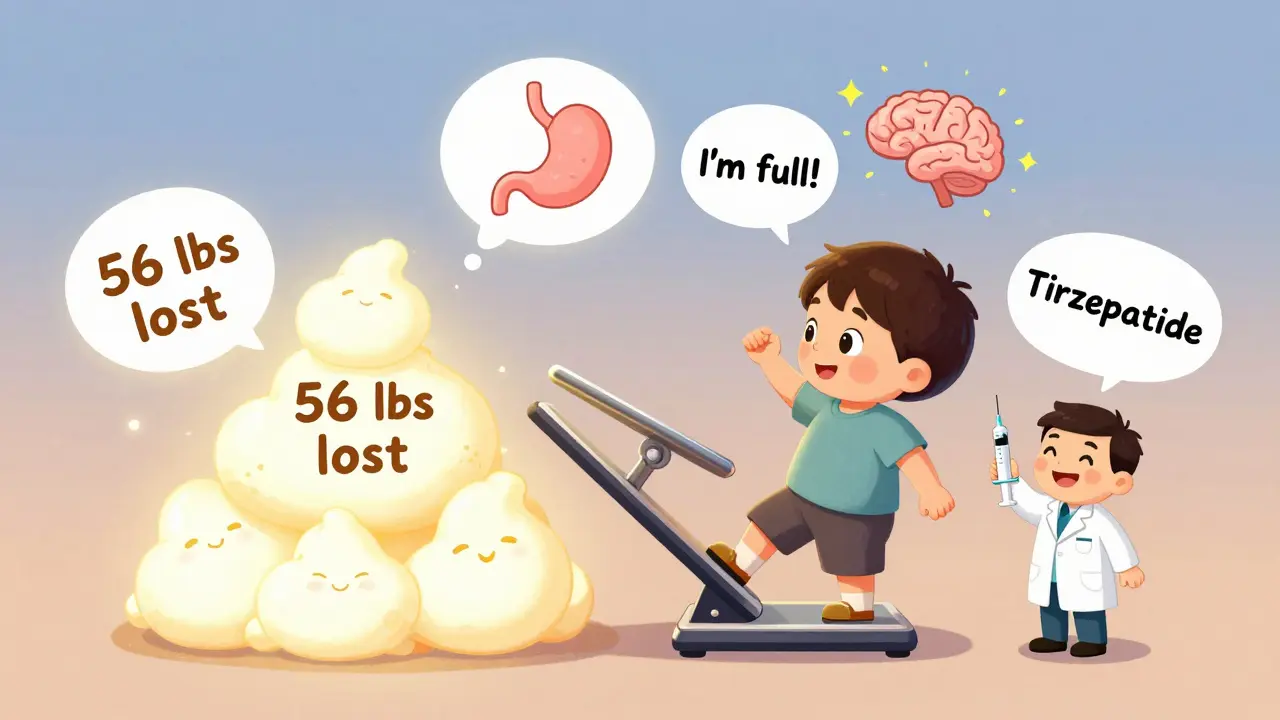
In clinical trials, people taking the highest dose of tirzepatide (15 mg weekly) lost an average of 22.5% of their body weight over 72 weeks. That’s not a small number. For someone weighing 250 pounds, that’s over 56 pounds gone. Compare that to semaglutide, which led to about 14.9% weight loss in the same timeframe. Tirzepatide outperformed it by more than 50%.
Real-world results match these numbers. On Reddit’s r/Mounjaro community, users report losing 40 to 60 pounds within six months. One user, u/HealthyJourney89, shared: “At 6 months on 15mg Zepbound, I’ve lost 58 lbs with minimal hunger-the difference from Wegovy was night and day.”
But here’s the catch: this isn’t magic. The weight loss happens because tirzepatide works in multiple ways:
- It tells your brain you’re full, even if you haven’t eaten much
- It slows down how fast your stomach empties, so food stays in longer
- It helps your body burn fat instead of storing it
- It improves how your muscles and fat cells respond to insulin
Why does dual action matter more than single?
Doctors used to think GLP-1 was the only important hormone for weight loss. But research from Duke University in 2023 showed that activating both GLP-1 and GIP together creates a synergy-something neither drug can do alone.
Here’s how it breaks down:
- GLP-1 reduces appetite, lowers blood sugar, and slows digestion
- GIP helps your body use glucose more efficiently and increases fat burning in adipose tissue
When you combine them, you get more than the sum of their parts. GIP doesn’t just help GLP-1-it makes GLP-1 work better. In lab studies, tirzepatide caused fat cells to release more adiponectin, a hormone that improves insulin sensitivity and reduces inflammation. That’s something semaglutide doesn’t do as strongly.
That’s why people on tirzepatide lose more fat and keep more muscle compared to other drugs. It’s not just about eating less-it’s about changing how your body stores and uses energy.
What are the side effects?
There’s no free lunch. The most common side effects are stomach-related: nausea (20-25%), vomiting (7-10%), and diarrhea (15-18%). These aren’t rare. In fact, 32% of people who started tirzepatide stopped taking it because of them.
But here’s the key: side effects are usually worst at the start. That’s why the FDA-approved dosing schedule takes 20 weeks to reach the full dose:
- Start at 2.5 mg once a week for 4 weeks
- Move to 5 mg for another 4 weeks
- Then 10 mg for 4 weeks
- Finally, 15 mg for maintenance
People who rush this process report worse nausea. Those who stick to the schedule say the side effects fade after a few weeks. Many users on Reddit say the nausea peaks around week 6 and then drops off.
Other tips to manage side effects:
- Eat smaller, low-fat meals
- Avoid fried or spicy foods
- Inject at night to sleep through nausea
- Use ginger tea or over-the-counter anti-nausea meds (like dimenhydrinate) during ramp-up
Who shouldn’t take it?
Tirzepatide isn’t for everyone. You should avoid it if you have:
- A personal or family history of medullary thyroid cancer
- Multiple Endocrine Neoplasia syndrome type 2 (MEN 2)
- A history of severe pancreatitis
These risks come from animal studies showing thyroid tumors in rats. No human cases have been confirmed yet, but the FDA requires a risk evaluation program (REMS) to monitor this.
Also, if you’re pregnant, planning to get pregnant, or breastfeeding, talk to your doctor. There’s not enough data yet to say it’s safe.
How much does it cost?
The list price is around $1,023 for a 4-week supply. That sounds high. But most people pay way less.
Here’s the real picture:
- 89% of commercially insured patients pay under $100 per month
- Manufacturer co-pay programs can reduce costs to $25-$75 monthly
- Medicare Part D often covers it for people with obesity and related conditions
Some patients still struggle with coverage. Insurance companies sometimes require proof of failed diet attempts or a BMI over 30 with a weight-related condition (like high blood pressure or sleep apnea). But the tide is turning-since Zepbound’s approval in late 2023, more insurers are covering it.

What happens when you stop?
This is the biggest concern: weight regain. Tirzepatide doesn’t cure obesity-it manages it. When people stop taking it, they start gaining weight back.
Studies show that within 6 months of stopping, people regain about 12-15% of the weight they lost. That’s not all of it, but it’s enough to be discouraging. Dr. John Morton from Yale put it plainly: “Like all obesity medications, benefits are maintained only while actively taking the drug.”
That’s why many experts recommend combining tirzepatide with lifestyle changes: regular movement, protein-rich meals, and sleep hygiene. The drug gives you a powerful tool-but you still need to use it.
What’s next for tirzepatide?
The FDA just approved Zepbound for obstructive sleep apnea in adults with obesity-the first time a weight-loss drug got approval for this specific use. That’s huge. Sleep apnea improves even before major weight loss, suggesting tirzepatide has direct effects on breathing and airway function.
Lilly is already testing a triple agonist called retatrutide, which adds a third hormone-glucagon-to the mix. Early results show 24.2% weight loss in just 24 weeks. That’s even more than tirzepatide.
And the market is exploding. Tirzepatide made $4.1 billion in sales in 2024 and is expected to hit $12.5 billion by 2029. It’s not just a drug-it’s a new category of treatment.
Final thoughts: Is it worth it?
If you’ve tried dieting, exercise, and other weight-loss meds without lasting results, tirzepatide offers something new: real, significant, and scientifically proven weight loss. It’s not easy. The side effects are real. The cost can be a hurdle. And you’ll need to stay on it long-term to keep the results.
But for many, it’s the first time they’ve seen their body respond like this. It’s not a quick fix. It’s a long-term tool. And if you’re ready to treat obesity as a medical condition-not a moral failure-tirzepatide might be the most effective option you’ve ever had.


14 Comments
Shelby Price
I've been on 10mg for 3 months. Nausea was brutal at first, but sleeping through the injection and eating bland meals made it bearable. Lost 32 lbs. Still hungry sometimes, but not obsessed with food like before.
Honestly? It's not a cure, but it's the first thing that made me feel like my body wasn't fighting me.
pradnya paramita
The GIP agonism is the real differentiator. GLP-1 alone induces satiety via vagal afferents and hypothalamic POMC activation, but GIP enhances adipose tissue lipolysis and skeletal muscle glucose uptake via PI3K-Akt signaling. The synergy isn't just additive-it's pharmacokinetic amplification. Most clinicians still don't get this.
Susheel Sharma
They’re selling this like it’s a miracle, but let’s be real-this is just Big Pharma’s new opioid. You get hooked, you pay $1k/month, and when you stop? You gain it all back plus interest. They don’t want you cured. They want you addicted.
Keith Harris
Oh wow, so now we’re treating obesity like it’s a broken faucet you just turn off with a magic spray? Meanwhile, people who actually move and eat real food are called ‘lazy.’ This drug isn’t progress-it’s a cop-out for people who refuse to change.
Jhoantan Moreira
I get where you're coming from 😅 but honestly? I tried everything-keto, intermittent fasting, Weight Watchers, even those weird appetite suppressants from the 90s. Nothing stuck. Tirzepatide didn’t make me lazy-it gave me the mental space to actually start working out. I’m not ‘cured’... but I’m finally trying. 🙏
Daz Leonheart
I started at 2.5mg and went slow. Took me 5 months to get to 15mg. Nausea was rough but manageable. Lost 47 lbs. My knees don't hurt anymore. My blood pressure is normal. I'm not saying it's perfect, but it gave me my life back. Don't knock it till you've tried it.
Mandy Vodak-Marotta
Okay so I’ve been on this for 6 months and I swear I didn’t think I’d be the type to cry over a weight loss drug but like… I cried when I stepped on the scale and saw 58 pounds gone. I didn’t even realize how much my clothes were weighing me down emotionally until they just… stopped fitting. And yeah, I still get nausea sometimes but it’s like the price of freedom. I don’t even miss junk food anymore. It’s wild.
caroline hernandez
The real win here is adiponectin upregulation. Most GLP-1s barely touch it. Tirzepatide’s dual agonism increases adiponectin secretion from adipocytes by 30-40% in vivo, which directly reduces systemic inflammation and improves insulin sensitivity in muscle tissue. That’s why lean mass retention is better than with semaglutide.
Caleb Sutton
They’re hiding the thyroid cancer risk. Rats got tumors. Humans? Maybe. But the FDA won’t tell you. They’re just rushing this to market because Lilly’s stock is sky-high. You think they care if you live or die? They care about quarterly earnings.
Jamillah Rodriguez
I just took one shot and my stomach felt like it was holding a brick for 3 days. I didn’t lose anything. I just lost my will to live. And now I’m $1000 poorer. Not worth it. 🤢
Prajwal Manjunath Shanthappa
Let’s be brutally honest-this isn’t medicine. It’s a luxury for the privileged who can afford $1,000/month and have the cognitive bandwidth to follow a 20-week titration schedule. Meanwhile, low-income folks are still being told to ‘eat less and move more’ while their insulin resistance spirals. This isn’t progress-it’s a classist placebo with a fancy name.
Alec Stewart Stewart
I’m not gonna lie-I was scared to start. But my doctor said it’s not about willpower, it’s about biology. I’m 5 months in, lost 41 lbs, and I actually have energy now. I didn’t think I’d ever feel this good again. It’s not magic. But it’s helping me do the work. And that’s enough.
Alex LaVey
I’m from a small town in Mississippi. Most people here don’t even know what GLP-1 is. But my cousin started this and now he’s hiking with his grandkids. That’s the real win. Doesn’t matter if it’s fancy science-if it gives someone their life back, it matters.
Samuel Bradway
I’ve been on it 8 months. Side effects faded after week 8. Lost 52 lbs. My sleep apnea improved before I even lost half the weight. My doctor said it’s probably reducing neck fat and inflammation. Honestly? I didn’t think I’d ever sleep through the night again. This thing saved my life.