
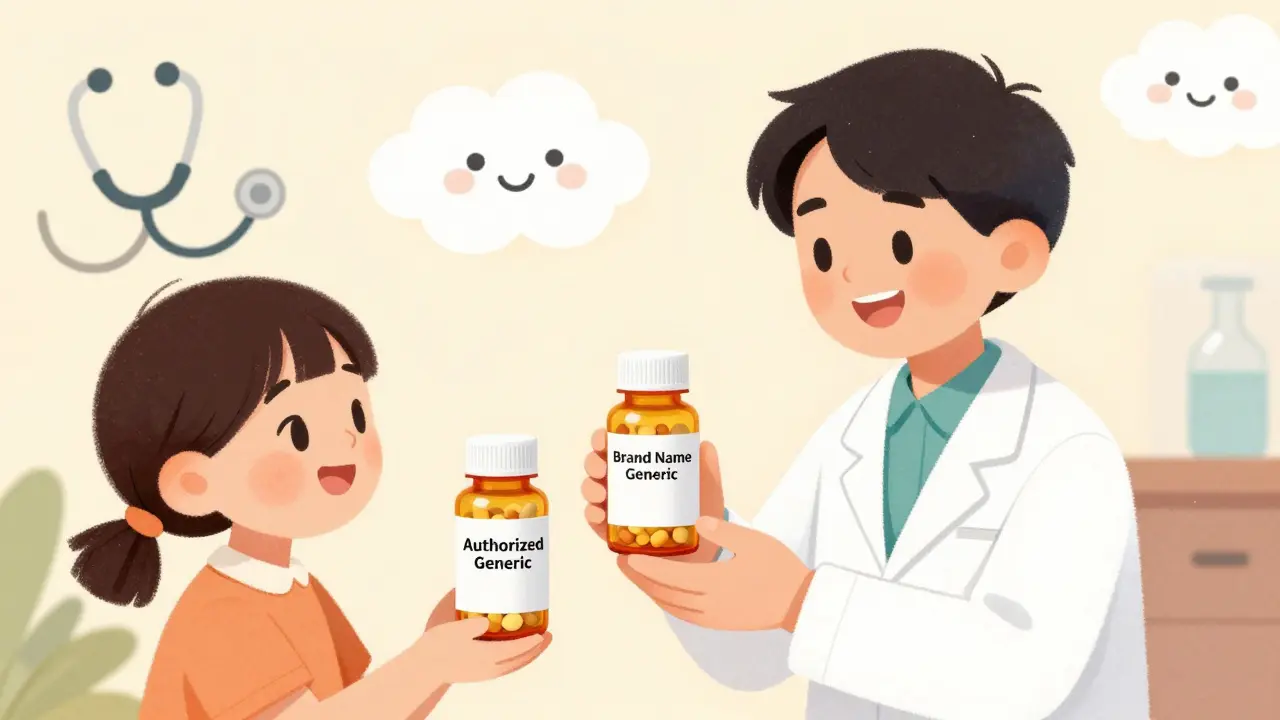
When your doctor switches your prescription from a brand-name drug to a generic, you might expect the same effect - but sometimes, you don’t get it. You feel different. Your symptoms creep back. Or worse, you get side effects you never had before. That’s not always because the generic is weak or fake. It’s often because authorized generics exist - and most people don’t know they’re an option.
Authorized generics aren’t just another kind of generic. They’re the exact same drug as the brand-name version, made by the same company, in the same factory, with the same ingredients down to the last milligram. The only difference? No brand name on the bottle. That’s it. And for patients managing chronic conditions, especially those with narrow therapeutic windows like warfarin, levothyroxine, or seizure medications, that small change can mean the difference between stability and crisis.
What Exactly Is an Authorized Generic?
Think of it this way: the brand-name drug company makes its pill, sells it under its own label, and then turns around and makes an identical version - but sells it under a generic label. That’s an authorized generic. It’s not a copycat. It’s the real thing, just packaged differently. The FDA allows this because it’s produced under the original New Drug Application (NDA), not a separate generic approval. No extra testing. No guesswork. Just the same active and inactive ingredients, same manufacturing process, same quality control.
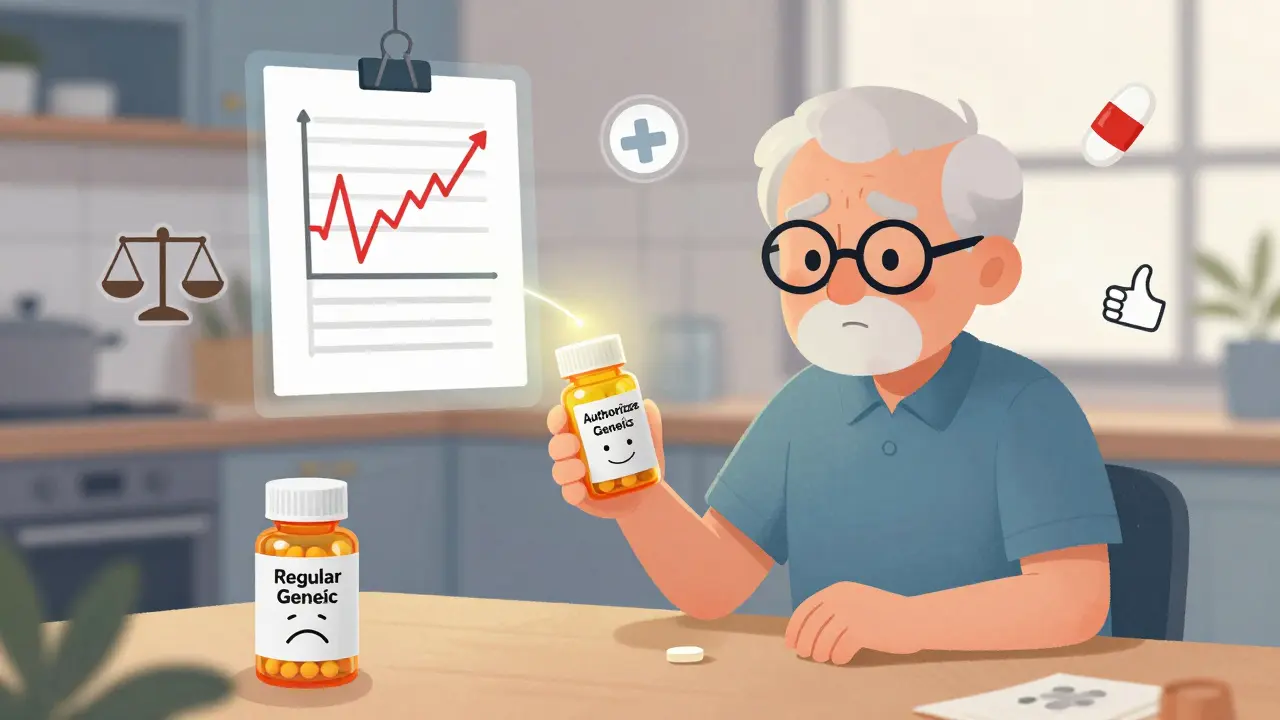
Regular generics? They’re approved under an Abbreviated New Drug Application (ANDA). They must prove they’re bioequivalent - meaning they deliver the same amount of drug into your bloodstream. But they can use different fillers, dyes, or coatings. And those differences? They matter. A 2023 GoodRx study found that 12.7% of patients switching to regular generics reported issues tied to inactive ingredients - things like lactose intolerance, dye allergies, or reactions to preservatives. With authorized generics, that number drops to 2.3%.
Why Authorized Generics Reduce Switchbacks
Switchbacks happen when patients stop taking their new generic because they feel it’s not working. It’s not just about perception. It’s about physiology.
A 2021 study in the Journal of Clinical Pharmacy and Therapeutics tracked 1,200 patients switching from brand-name medications to generics. Those on regular generics had an 18.4% switchback rate. Those on authorized generics? Only 7.2%. That’s more than a 60% reduction.
Why? Because patients didn’t notice a change. Their blood pressure stayed steady. Their thyroid levels didn’t spike. Their asthma didn’t flare. When the pill looks, feels, and works the same, adherence stays high. For asthma patients, the Asthma and Allergy Foundation of America found a 42% lower discontinuation rate with authorized generics versus regular ones.
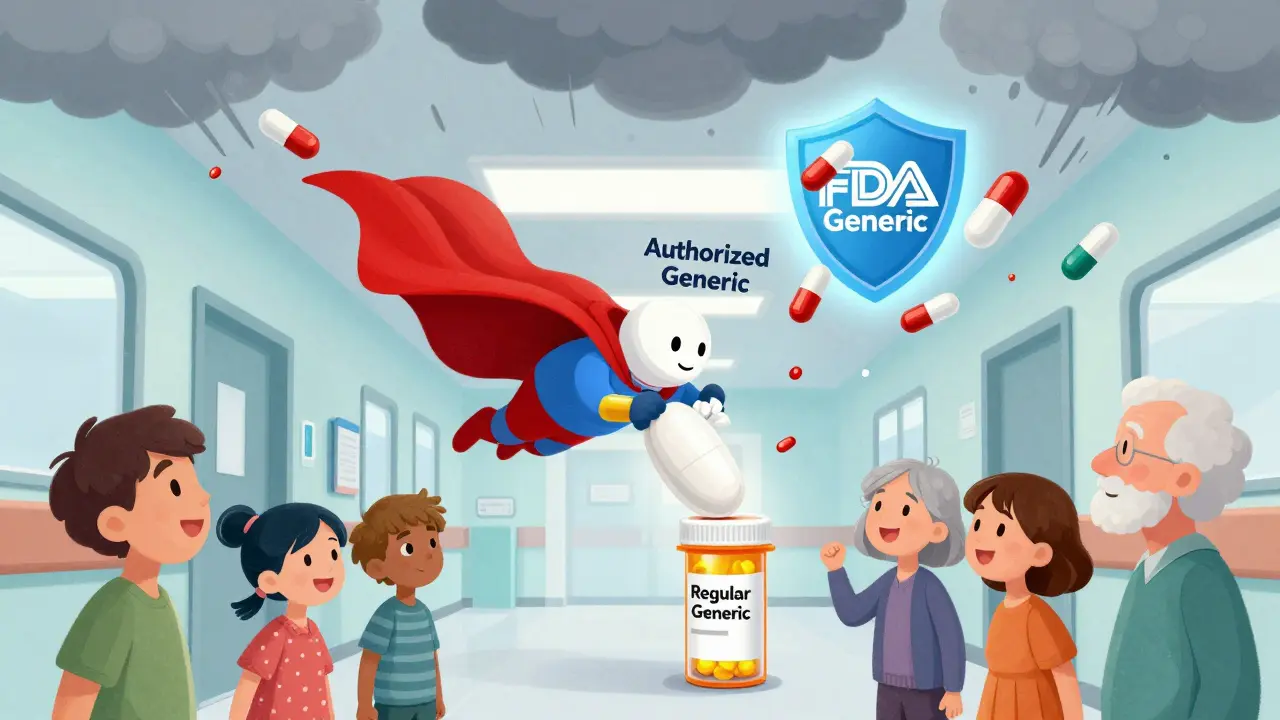
And it’s not just about feeling better. For drugs with a narrow therapeutic index - where the difference between a helpful dose and a toxic one is tiny - even small formulation changes can be dangerous. About 5.3% of all prescription drugs fall into this category. In these cases, authorized generics aren’t just a cost-saving option. They’re a safety net.
The Cost Advantage - But It’s Not Always Clear
Authorized generics cut prices. The Federal Trade Commission found they reduce retail drug prices by 4-8% and wholesale prices by 7-14%. That’s real money. A patient on a $300/month brand-name drug could save $15-$25 a month with an authorized generic.
But here’s the catch: insurance doesn’t always reflect that savings. A 2022 Health Affairs report showed that 28% of commercial insurance plans put authorized generics on tier 3 (specialty tier), while regular generics were on tier 2. That means higher copays - sometimes even higher than the brand-name drug.
One Reddit user shared: "My insurance covered the brand but not the authorized generic version, costing me $45 more monthly despite identical medication." That’s not a mistake. It’s a system flaw. Pharmacists can’t always explain it. Prescribers rarely know. Patients are left confused - and sometimes stuck paying more for the exact same drug.
Medicare Part D changed that in 2022. Now, plans must cover authorized generics at the same or lower cost-sharing as the brand. That’s a big win for over 1.2 million seniors. But outside Medicare? It’s still a gamble.
How to Navigate the Transition
Switching to an authorized generic isn’t automatic. You need to ask. Here’s how to do it right:
- Check availability. Use the FDA’s Drugs@FDA database or the new Authorized Generic Finder tool launched in 2023. Search by drug name and look for "Authorized Generic" listed under the brand.
- Call your pharmacy. Ask: "Is there an authorized generic for this drug? If so, what’s the cost compared to the brand and regular generic?"
- Verify insurance. Log into your plan’s portal or call customer service. Ask: "Is the authorized generic covered? What tier is it on? What’s my copay?" Don’t assume it’s cheaper.
- Talk to your doctor. If you’re on a narrow therapeutic index drug - like digoxin, cyclosporine, or levothyroxine - ask if an authorized generic is appropriate. Bring the FDA’s patient fact sheet on authorized generics. They’ll appreciate the prep.
- Monitor closely. Even with authorized generics, your body might react differently to the new packaging or pill shape. Keep track of symptoms for the first 30 days. Report anything unusual.
Doctors and pharmacists need 7-10 minutes to explain a regular generic switch. For authorized generics? Just 3-5. Why? Because you don’t need to explain bioequivalence. You just say: "This is the same pill. Just cheaper."
What’s Holding Back Wider Use?
Only 37.5% of brand-name drugs with generic alternatives have an authorized generic version. Why? Because manufacturers don’t always launch them. Sometimes, they wait until patent challenges start. Sometimes, they don’t want to compete with their own brand.
And then there’s the labeling mess. Most electronic health records (EHRs) can’t tell the difference between authorized and regular generics. Your chart might just say "levothyroxine" - no indication of which version you’re on. That’s dangerous during hospital transfers or ER visits.
The FDA is fixing this. By 2025, new labeling rules will require manufacturers to clearly mark authorized generics on packaging. Until then, patients need to be their own advocates.
Real Stories, Real Impact
One woman on warfarin switched from the brand to a regular generic and started bruising easily. Her INR levels fluctuated. She went back to the brand - and paid $220 a month. Her pharmacist found the authorized generic. Same pill. Same manufacturer. $38 a month. Her INR stabilized. No more bruises.
A man with epilepsy switched to a regular generic and had two seizures in two weeks. His neurologist had no idea which version he was on. When they switched him to the authorized generic, his seizures stopped. He now keeps the pill bottle as proof: "It’s the same. Just cheaper."
On GoodRx, 73% of patients rated their authorized generic transition as "excellent" compared to 58% for regular generics. The top reason? "I didn’t feel any different."
What’s Next?
The market is growing. Authorized generics hit $18.7 billion in sales in 2022. Analysts predict 8.2% annual growth through 2027. More value-based care programs are now tracking authorized generic use as a quality metric. The NIH’s TRANSITION study - tracking 5,000 patients across 12 drug classes - will release results in late 2024. It could be the largest real-world evidence ever collected on this topic.
But until then, the power is in your hands. If you’re switching to a generic, ask: "Is there an authorized version?" If your pharmacist says no, ask again. Check the FDA’s tool. Talk to your doctor. Don’t settle for "close enough." For some drugs, "close enough" isn’t safe.
Are authorized generics the same as brand-name drugs?
Yes. Authorized generics are manufactured by the same company that makes the brand-name drug, using the exact same active and inactive ingredients, in the same facility. The only difference is the label. They are not bioequivalent - they are identical.
Why are authorized generics cheaper than the brand?
They’re cheaper because they don’t carry the marketing, advertising, and patent protection costs of the brand-name version. The manufacturer sells them at a lower price to compete with other generics, but without changing the formula. The savings come from eliminating brand-name overhead, not cutting quality.
Can I trust an authorized generic if it looks different?
Yes. Even if the pill is a different color, shape, or has different markings, the active ingredient and its release profile are unchanged. These visual differences are only for identification purposes. The FDA requires that authorized generics maintain identical strength, dosage form, and route of administration.
Why does my insurance cover the brand but not the authorized generic?
Some insurance plans mistakenly treat authorized generics as higher-tier drugs because they’re less common. Others have contracts with brand-name manufacturers that discourage switching. Always check your plan’s formulary and ask for a tier override. Medicare Part D now requires equal or lower cost-sharing for authorized generics - but private insurers don’t always follow.
How do I find out if an authorized generic exists for my drug?
Go to the FDA’s Drugs@FDA website and search for your drug. Look under the "Authorized Generic" section. You can also ask your pharmacist to check the FDA’s Authorized Generic Finder tool, launched in 2023. It’s free, official, and updated in real time.
Are authorized generics available for all medications?
No. Only about 37.5% of brand-name drugs with generic versions also have an authorized generic. Availability depends on the manufacturer’s decision to launch one. High-cost, high-demand drugs like statins, blood thinners, and thyroid medications are more likely to have them. Newer or less profitable drugs often don’t.
Should I switch to an authorized generic if I’m stable on my brand-name drug?
If you’re stable and your insurance covers the brand at low cost, switching isn’t necessary. But if you’re paying high out-of-pocket costs, or if you’ve had side effects with regular generics, an authorized generic is a safe, cost-effective alternative. Talk to your pharmacist - they can compare prices and availability.
If you’re managing a chronic condition, don’t assume all generics are equal. Authorized generics exist to give you the same drug, at a lower price - without the risk. Ask for them. Demand clarity. Your health depends on it.

9 Comments
Gloria Ricky
OMG I JUST REALIZED I WAS ON A REGULAR GENERIC FOR MY LEVOTHYROXINE AND MY ANXIETY GOT WORSE. I THOUGHT IT WAS JUST STRESS BUT NOPE. SWITCHED TO THE AUTHORIZED ONE AND MY TSH IS BACK TO NORMAL. WHY DOESN’T ANYONE TELL YOU THIS???
Jason Pascoe
Interesting read. I’m an Aussie pharmacist and we see this all the time - patients convinced generics aren’t working, when really it’s the fillers. Authorized generics are a quiet hero. Not flashy, no marketing, just consistent. Shame they’re not more widely promoted.
Sonja Stoces
LOL this post is so naive. You think the FDA actually cares about your thyroid? Nah. They care about pharma profits. Authorized generics? More like ‘authorized profit-shifting’. The same company makes both - so they just slap a cheaper label on and call it a day. You’re still getting scammed, just in a fancier way.
Also, 73% rated it ‘excellent’? Probably the same 5 people who wrote all the reviews.
Annie Joyce
Y’all need to stop treating generics like they’re all the same. It’s like saying all sneakers are equal - sure, they cover your feet, but one’s got memory foam and the other’s got cardboard insoles.
I’m a nurse practitioner and I’ve had patients come in crying because their seizure meds ‘stopped working’ after a switch. We always check if there’s an authorized version. If there is? We fight for it. Like, *literally* call the insurance company, write a letter, whatever. It’s not just about cost - it’s about not having a seizure because your pill’s coating is made of cornstarch instead of lactose-free filler.
And honestly? If your doc doesn’t know what an authorized generic is, find a new one. This isn’t rocket science. It’s pharmacology 101.
Also, the FDA tool? Life saver. Bookmark it. Print it. Tape it to your fridge. You’re welcome.
Luke Trouten
There’s something quietly profound about how medicine has become this intricate dance between biology, commerce, and bureaucracy. We’re told to trust science - yet we’re left to navigate a system where identical pills, made in the same factory, cost wildly different amounts based on which label is printed on them.
The real tragedy isn’t that authorized generics exist - it’s that we need them to exist at all. If the system were designed for patients first, we wouldn’t need to ask, ‘Is this the *real* version?’ We’d just get the best option, period.
Still, I’m glad someone’s shining a light on this. Knowledge is the only real power we have in this mess.
Kristin Jarecki
As a healthcare administrator, I can confirm that electronic health record systems are woefully inadequate in distinguishing between authorized and non-authorized generics. This is not a patient issue - it is a systemic failure in interoperability and data standardization. The FDA’s forthcoming labeling requirements are a necessary first step, but they must be accompanied by mandatory coding updates in all EHR platforms. Without this, the clinical risk persists regardless of patient awareness.
Furthermore, pharmacy benefit managers must be held accountable for tier placement disparities. The 2022 Health Affairs report cited herein is not an anomaly - it is indicative of a broader pattern of perverse financial incentives that prioritize insurer margins over therapeutic continuity.
Jonathan Noe
Bro, I did the math. My brand-name warfarin was $280/month. Authorized generic? $42. That’s a $238 monthly savings. I’ve been telling everyone I know. My cousin with atrial fibrillation just switched and her INR is perfect. No more bruising. No more panic. Just cheaper, same pill. Why is this not on the news? Why isn’t every pharmacy posting signs? This is the kind of thing that should be shouted from rooftops.
Suzette Smith
Okay but what if you’re on a drug that doesn’t even have an authorized generic? Like, I’m on my 4th different generic for my antidepressant and each one feels like a different person. I’m just tired.
Sophia Nelson
This whole thing is just corporate manipulation. They make a drug, charge $300, then release a ‘cheaper’ version so you think you’re saving money - but you’re still paying more than you should because the system is rigged. I’m not falling for it. I’m sticking with my brand. At least I know what I’m getting.