
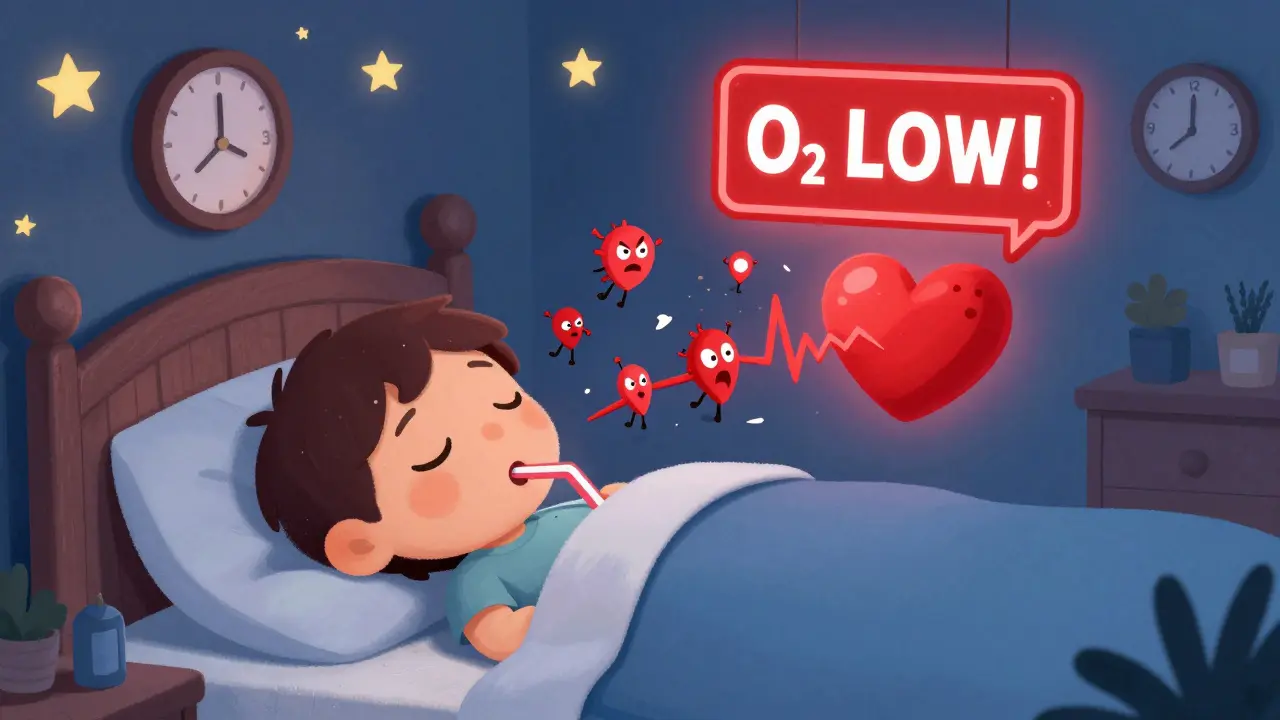
If you snore loudly, wake up gasping for air, or feel exhausted even after a full night’s sleep, you might have obstructive sleep apnea (OSA). But what most people don’t realize is that this common sleep disorder isn’t just annoying-it’s quietly damaging your heart. OSA doesn’t just steal your rest. It spikes your blood pressure, triggers dangerous heart rhythms, and raises your risk of stroke, heart failure, and atrial fibrillation-even if you’re young and otherwise healthy.
What Happens to Your Body During Sleep Apnea?
When you have obstructive sleep apnea, the muscles in your throat relax too much during sleep. Your airway collapses, blocking airflow for 10 seconds or longer. Your brain senses the lack of oxygen and jolts you awake-just enough to restart breathing, but not enough for real rest. These episodes can happen 30, 50, or even 100 times a night. You won’t remember them. But your heart does.
Each time your airway closes, your oxygen levels drop sharply. Your body reacts by flooding your system with stress hormones. Your heart rate jumps. Your blood pressure spikes by 20 to 40 mmHg in seconds. This isn’t a one-time event. It repeats every few minutes, all night long. Over months and years, this constant stress rewires your cardiovascular system. Your arteries stiffen. Your heart muscle thickens. Your electrical system becomes unstable.
Why Blood Pressure Doesn’t Drop at Night
For most people, blood pressure naturally dips by 10-20% during sleep. This is called “nocturnal dipping.” It’s your body’s way of giving your heart a break. But if you have OSA, that dip disappears. Instead, your blood pressure stays high-or even rises-throughout the night. This is called nocturnal hypertension.
Studies show that 30-40% of people with high blood pressure have undiagnosed sleep apnea. And here’s the kicker: treating OSA with CPAP therapy can lower systolic blood pressure by 5-10 mmHg on average. That’s the same drop you’d see with a second blood pressure medication. For people with resistant hypertension-blood pressure that won’t budge despite three different drugs-OSA is often the hidden cause.
Arrhythmias: When Your Heart Gets Out of Sync
Your heart doesn’t just work harder during apnea episodes-it starts misfiring. The repeated drops in oxygen and surges in adrenaline create chaos in your heart’s electrical system. This leads to arrhythmias-abnormal heart rhythms that can be harmless or life-threatening.
Atrial fibrillation (AFib), the most common serious arrhythmia, is strongly linked to OSA. People with severe sleep apnea are 3 to 5 times more likely to develop AFib than those without it. Even worse, after procedures like ablation to treat AFib, patients with untreated OSA are twice as likely to have it come back. One study found that consistent CPAP use reduces AFib recurrence by 42% over a year.
OSA doesn’t just affect the upper chambers of the heart. It also increases the risk of ventricular arrhythmias-irregular beats in the lower chambers-that can lead to sudden cardiac arrest. This is why doctors now screen for sleep apnea in patients with unexplained heart rhythm problems, even if they’re young and don’t appear overweight.
How OSA Compares to Other Heart Risks
Obesity, smoking, and high cholesterol are well-known heart dangers. But OSA is different. It’s not just a risk factor-it’s an active, ongoing assault on your cardiovascular system. While obesity increases AFib risk by about 50%, severe OSA increases it by 140%. It raises stroke risk by 60% and heart failure risk by 140%. And unlike genetic risks or age, OSA is treatable.
What makes OSA uniquely dangerous is the combination of three forces: intermittent hypoxia (oxygen drops), sleep fragmentation (constant waking), and mechanical stress (pressure swings in your chest). Together, they trigger inflammation, damage blood vessel linings, and activate clotting systems. This isn’t just a sleep problem-it’s a systemic disease.
Who Should Be Screened?
Doctors now recommend screening for OSA in people with:
- High blood pressure, especially if it’s hard to control
- Atrial fibrillation or other unexplained arrhythmias
- Heart failure or a history of stroke
- Excessive daytime sleepiness, loud snoring, or witnessed breathing pauses
And here’s something surprising: you don’t have to be overweight. While obesity increases risk, about 20% of OSA patients are normal weight. Thin people with narrow airways, large tongues, or a recessed jaw can have severe OSA too. That’s why screening isn’t based on body size-it’s based on symptoms and medical history.
How It’s Diagnosed
Diagnosis starts with a simple sleep study. Most people can do this at home with a portable monitor that tracks breathing, oxygen levels, and heart rate. If you have complex health issues-like heart failure or COPD-you might need an overnight stay in a sleep lab for a full polysomnography.
The key number is the AHI-Apnea-Hypopnea Index. This measures how many breathing disruptions you have per hour:
- Mild: 5-14 events/hour
- Modest: 15-29 events/hour
- Severe: 30+ events/hour
If your AHI is 5 or higher and you have symptoms like fatigue or snoring, you have OSA. If it’s 15 or higher-even without symptoms-you still need treatment.
CPAP Therapy: The Gold Standard
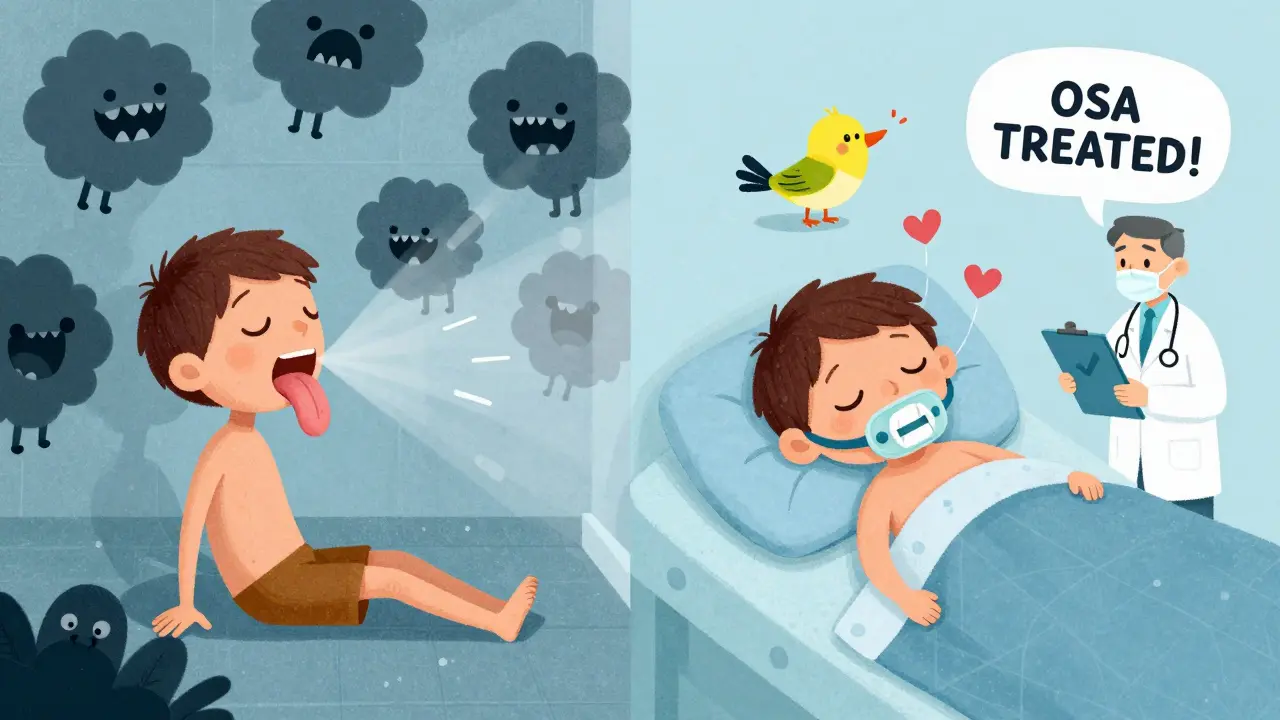
Continuous Positive Airway Pressure (CPAP) is the most effective treatment. A small machine delivers steady air pressure through a mask, keeping your airway open. It’s not glamorous. But it works.
Studies show that using CPAP for at least 4 hours a night reduces:
- Daytime blood pressure by 5-10 mmHg
- Atrial fibrillation recurrence by 42%
- Heart failure hospitalizations by 35%
One user on a sleep apnea forum shared that after three months of consistent CPAP use, their blood pressure dropped from 160/95 to 128/82. Another said their AFib episodes went from weekly to once every two months.
The biggest problem? Getting people to use it. About 30% quit within the first year. Common complaints include mask discomfort, dry mouth, and claustrophobia. But most issues can be fixed. Switching mask types, using heated humidifiers, adjusting pressure settings, and starting with a ramp feature make a huge difference. Eighty-five percent of people who stick with it for 30 days report better sleep and more energy.
What If CPAP Doesn’t Work?
If you can’t tolerate CPAP, there are other options:
- Oral appliances: Custom mouthpieces that push your jaw forward to keep your airway open. Best for mild to moderate OSA.
- Weight loss: Even a 10% reduction in body weight can cut AHI by half.
- Positional therapy: Sleeping on your side instead of your back reduces apneas in many people.
- Upper airway surgery: For select cases with clear anatomical blockages.
- Inspire Therapy: A small implant that stimulates the nerve controlling your tongue. It’s FDA-approved and reduces AHI by 79% in clinical trials.
Insurance, including Medicare, now covers screening and treatment for OSA in patients with heart conditions. The cost of untreated OSA-hospital visits, medications, missed work-is far higher than the cost of diagnosis and therapy.
The Bigger Picture
OSA is no longer seen as a side issue. The American Heart Association now lists it as a Class I risk factor for atrial fibrillation-on the same level as hypertension and obesity. The American College of Cardiology is expected to elevate it to a "major risk factor" in 2025 guidelines.
And new research is showing that even young adults under 40 are at risk. A 2024 study found that OSA causes measurable heart damage in people as young as 25. This isn’t just an older person’s disease. It’s a silent threat that can strike anyone.
Every time you skip your CPAP, you’re letting your heart take another hit. But every night you use it, you’re giving your heart a chance to heal. The science is clear: treating sleep apnea isn’t about better sleep. It’s about living longer, healthier, and free from the fear of a sudden cardiac event.
Can sleep apnea cause high blood pressure even if I’m not overweight?
Yes. While obesity increases the risk, sleep apnea can occur in people of any body size. The issue is airway structure-not weight. Repeated oxygen drops and stress hormone surges during apnea episodes directly raise blood pressure, regardless of BMI. Studies show that up to 40% of people with high blood pressure have undiagnosed sleep apnea, including many who are normal weight.
How long does it take for CPAP to lower blood pressure?
Some people see a drop in blood pressure within a few weeks of consistent CPAP use. On average, systolic pressure drops by 5-10 mmHg after 3 months of using the device for at least 4 hours per night. The effect is strongest in people with resistant hypertension. Consistency matters more than perfect usage-you don’t need to use it 8 hours every night, but you do need to use it most nights.
Is atrial fibrillation caused by sleep apnea reversible?
In many cases, yes. Treating sleep apnea with CPAP can significantly reduce the frequency and severity of AFib episodes. One study found that after 12 months of consistent CPAP use, AFib recurrence dropped by 42%. While CPAP won’t cure AFib in everyone, it removes a major trigger and improves the success of other treatments like ablation. The earlier you treat OSA, the better your chances of reversing heart rhythm damage.
Can I test for sleep apnea at home?
Yes. Home sleep apnea tests are accurate for most people and are covered by insurance if you have symptoms like snoring, daytime fatigue, or high blood pressure. These tests measure breathing, oxygen levels, and heart rate. They’re simpler than in-lab studies and don’t require an overnight hospital stay. However, if you have other serious health conditions like heart failure or COPD, your doctor may recommend an in-lab test for more detailed monitoring.
Does losing weight cure sleep apnea?
Weight loss can dramatically improve or even eliminate sleep apnea, especially if you’re overweight. Losing just 10% of your body weight can cut your AHI by half. But it’s not a guaranteed cure. Some people with normal weight still have severe OSA due to anatomy. For others, even after significant weight loss, some apnea remains. That’s why CPAP or other treatments are still needed in many cases-even after weight loss.
Why is OSA called a silent killer?
Because most people don’t know they have it. You don’t feel the breathing pauses-you just wake up tired. No pain, no obvious symptoms beyond fatigue. But while you sleep, your heart is under constant stress. By the time heart problems show up-high blood pressure, arrhythmia, stroke-it’s often too late. Screening is the only way to catch it early. That’s why doctors now recommend testing for OSA in anyone with heart disease, high blood pressure, or unexplained fatigue.

15 Comments
Praseetha Pn
Okay but have you ever heard of the 5G sleep apnea conspiracy? I know a guy in Bangalore whose CPAP stopped working after the new tower went up-his oxygen levels dropped even more. They’re using microwave pulses to keep us docile. The FDA knows. The WHO knows. But they won’t tell you because Big Pharma profits off your broken heart. You think CPAP helps? Try sleeping on a bed of Himalayan salt under a copper pyramid. I did. My AHI dropped to zero. No joke.
rachel bellet
Let’s be clear: the data on OSA and cardiovascular risk is robust, but the clinical implementation is catastrophically inefficient. CPAP adherence rates are abysmal because the paradigm is fundamentally flawed-continuous positive airway pressure does not address the neurogenic sympathetic overdrive or the chronic low-grade inflammation driven by intermittent hypoxia. You need a multimodal intervention: circadian entrainment, vagal tone optimization, and metabolic reprogramming. Otherwise, you’re just treating symptoms with a plastic mask while the endothelial damage progresses. The AHA’s Class I recommendation is a start-but it’s not a solution.
Selina Warren
Listen. I used to think sleep apnea was just snoring. Then I watched my dad drop dead at 52 from a stroke-no warning, no history. Autopsy said severe OSA. I got tested. AHI of 47. Started CPAP. Three weeks later, I didn’t need my coffee. Four months? My blood pressure went from 158/98 to 122/80. I’m alive because I stopped ignoring my body. You think it’s inconvenient? Try dying in your sleep while your wife screams for help. Do it. Do it now. Your heart isn’t asking for permission-it’s begging.
Robert Davis
I’ve had CPAP for two years. I use it maybe three times a week. I know I should use it more. But the mask gives me nightmares. I dream I’m suffocating. Which is ironic, I guess. I don’t feel tired anymore, so… maybe it’s not that bad? Also, I read somewhere that sleep apnea is just a myth invented by mask companies. Probably true. My neighbor’s dog snores louder than me.
Jake Moore
Just wanted to add: if you’re reading this and you’re on the fence about getting tested, do it. Seriously. I’m a nurse. I’ve seen people come in with ‘heart failure of unknown cause’-turns out they had severe OSA and never knew. Home sleep tests are free with insurance. CPAP machines are often covered 100%. You’re not being lazy-you’re being ignorant of a treatable condition that’s killing you slowly. Don’t wait for a cardiac arrest to wake up.
Joni O
hey i just wanted to say… i started cpap last year after my doc said my bp was ‘scary’… i was so scared i almost didn’t do it. but i did. and now i sleep like a baby. i still forget it sometimes, but i try. i just wanted to say thank you to the people who wrote this post. it helped me feel less alone.
ps: i typoed ‘cpap’ as ‘cpap’ again. sorry. i’m tired. but not as tired as i used to be.
Max Sinclair
This is one of the most important health threads I’ve read in a long time. The connection between OSA and cardiovascular disease is under-discussed, and the fact that it’s treatable makes it even more tragic that so many go undiagnosed. I’m glad the AHA and ACC are finally recognizing it as a major risk factor. If you’re reading this and have unexplained fatigue, snoring, or high BP-get tested. It’s not a luxury. It’s preventative medicine at its most powerful.
Nishant Sonuley
Look, I’m from India. I’ve seen my uncle, a thin guy with a tiny neck, get diagnosed with severe OSA after he had a mini-stroke at 48. Everyone thought he was just ‘stressed’ or ‘overworked.’ But no-it was his airway collapsing every 45 seconds. Now he uses CPAP, and he’s back to playing cricket with his grandkids. Meanwhile, here in the US, people are still arguing whether it’s ‘real’ or ‘just fat people.’ Newsflash: anatomy > BMI. My cousin’s sister, 5’2”, 110 lbs, AHI of 58. She’s alive because she got tested. Don’t let stereotypes kill you. Get screened. Even if you’re ‘not overweight.’
Emma #########
I just wanted to say… I cried reading this. I thought I was just ‘always tired’ because I’m a mom. Turns out I had severe OSA. My husband said I stopped breathing for 20 seconds at a time. I didn’t even know. I started CPAP last month. I haven’t screamed at my kids in two weeks. I feel human again. Thank you for writing this. I’m sharing it with everyone I know.
Andrew McLarren
It is with the utmost seriousness and scientific rigor that I submit the following observation: the physiological mechanisms underlying obstructive sleep apnea and its resultant cardiovascular sequelae are not only well-documented in peer-reviewed literature, but are also empirically validated through longitudinal cohort studies conducted by the National Heart, Lung, and Blood Institute. The clinical imperative to screen for and treat this condition, particularly in populations with comorbid hypertension and arrhythmia, is not merely advisable-it is ethically obligatory.
Andrew Short
Of course they say CPAP works. It’s a $2 billion industry. The real solution? Stop eating processed carbs and sleep on your stomach. But no-let’s sell you a $3,000 machine and call it medicine. Meanwhile, your liver’s still inflamed, your cortisol’s still elevated, and your gut’s still leaking. CPAP is a bandaid on a bullet wound. Wake up. The system is rigged.
christian Espinola
Let’s be honest: sleep apnea is just another way the medical-industrial complex profits off your ignorance. You think your ‘AHI’ matters? Your body’s been screaming for years. You just chose to mute it with a mask. Meanwhile, the real cause? Electromagnetic pollution, glyphosate in your water, and the fact that you sleep under a Wi-Fi router. Fix that, and you won’t need CPAP. But no-keep buying the mask. Keep paying. Keep being a good little patient.
Chuck Dickson
Yo. I used to hate my CPAP. Felt like a cyborg. Then I got a new mask-soft silicone, no straps on my head, just a nasal pillow. Changed everything. I started using it 7 nights a week. Lost 15 lbs without trying. My wife says I snore less. My boss says I’m ‘lighter’ in meetings. I didn’t know I was this tired. Don’t wait for a heart attack. Just try it for 10 days. You’ll thank yourself. Seriously.
Naomi Keyes
It’s important to note that while CPAP is the gold standard, the literature on its efficacy is heavily biased toward industry-funded trials. Furthermore, the definition of ‘adherence’ (4 hours/night) is arbitrary and not physiologically grounded. Many patients experience significant benefit with 2–3 hours of use, yet are labeled ‘non-compliant.’ This is a systemic failure of measurement, not patient failure. Also: why is the term ‘sleep apnea’ used interchangeably with ‘obstructive’? There are central and mixed forms-why aren’t we discussing them? And why is Inspire Therapy so underutilized? The answer: cost, access, and ignorance. The system is broken.
Danny Gray
What if… sleep apnea isn’t a disease at all? What if it’s our body’s way of telling us we’ve been living too fast? That our circadian rhythm has been hijacked by screens, caffeine, and societal pressure? That the real problem isn’t the airway-it’s the soul? Maybe we don’t need a mask. Maybe we need to turn off the lights, go to bed early, and stop pretending we’re machines. Maybe the heart doesn’t need fixing… it just needs rest. And silence. And maybe, just maybe, a little less productivity.