
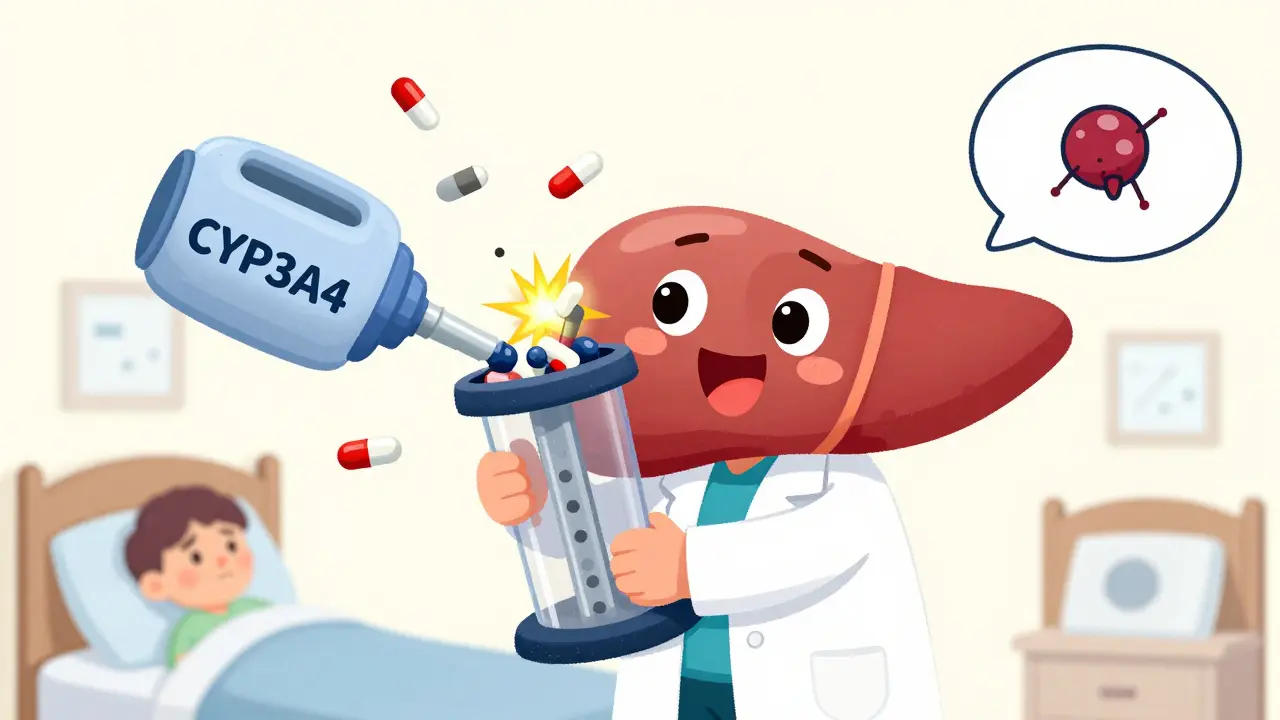
When you take rifampin for tuberculosis or to prevent meningitis, you’re not just fighting bacteria-you’re also triggering a hidden chain reaction inside your body that can undo the effects of other critical medications. Rifampin is one of the most powerful enzyme inducers known in clinical medicine, and its impact on anticoagulants like warfarin, rivaroxaban, and apixaban can be dangerous, even deadly. If you’re on blood thinners and get prescribed rifampin, your INR could drop below therapeutic levels without warning. Your DOAC might stop working entirely. And if you’re taking antivirals for HIV or hepatitis, those drugs could become useless. This isn’t theoretical. It’s happening in real patients, every day.
How Rifampin Turns Off Your Blood Thinners
Rifampin doesn’t block anticoagulants directly. Instead, it flips a switch in your liver that tells your body to make more of a specific enzyme: CYP3A4. This enzyme is like a molecular shredder for drugs. When rifampin activates the pregnane X receptor (PXR), your liver starts producing up to 10 times more CYP3A4. That same enzyme also breaks down CYP2C9, which handles the more potent S-warfarin isomer. The result? Your anticoagulant gets broken down faster than your body can replace it.
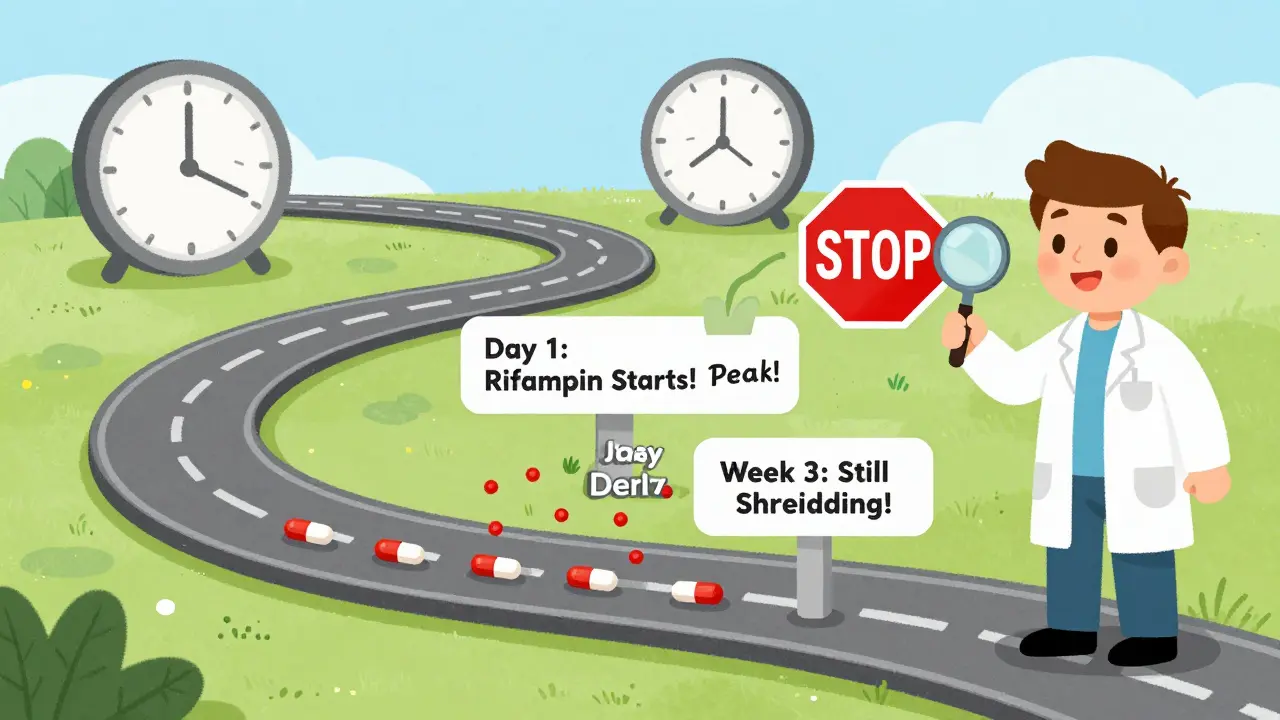
The timing is critical. The induction starts within 24 to 48 hours of your first rifampin dose. By day 5 to 7, enzyme levels peak. And here’s what most people don’t realize: even after you stop rifampin, the effect lingers for 2 to 3 weeks. That’s because enzymes don’t vanish overnight-they degrade slowly. So if you think stopping rifampin means your anticoagulant will bounce back immediately, you’re wrong. Your INR might stay low for weeks, leaving you vulnerable to clots.
Studies show dramatic drops in drug levels. For warfarin, rifampin reduces its area under the curve (AUC) by 15% to 74%. For rivaroxaban, the drop is 50% to 67%. Apixaban and dabigatran fall by similar amounts. Even edoxaban, which is less affected, still sees a 35% reduction. In one documented case, a 57-year-old woman with a mechanical heart valve had her INR plunge to 1.1-far below the therapeutic range of 2.0 to 3.0-despite taking her usual dose of phenprocoumon. She didn’t have a stroke because doctors caught it early, but she spent 15 days on heparin injections until rifampin fully cleared her system.
Direct Oral Anticoagulants (DOACs) and Rifampin: A High-Risk Combo
DOACs were supposed to be safer than warfarin. No more weekly INR checks. No more dietary restrictions. But rifampin turns that advantage into a liability. Unlike warfarin, DOACs have no reliable monitoring test. You can’t check if your rivaroxaban level is low. You won’t know until you have a clot or a bleed.
The European Heart Rhythm Association says it plainly: concomitant use of DOACs with rifampin is not recommended. The FDA and other global health bodies agree. Yet, in real-world practice, it still happens. A 2023 study of over 2,000 patients found that 85% of those on oral anticoagulants with rifampin were on DOACs-not warfarin. Why? Because DOACs are now the default choice. But the interaction risk hasn’t changed.
One study in Frontiers in Pharmacology looked at six patients with prosthetic joint infections who needed both rifampin and rivaroxaban. They didn’t stop the rivaroxaban. Instead, they adjusted the dose gradually-increasing it by 50% during rifampin use, then tapering back slowly after stopping. This approach worked for them, but it’s not a standard protocol. Most hospitals don’t have one. As of 2022, only 12% of U.S. hospitals had written guidelines for managing this interaction. That’s not because doctors are careless. It’s because the evidence is still evolving.
Antivirals Are Also at Risk
Rifampin doesn’t just mess with blood thinners. It slashes levels of many antivirals too. For HIV patients on protease inhibitors like lopinavir or darunavir, rifampin can reduce drug concentrations by more than 80%. That’s enough to cause treatment failure and trigger drug resistance. The same goes for hepatitis C drugs like ledipasvir/sofosbuvir. In one case, a patient on rifampin for TB developed detectable hepatitis C viral load within 10 days of starting treatment-despite previously undetectable levels.
Even newer antivirals like molnupiravir and nirmatrelvir (Paxlovid) are affected. While formal studies are still limited, their metabolism relies heavily on CYP3A4. If rifampin is in the picture, those drugs won’t reach the levels needed to suppress the virus. That’s why the CDC and WHO both advise against using rifampin with these antivirals unless absolutely unavoidable.
What Should You Do Instead?
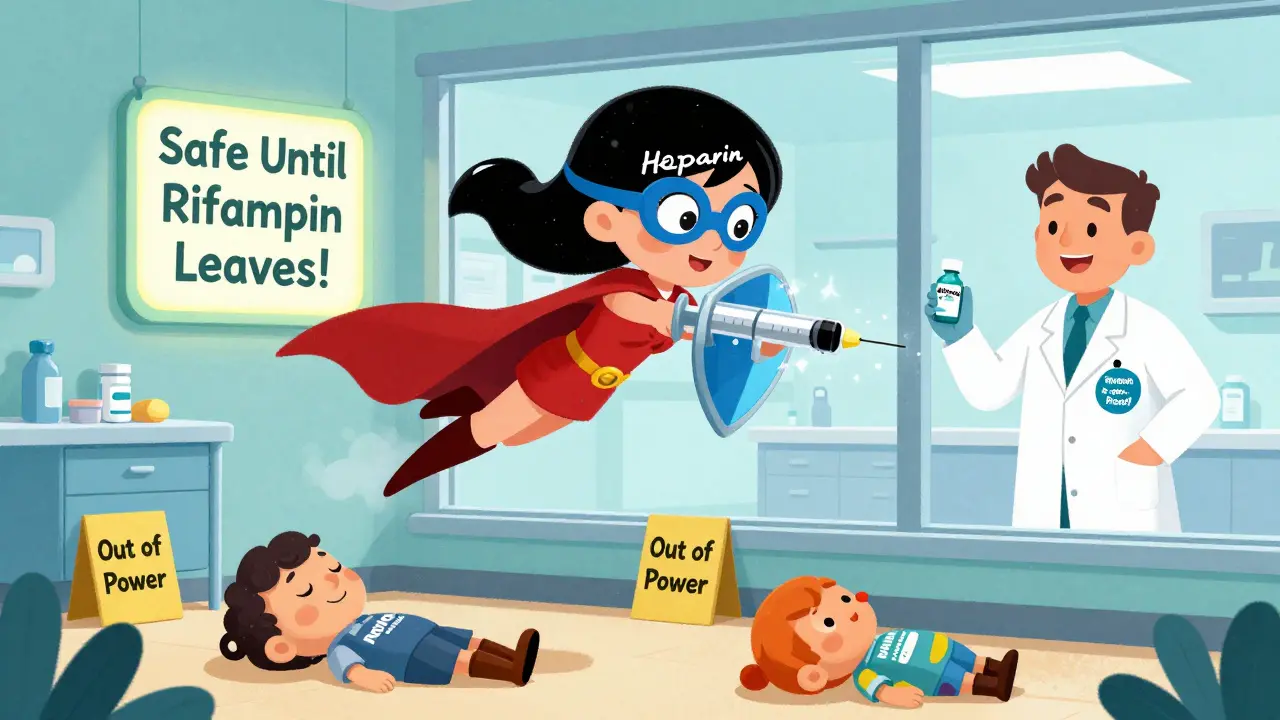
The safest move? Avoid the combo entirely. If you need rifampin and are on a DOAC, switch to a parenteral anticoagulant-like enoxaparin or dalteparin-during the course of rifampin therapy. These drugs aren’t metabolized by the liver. They’re excreted by the kidneys. Rifampin doesn’t touch them. Once rifampin is stopped and you’ve waited 2 to 3 weeks, you can safely restart your DOAC.
If you’re on warfarin, you can keep it-but only with aggressive monitoring. Your INR should be checked every 2 to 3 days when starting rifampin, then weekly until stable. You may need to increase your dose by 3 to 5 times. Point-of-care INR devices have made this manageable. With 95% accuracy compared to lab tests, they allow for same-day dose adjustments. But again, this only works for warfarin. DOACs don’t have this safety net.
For antivirals, the choice is simpler: delay rifampin until the antiviral course is complete, or switch antivirals. For HIV, raltegravir or dolutegravir are less affected by CYP3A4 induction and can be used instead of protease inhibitors. For hepatitis C, sofosbuvir-based regimens without CYP3A4-dependent drugs may be an option.
Why This Matters More Than You Think
There’s a quiet epidemic here. As DOACs replace warfarin, we’ve gotten complacent. We assume newer = safer. But when rifampin enters the picture, the old rules come roaring back. A patient on rivaroxaban for atrial fibrillation might not even know they’re at risk. They take their pill daily. They don’t have symptoms. Then one day, they wake up with a stroke. The cause? A simple TB treatment.
And it’s not just about anticoagulants. Rifampin is used in leprosy, brucellosis, and even some stubborn staph infections. It’s in the same pill as isoniazid for TB. Patients don’t always tell their doctors they’re taking it. Pharmacists don’t always catch it. And when multiple drugs are involved, the risk multiplies.
That’s why the FDA now requires all new drugs to be tested against rifampin before approval. The goal? To prevent future interactions. But for the drugs already on the market-most anticoagulants, many antivirals, even some antidepressants and birth control pills-we’re still playing catch-up.
The Future: New Anticoagulants That Don’t Care About Rifampin
Researchers are already designing the next generation of anticoagulants to avoid this problem. A 2023 study in Nature Scientific Reports looked at milvexian, a new factor XIa inhibitor. Unlike warfarin or rivaroxaban, milvexian doesn’t rely on CYP enzymes. It’s designed to be stable even in patients on strong inducers. Early data shows it’s not affected by rifampin at all.
This is the future. Drugs built not just to work-but to work even when other drugs are in the system. But until those drugs are widely available, we’re stuck with the old ones. And that means vigilance.
If you’re on anticoagulants or antivirals, and your doctor says you need rifampin-ask: What’s the plan? Don’t assume they know. Don’t assume it’s safe. Bring up the interaction. Ask about switching to heparin. Ask about timing. Ask about monitoring. Your life might depend on it.
Can I take warfarin with rifampin?
Yes, but only with close monitoring and major dose adjustments. Rifampin can reduce warfarin levels by up to 74%, so your INR will likely drop. You’ll need INR checks every 2-3 days when starting rifampin, and your dose may need to be increased 3-5 times. Even after stopping rifampin, wait 2-3 weeks before reducing the warfarin dose back down. Most patients on warfarin can manage this safely with a point-of-care INR device, but it requires active involvement from both patient and provider.
Can I take rivaroxaban or apixaban with rifampin?
Generally, no. Rifampin reduces rivaroxaban and apixaban levels by 50-67%, which can lead to dangerous clotting. There are no reliable blood tests to monitor these drugs. Most guidelines recommend avoiding this combination. If absolutely necessary, switching to injectable anticoagulants like enoxaparin during rifampin therapy is the safest option. Do not attempt to increase the DOAC dose on your own-this can lead to unpredictable bleeding risks.
How long does rifampin’s effect last after stopping?
The enzyme-inducing effect of rifampin can last 2 to 3 weeks after you stop taking it. This is because CYP3A4 and other enzymes degrade slowly. Even if you feel fine, your body is still breaking down anticoagulants and antivirals faster than normal. Never restart your anticoagulant or antiviral right after finishing rifampin. Wait at least 14 days-preferably 21 days-to allow enzyme levels to return to baseline.
What should I do if I’m on HIV meds and need rifampin?
Rifampin can reduce HIV drug levels by over 80%, leading to treatment failure and drug resistance. Avoid combining them if possible. If rifampin is essential, switch to an HIV regimen that doesn’t rely on CYP3A4 metabolism-such as dolutegravir or raltegravir. These drugs are less affected. Never adjust your HIV dose without consulting an infectious disease specialist. Missing doses or lowering levels can create drug-resistant strains of HIV that are harder to treat.
Are there any anticoagulants that are safe with rifampin?
Yes-parenteral anticoagulants like enoxaparin (Lovenox), dalteparin (Fragmin), or unfractionated heparin. These drugs are not metabolized by liver enzymes and are not affected by rifampin. They’re the recommended alternative during rifampin therapy. Once rifampin is stopped and 2-3 weeks have passed, you can safely switch back to an oral anticoagulant. This is the standard of care for patients who need both treatments.
If you’re on any of these medications and are prescribed rifampin, don’t wait for your doctor to bring it up. Ask. Push. Demand clarity. Because in this case, ignorance isn’t just risky-it’s deadly.



11 Comments
Natasha Rodríguez Lara
I’ve been on apixaban for AFib for 4 years, and when my TB doc prescribed rifampin, I had no idea this was even a thing. I’m lucky I caught this thread before my next refill. I switched to Lovenox for 3 weeks and honestly? It was way less stressful than I thought. Just inject it, don’t think about it. No more worrying if my INR’s gonna crash.
Doctors need to do better. This isn’t obscure info - it’s life-or-death. Why isn’t this on every prescription label?
peter vencken
bro i just took my warfarin and rifampin together for 3 days before my pcp yelled at me. i thought they were both just antibiotics. turns out i was lucky i didnt clot. now i got a lil lovenox pen in my bag like a superhero.
also why is the fda so slow? we got apps that track my coffee intake but not my drug interactions? lol
James Moreau
As someone who works in hospital pharmacy, I see this interaction way too often. Most patients assume ‘new drug = no interactions’ and don’t mention they’re on rifampin unless asked directly. We’ve had two strokes in the last year from this exact combo.
Our hospital just rolled out a mandatory alert in our e-prescribing system - if rifampin is ordered with a DOAC, it flags and forces a clinical pharmacist consult. It’s not perfect, but it’s a start.
Also, kudos to the author for mentioning milvexian. That drug could be a game-changer. We’re already testing it in our anticoagulation clinic.
J. Murphy
so like… what if i just skip the blood thinner?
tb is the real threat right? why are we overcomplicating this? just take the pill.
also why are we trusting studies from 2023? that’s basically ancient history in med land.
Jesse Hall
OMG this is why I love Reddit. I just found out my dad is on both and he didn’t even know. I’m sending him this right now. 😭
He’s 68, had a valve replacement, and just started rifampin for ‘some infection.’ I called his cardiologist and they were like ‘wait what?!’
He’s on enoxaparin now. Thank you for writing this. You just saved his life. 🙏
Sean Bechtelheimer
they’re hiding the truth. rifampin is a government tool to lower drug efficacy. why else would they let it be used with DOACs?
the cia runs the FDA. the pharma companies are in on it.
just look at how fast they approved it in the 80s… coincidence? i think not. 😈
Brandon Shatley
i didnt know rifampin did this. i thought it was just for tb.
my cousin took it and then had a stroke. they said it was ‘unexplained.’ now i think… maybe not.
maybe doctors just dont talk about this enough. i feel like i should’ve known. sorry for being dumb.
Kenneth Jones
stop acting like this is some groundbreaking revelation. we’ve known about this since the 90s. if you’re too lazy to read the damn drug monograph, that’s on you.
stop blaming the system. blame yourself for not doing your homework.
also stop using emoticons. it’s unprofessional.
Mihir Patel
bro i just got diagnosed with tb and im on rivaroxaban for a clot i got after surgery. i panicked. i called my doc at 2am. he said ‘wait 2 weeks’ and i was like NOOOOOO.
so i switched to heparin injections. my arm is bruised like a rainbow.
but i’m alive. and now i’m gonna make a tiktok about this. #RifampinWarning #DOACsDontLie
Kevin Y.
Thank you for this exceptionally well-researched and clearly articulated piece. The clinical implications are profound, and your synthesis of current evidence - especially the data on milvexian - offers real hope for future practice.
I’m a clinical pharmacologist at Johns Hopkins, and I’ve been advocating for standardized rifampin interaction protocols for years. The fact that only 12% of U.S. hospitals have written guidelines is unacceptable. I hope this post catalyzes institutional change.
With respect and admiration,
Raphael Schwartz
why are we letting foreigners tell us how to treat our own people? rifampin is cheap. DOACs are expensive.
they just want us to pay more.
just take the pill. dont listen to these overeducated doctors.
usa first.