
What Are Refractive Errors?
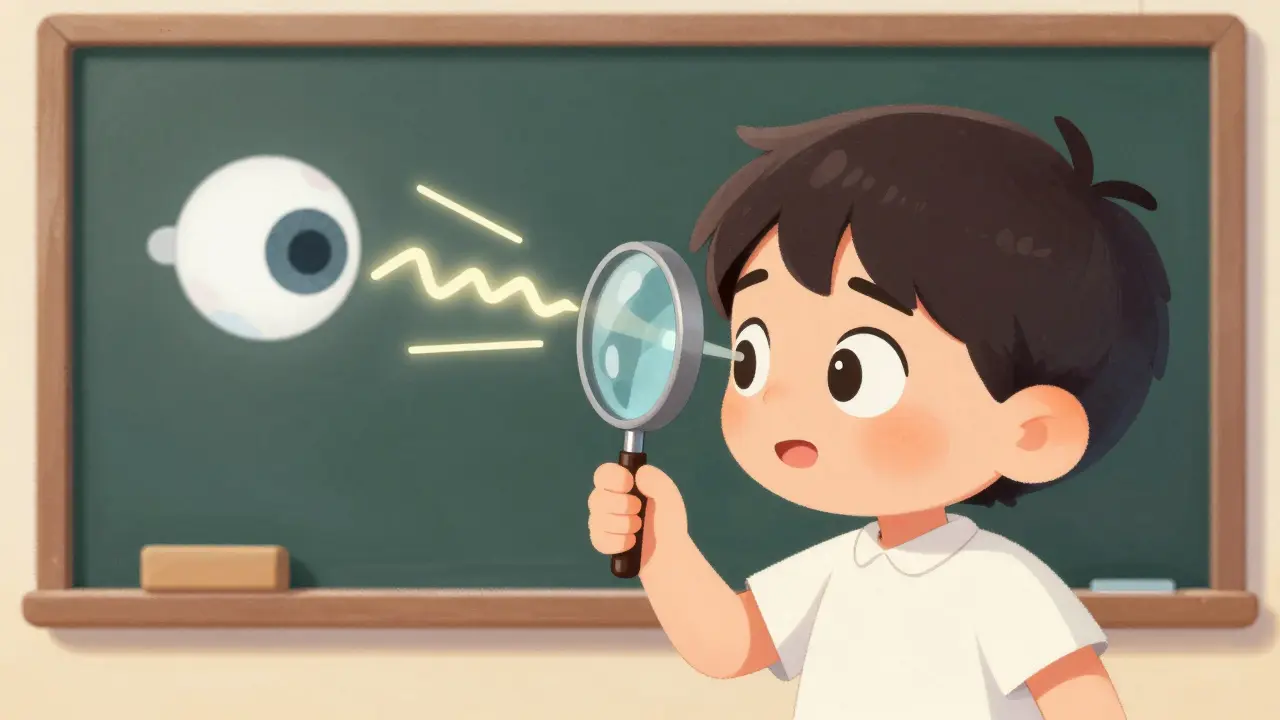
Refractive errors happen when your eye can’t focus light properly on the retina. It’s not a disease-it’s a shape problem. Your eye is like a camera. If the lens or the length of the eyeball is off, the image comes out blurry. That’s it. Three main types cause most vision problems: myopia (nearsightedness), hyperopia (farsightedness), and astigmatism. Together, they affect over half of adults between 40 and 69, according to UK Biobank data. And they’re not rare in kids-about 20% of eye visits in children involve one of these issues.
Myopia: Why Distant Objects Look Blurry
Myopia means you see close things clearly but struggle with distance. A child might sit right up to the TV or squint to read the board at school. The cause? The eyeball is too long-or the cornea is too curved. Light focuses in front of the retina instead of on it. In adults, this usually means an axial length over 24mm or a corneal curve stronger than 43 diopters.
It often starts around age 10 and gets worse each year until the late teens. East Asian populations have seen a dramatic rise-up to 90% of young adults in Singapore and South Korea are nearsighted. Experts link this to too much screen time and not enough outdoor light. The National Eye Institute says spending at least two hours a day outside during childhood can slow its progression.
Correction is simple: minus (-) lenses in glasses or contacts. These lenses spread out the light before it enters your eye, letting it land correctly on the retina. But high myopia-over -6.00 diopters-comes with risks. It raises your chance of retinal detachment by 5 to 10 times. That’s why regular eye exams are critical, especially if your prescription keeps climbing.
Hyperopia: When Near Vision Gets Tough
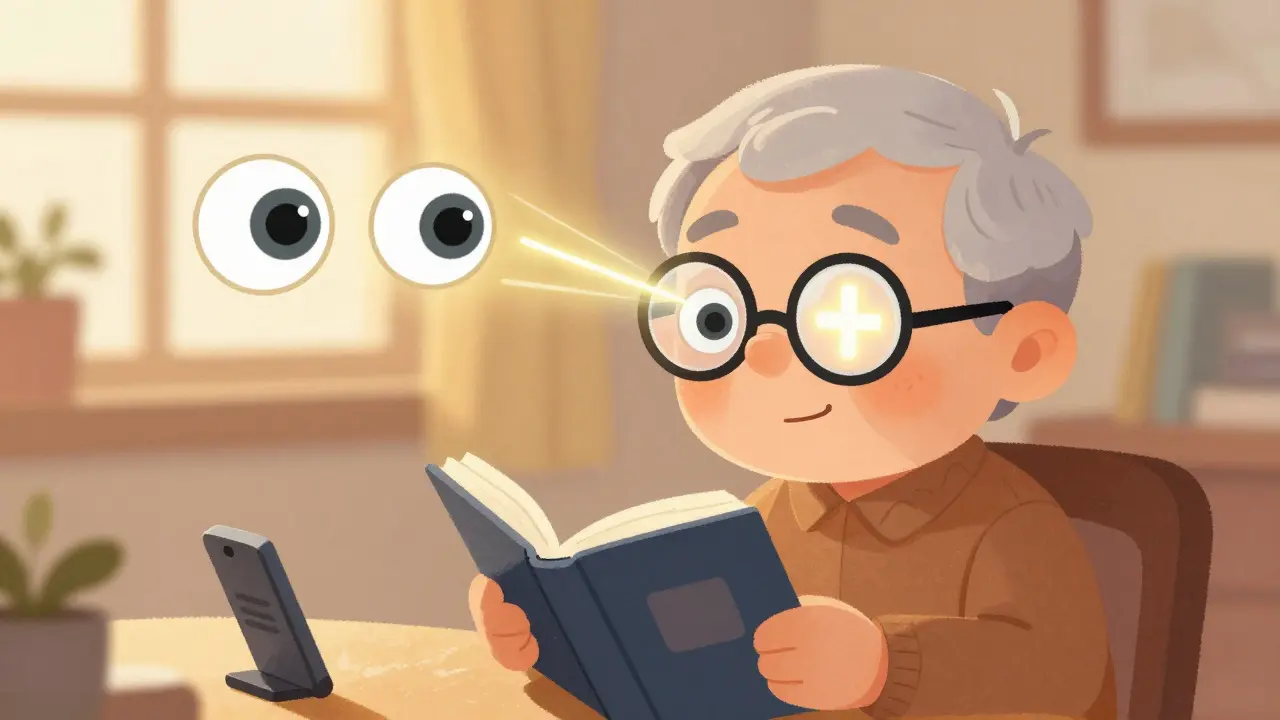
Hyperopia is the opposite. You see distant objects better than close ones. Kids often have mild hyperopia and don’t notice it-their eyes can compensate. But as you age, the lens loses flexibility, and suddenly reading a menu or your phone becomes a chore. The problem? The eyeball is too short-under 22mm-or the cornea is too flat, under 40 diopters. Light focuses behind the retina.
About 5 to 10% of Americans have noticeable hyperopia, according to Space Coast Ophthalmology. Native American populations show higher rates, sometimes up to 25%. It’s often inherited. You might not realize you have it until your 40s, when presbyopia (age-related focusing loss) adds to the problem.
Correction uses plus (+) lenses. These bend light inward so it lands on the retina instead of behind it. Glasses are the most common fix. Contacts work too, but some people find them less comfortable for reading. If you’re over 40 and struggling with close-up tasks, it might not just be presbyopia-it could be uncorrected hyperopia.
Astigmatism: The Irregular Curve That Messes With Focus
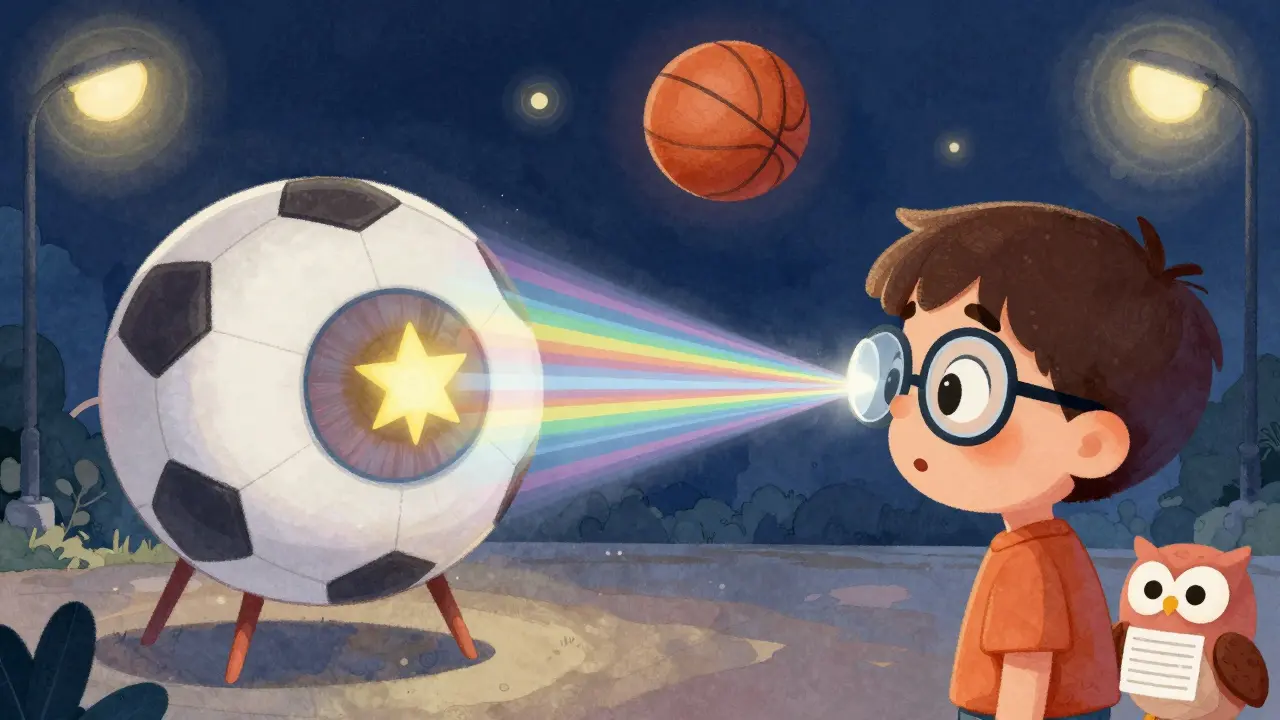
Astigmatism isn’t about length or shape alone-it’s about distortion. The cornea or lens is shaped more like a football than a basketball. That means light doesn’t focus at one point. Instead, it splits into multiple focal lines. You might see double images, glare at night, or feel like you’re looking through water.
It affects 30 to 60% of the population. Most people have some level of astigmatism, even if it’s mild. Unlike myopia or hyperopia, it can blur both near and far vision at the same time. That’s why someone with astigmatism might complain about headaches, eye strain, or difficulty driving after dark.
Correction requires cylinder-shaped lenses with a specific axis-usually between 0 and 180 degrees. It’s not just about power; it’s about direction. One Reddit user said it took three weeks to adjust to a new axis at 175 degrees. That’s normal. The brain needs time to relearn how to interpret the corrected image. If your vision still feels warped after a few weeks, your prescription might be off. Undercorrected astigmatism is one of the most common reasons people say their glasses “don’t feel right.”
How Correction Methods Compare
You have three main options: glasses, contacts, and surgery. Each has trade-offs.
- Glasses: Immediate, safe, and easy. Satisfaction ratings average 4.2 out of 5. But they can fog up, slip down your nose, or break. Kids often resist wearing them-unless they help pick the frames. Studies show compliance jumps when children have input.
- Contact Lenses: Offer a wider field of view and no frames. But they require daily care. Around 3 to 4% of wearers develop microbial keratitis, a serious eye infection, according to the CDC. Many users report discomfort after 8 hours of wear. Daily disposables reduce risk but cost more over time.
- Refractive Surgery: LASIK, PRK, and SMILE reshape the cornea with lasers. LASIK, approved by the FDA in 1995, gives most people 20/20 vision within a day. Satisfaction scores hit 4.5 out of 5. But 20 to 40% experience dry eyes afterward, and some get halos or glare at night. SMILE is newer and causes fewer dry eye issues-its use is growing 15% a year.
Surgery isn’t for everyone. You need a stable prescription for at least a year, corneas thicker than 500 microns, and to be 18 or older. If you’re still growing, or your vision changes often, surgery isn’t an option yet.
New Ways to Slow Myopia Progression
For kids with worsening myopia, correction isn’t the only answer. There are now ways to slow it down.
- Ortho-K lenses: Worn overnight, they gently reshape the cornea. Studies show they reduce myopia progression by 36 to 56%.
- Low-dose atropine drops: Used nightly, 0.01% to 0.05% atropine cuts myopia progression by 50 to 80% over two years. Side effects are minimal-slight light sensitivity or blurry near vision.
These aren’t cures, but they’re game-changers. They give kids a better shot at avoiding high myopia-and its long-term risks-by adulthood.
What to Do Next
If you or your child has blurry vision, don’t wait. Get a full eye exam. A simple refraction test can identify the exact type and degree of refractive error. Don’t assume your old glasses are still right-prescriptions change, especially in kids.
For adults over 40, remember: blurred near vision isn’t always presbyopia. It could be uncorrected hyperopia or astigmatism. A comprehensive checkup clears that up.
If you’re considering surgery, talk to a surgeon who uses wavefront-guided technology. It maps your eye’s unique imperfections, making corrections more precise-especially for astigmatism.
And if you’re a parent of a child with myopia: get them outside. More sunlight, less screen time. It’s one of the few proven ways to slow down the progression.
Frequently Asked Questions
Can refractive errors be cured?
They can’t be cured, but they can be fully corrected. Glasses, contacts, and surgery restore clear vision by compensating for the eye’s shape. Surgery permanently changes the cornea, so you won’t need lenses anymore-but your eye’s structure still has the original imperfection. That’s why regular checkups are still important, especially for high myopia.
Is astigmatism worse than myopia or hyperopia?
Not necessarily. All three are common and manageable. Astigmatism is more complex because it involves irregular curvature, so correction needs precise axis alignment. That can make the adjustment period longer. But once corrected, vision is just as clear as with myopia or hyperopia. The real issue is undercorrection-many people wear the wrong cylinder power or axis for years without realizing it.
Can children have astigmatism?
Yes. Many children are born with mild astigmatism, and it often improves on its own. But if it’s significant and affects vision development, it needs correction. Uncorrected astigmatism in kids can lead to amblyopia (lazy eye). That’s why pediatric eye exams are essential-even if the child doesn’t complain.
Do I need surgery if I have astigmatism?
No. Most people with astigmatism do fine with glasses or toric contact lenses. Surgery is an option if you want to reduce dependence on corrective lenses. LASIK and PRK can correct astigmatism effectively, especially with wavefront-guided mapping. But surgery isn’t required unless you’re tired of wearing glasses or contacts.
Why does my vision get worse every year?
If you’re under 20, it’s likely myopia progression-common during growth spurts. Your eye is still elongating. After 20, prescriptions usually stabilize. If your vision keeps changing after 25, it could signal an underlying issue like keratoconus or uncontrolled diabetes. See an eye doctor if your prescription changes more than 0.50 diopters in a year.

10 Comments
Sazzy De
I had my first pair of glasses at 12 and still wear them at 38. Never thought about how much the shape of my eyeball was the real issue. Just knew the world was blurry until I put them on.
Now I just take them off when I’m in bed and pretend I’m a pirate.
Lily Steele
My kid got diagnosed with astigmatism at 6. We thought it was just being tired. Turns out she was squinting so hard at the whiteboard her nose was red. Glasses were a game changer. She picked the purple frames herself and now refuses to wear anything else.
Beth Beltway
People still don’t get that myopia isn’t just a ‘lifestyle issue’. You can’t ‘fix’ it with more time outside if your genetics are wired for elongated eyeballs. That 2-hour outdoor advice is nice but it’s not a cure. Stop pretending it’s that simple. And stop blaming screens. My dad had -8.00 in the 70s with no phones.
Kelly Weinhold
I just want to say how amazing it is that we have options now. Ortho-K for kids? Low-dose atropine? That’s like sci-fi stuff from 10 years ago. My niece started the drops last year and her prescription hasn’t moved. I cried when her optometrist told me. We’re not just fixing vision anymore-we’re changing futures. Seriously, if you’re a parent with a kid who’s nearsighted, don’t wait. Talk to someone. There’s hope.
And yes, get them outside. Sunlight is magic.
Rob Webber
I had LASIK at 22. Thought I was never going to need glasses again. Three years later I’m on artificial tears three times a day and still can’t drive at night without halos. The marketing makes it sound like a miracle. It’s not. It’s a trade-off. Do your research. Don’t just go for the cheapest clinic.
calanha nevin
Astigmatism correction requires precision. Many optometrists still use outdated methods. If your glasses feel off after two weeks, go back. Ask for wavefront mapping. It’s not always covered by insurance but it’s worth it. I had a 0.75 cylinder error for five years. Headaches. Blurry street signs. Never knew why until I got a proper scan.
Lisa McCluskey
My mom had hyperopia and never knew it. Thought she was just getting old. At 58 she got her first pair of reading glasses and said she could read her own handwriting again. It’s wild how something so simple can feel like a gift.
owori patrick
In Nigeria, many kids don’t get checked until they’re failing school. I was one of them. Got my first glasses at 16. I didn’t know the sky was blue until I saw it clearly. Now I volunteer at clinics. A simple exam can change a life. Don’t wait.
Claire Wiltshire
It’s important to clarify that refractive errors are not diseases, as correctly stated in the original post. They are optical anomalies resulting from anatomical variations. While correction methods are highly effective, the underlying structural condition remains. Therefore, ongoing monitoring-particularly for high myopia-is not optional, but a medical imperative. Regular fundoscopic exams can detect early signs of retinal thinning or lattice degeneration, which may be asymptomatic until vision loss occurs.
April Allen
The real paradigm shift isn’t in correction-it’s in neuroplasticity. The brain adapts to the visual input it receives. When you correct astigmatism with a new axis, the cortex has to rewire how it interprets orientation and contrast gradients. That’s why adjustment periods vary. It’s not the lens-it’s the neural mapping. And that’s why some people never fully adapt if the correction doesn’t match their cortical preference. Wavefront-guided isn’t just about precision-it’s about aligning optical correction with neural topology.