
What Changed in Congressional Substitution Rules Between 2023 and 2025?
Before 2023, any member of the U.S. House could swap out an amendment text on the fly during committee markup. No notice. No approval. Just paste a new version and go. That changed. By January 2025, the House adopted new rules that turned substitution from a free-for-all into a tightly controlled process. The goal? Less chaos, more control. The cost? Less room for surprise fixes, especially from the minority party.
The New Rules: How Substitution Works Today
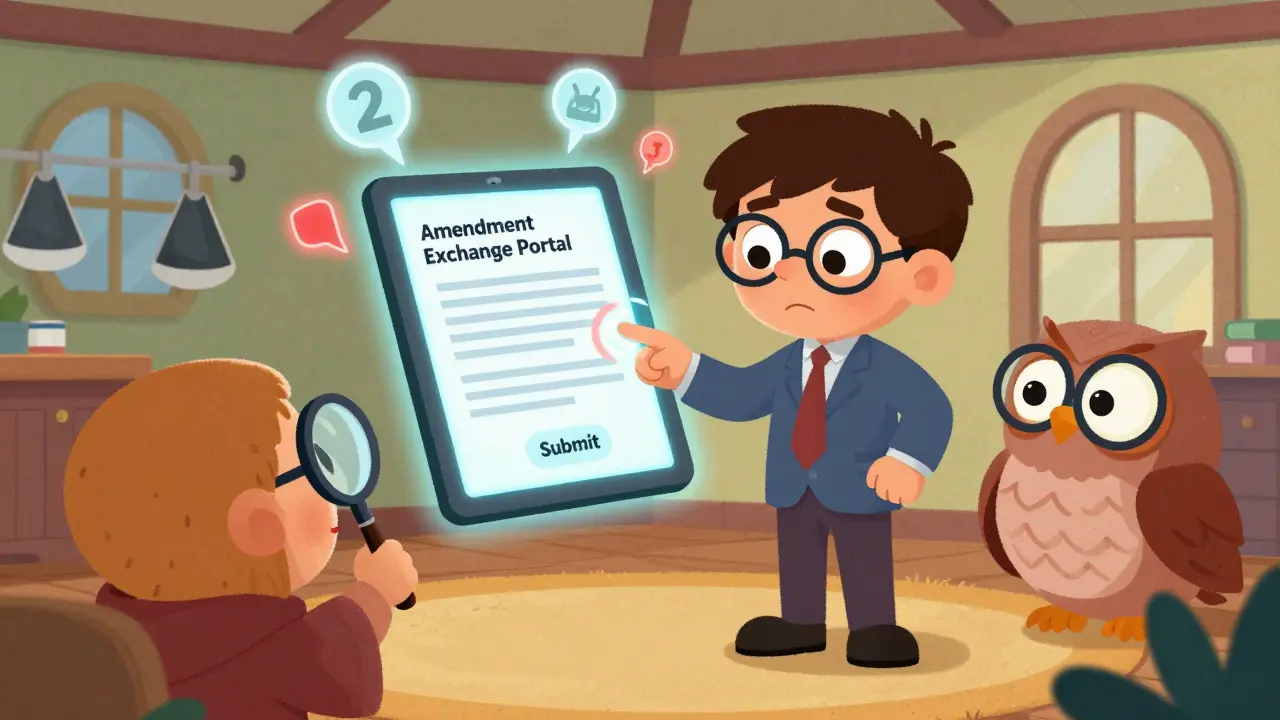
Under the current system, you can’t just drop a new amendment into a markup session. You have to file it electronically at least 24 hours in advance using the Amendment Exchange Portal. This isn’t just uploading a document-it’s filling out structured metadata. You must tag every line you’re replacing, explain why you’re changing it, and classify your substitution as Level 1, 2, or 3.
Level 1 means tiny wording tweaks-fixing a typo or clarifying a phrase. Level 2 is procedural-adjusting timing, scope, or enforcement mechanisms. Level 3 is the big one: changing policy, adding new funding, or altering legal standards. Each level has its own approval hurdle. Level 1 and 2 need simple majority support from the new Substitution Review Committee. Level 3? You need 75% of the committee to agree. That’s a big jump from the old 50% rule.
Who Controls the Process Now?
The Substitution Review Committee, created in early 2025, is made up of three members from the majority party and two from the minority. They have 12 hours to approve or reject any substitution request. That’s tight. In practice, this means minority members often have to submit their changes days in advance, knowing they’ll be reviewed during a short window, sometimes before their own staff has fully analyzed the impact.
House Republican leadership says this keeps out "poison pill" amendments-last-minute changes designed to kill a bill by making it unpalatable. Representative Tony Gonzales (R-TX) told the Rules Committee in May 2025 that the system stopped "last-minute sabotage" during the defense authorization bill markup. But critics point out that the same system blocked critical updates to disaster relief bills in May 2025, forcing lawmakers to seek special rule waivers 67% of the time just to respond to emergencies.

Speed vs. Fairness: The Trade-Off
There’s no denying the system is faster. In the first quarter of 2025, the House cut amendment processing time by 37% compared to the same period in 2024. More bills cleared committee markup-up 28%. That’s efficiency.
But speed isn’t the same as fairness. Minority party staff report a 58% increase in formal objections to rejected substitutions. A May 2025 survey of 127 committee staff showed 83% of minority-side staff rated the system as "restrictive of legitimate input," averaging just 2.1 out of 5. Meanwhile, 68% of majority staff called it "more efficient," giving it a 4.2 out of 5.
One example stands out: Representative Pramila Jayapal (D-WA) had her substitution to H.R. 1526 rejected because the portal misclassified her changes as Level 3. Her edits were procedural-adjusting reporting deadlines. But the system flagged them as policy changes. She had to refile, delay the bill, and lose valuable floor time. The portal doesn’t understand context. It reads line numbers and keywords. That’s a flaw built into the design.
How This Compares to the Senate
The Senate hasn’t changed its rules. There’s still no review committee. No mandatory metadata. Just a 24-hour notice. That means substitutions in the Senate happen roughly 43% faster than in the House. Bills move quicker. Amendments get added more freely. But so do surprises.
This creates a strange imbalance. A bill might pass the House with tight controls, then hit the Senate where a single senator can swap in a major amendment with no warning. Lawmakers now have to draft two versions of every amendment-one for the House’s rigid system, another for the Senate’s open one. It’s inefficient in a different way.
Real Problems: Training, Errors, and Ambiguity
When the portal launched in January 2025, 43% of first-time filers got it wrong. They didn’t tag lines correctly. They skipped the justification. They misclassified the level. The House responded with 12 detailed guidance memos and mandatory training. By May, the error rate dropped to 17%. Still, it’s a burden.
Committee staff now spend an average of 14 hours training new members just to file one substitution correctly. That’s not just time-it’s opportunity cost. Lawmakers who could be negotiating with colleagues are stuck learning software.
And the ambiguity? It’s real. The Minority Staff Association pointed out in April 2025 that "Level 3 determinations remain inconsistently applied." One committee might call a funding change Level 3. Another might call it Level 2. There’s no official definition beyond broad categories. That opens the door to partisan decisions disguised as technical errors.

What’s Next? The Push for Transparency and Reform
By June 2025, pressure mounted after the energy policy markup revealed wild inconsistencies in how substitutions were rated. That led to a new bill: H.R. 4492, the "Substitution Transparency Act." It would require every review committee to publish its deliberations within 72 hours. Right now, those meetings are closed. No public record. No accountability.
Meanwhile, the Senate GOP is testing a draft that would force the House and Senate to use the same substitution rules. But the parliamentarian shot down key parts, saying they violate the Byrd Rule-meaning they can’t be included in budget reconciliation bills. That’s a dead end for now.
Legal challenges are brewing. The Constitutional Accountability Center filed an amicus brief in May 2025 arguing the rules restrict representative speech under the First Amendment. Others warn they violate the Presentment Clause by making it harder for minority voices to influence legislation. These arguments won’t be settled in 2026. But they’re coming.
How Lobbyists and Staff Are Adapting
Lobbying firms didn’t wait for the rules to settle. By early 2025, 63% of major firms restructured their amendment tracking teams. They shifted focus from floor lobbying to committee staff relationships. Why? Because now, the real power lies with the five people on the Substitution Review Committee-not the full chamber.
Expenditure data shows a 29% increase in committee-specific lobbying in the first half of 2025. That’s money spent on dinners, briefings, and one-on-one meetings with staff who know how the portal works, who’s on the committee, and what kind of justification gets approved. It’s not about persuading 435 members anymore. It’s about convincing five.
Will These Rules Last?
Supporters say these changes are here to stay. The Heritage Foundation predicts "permanent entrenchment" of the new efficiency measures. The House has already seen a drop in procedural gridlock. Bills move. Votes happen. Leadership likes that.
But critics see a ticking clock. The Brennan Center warns of a "potential backlash after the 2026 elections." If Democrats regain control of the House, they’ll likely roll back the 75% threshold. They’ll scrap the review committee. They’ll bring back the old system-or make it even looser.
For now, the rules are in place. The portal is live. The training is done. The data shows it works-faster, cleaner, more controlled. But it also shows it’s less open. Less fair. Less democratic. Whether that trade-off is worth it depends on who you ask-and which side of the aisle you’re on.
What is the Amendment Exchange Portal?
The Amendment Exchange Portal is the official online system used by House members to submit amendment substitutions. Launched on January 15, 2025, it requires users to upload amendment text with metadata, including exact line numbers being replaced, justification for changes, and classification as Level 1, 2, or 3. It’s mandatory for all substitutions filed after that date.
How do Level 1, 2, and 3 substitutions differ?
Level 1 substitutions are minor wording changes-like fixing grammar or clarifying phrasing. Level 2 are procedural adjustments-changing deadlines, enforcement, or reporting requirements. Level 3 are substantive policy changes-adding new funding, altering legal standards, or creating new programs. Each level requires higher approval thresholds, with Level 3 needing 75% committee support.
Why was the 75% approval threshold introduced?
The 75% threshold for Level 3 substitutions was introduced to prevent majority party leadership from being forced to accept major policy changes pushed by the minority. Before 2025, only 50% was needed. The change was meant to reduce "poison pill" amendments and increase control over the legislative agenda, especially for complex or controversial bills.
Can the Senate use the same substitution rules?
No. The Senate still operates under older rules that require only a 24-hour notice for substitution and have no formal review committee. This makes the Senate process significantly faster-about 43% faster-than the House’s new system. The two chambers now operate under very different frameworks, creating complications for bills moving between them.
What are the biggest criticisms of the new substitution rules?
The biggest criticisms are that the rules reduce minority party influence, create partisan ambiguity in classification, and add bureaucratic delays. Minority staff report 83% feel the system restricts legitimate input. The automated portal misclassifies amendments, and Level 3 determinations lack consistent standards. Critics argue it prioritizes efficiency over democratic deliberation.
Are there any legal challenges to these rules?
Yes. The Constitutional Accountability Center filed an amicus brief in May 2025 arguing the substitution rules violate the First Amendment by restricting representative speech. Others are preparing challenges under the Presentment Clause, claiming the rules make it harder for minority members to influence legislation. These cases could reach the courts after the 2026 elections.
How has lobbying changed because of these rules?
Lobbying has shifted from trying to influence the full House to targeting the five members of the Substitution Review Committee. Major firms restructured their teams in early 2025, increasing spending on committee-specific lobbying by 29%. Relationships with staff who understand the portal and the approval thresholds are now more valuable than floor speeches or public pressure.



Write a comment