

If you’ve ever woken up drenched in sweat, heart pounding, with the same terrifying scene still playing in your head - you’re not alone. For people with PTSD, nightmares aren’t just bad dreams. They’re relentless. They come every night. Sometimes multiple times. And no matter how hard you try to push them away, they come back. You might be sleeping in a safe house, surrounded by loved ones, but your mind is still trapped in the past. That’s where imagery rehearsal therapy comes in - a simple, proven way to take back control of your dreams.
Why Nightmares Stick Around After Trauma
Trauma doesn’t just live in your memories. It lives in your sleep. Studies show up to 72% of people with PTSD suffer from frequent, distressing nightmares. These aren’t random. They’re often exact replays of the traumatic event - the crash, the attack, the fire, the battlefield. Even years later, your brain keeps replaying it like a broken record. And it’s not just about fear. These nightmares mess with your whole life. You start avoiding sleep. You feel exhausted all day. You become irritable, withdrawn, anxious. Standard PTSD therapy helps with flashbacks and avoidance, but it often doesn’t touch the nightmares. That’s why so many people keep struggling - even after years of talk therapy.What Is Imagery Rehearsal Therapy (IRT)?
Imagery Rehearsal Therapy, or IRT, was developed in the early 2000s to specifically target trauma-related nightmares. Unlike other treatments, it doesn’t ask you to relive the trauma. Instead, it gives you a tool to rewrite the nightmare - while you’re awake. The goal isn’t to forget what happened. It’s to change what happens in your dreams. And it works. A 2014 review of 13 clinical trials found that IRT reduces nightmare frequency by a large margin - more than medication in many cases. It also improves sleep quality and reduces overall PTSD symptoms. The effects last. People who stick with it report fewer nightmares even six months to a year later.The Four Steps of IRT
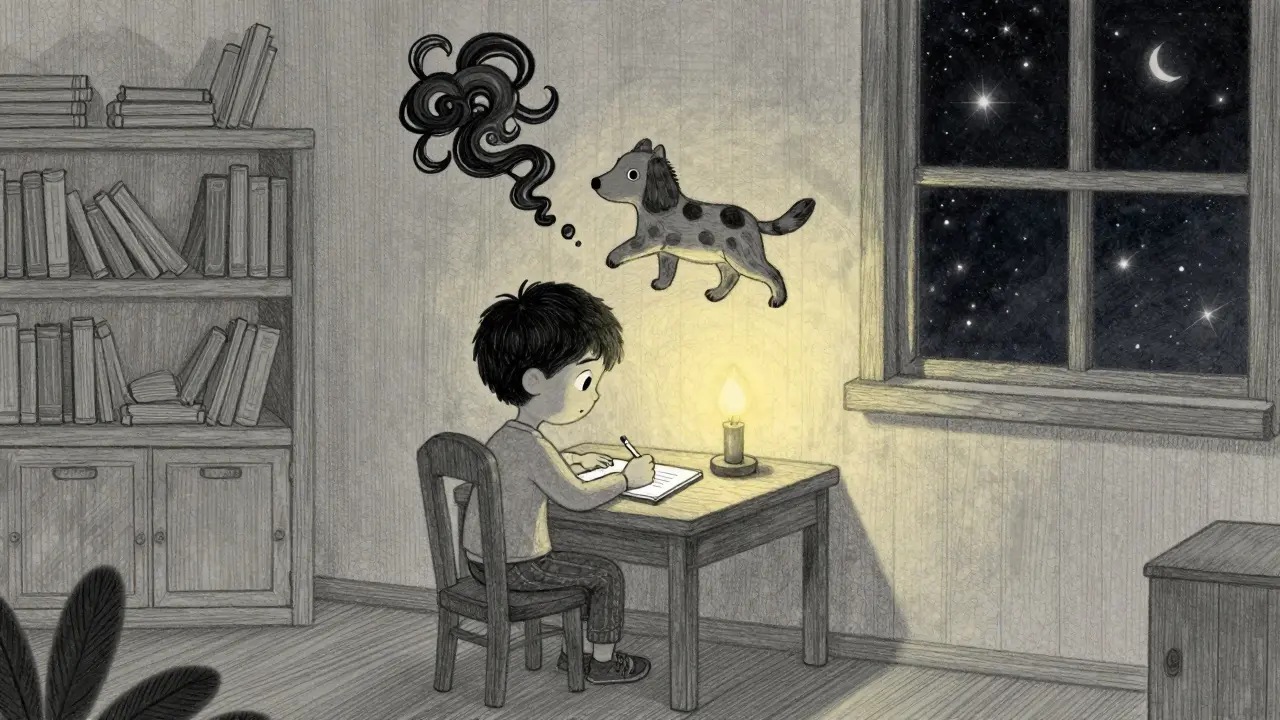
IRT is straightforward. It doesn’t need fancy equipment or long sessions. Here’s how it works:- Write it down. Right after waking from a nightmare, grab a notebook and pen (not your phone - the screen light messes with sleep). Write down the nightmare exactly as you remember it. Don’t edit. Just get it out.
- Change the story. Now, rewrite the nightmare. Not to make it happy. But to make it less scary. Maybe the attacker disappears. Maybe you find a way out. Maybe you’re not alone. The new version doesn’t have to be realistic - just calming. The key is to replace helplessness with control.
- Practice the new dream. Every night, before sleep, close your eyes and imagine the new version of the dream. Picture it clearly. Feel the new outcome. Do this for 10 to 15 minutes. Some people pair this with deep breathing or gentle muscle relaxation to calm the body.
- Repeat nightly. Consistency matters. You don’t need to do it perfectly. Just show up. Most people start seeing changes within two to three weeks. The biggest drop in nightmares usually happens between the third and fifth session.
It sounds simple. But it’s powerful. You’re not erasing the past. You’re giving your brain a new script to follow when it’s dreaming.
Why IRT Beats Medication for Nightmares
For years, doctors prescribed prazosin - a blood pressure drug - to treat PTSD nightmares. It was widely used, especially in the military. But in 2018, a major study of 304 U.S. veterans found prazosin worked no better than a placebo. The nightmares didn’t improve. Sleep didn’t get better. The drug had side effects - dizziness, low blood pressure - but no real benefit. Meanwhile, IRT kept working. Studies show it reduces nightmare frequency with a large effect size (d = 1.24). Veterans who completed IRT reported an 83% success rate - at least half their nightmares disappeared. Over 60% stopped having them completely. That’s not luck. That’s science.Who Can Benefit - And Who Might Struggle
IRT works best for people whose nightmares are clearly tied to a single trauma. Military veterans, survivors of assault, first responders - they often see fast results. But it’s not a magic fix for everyone. If you have other sleep disorders - like sleep apnea or restless legs - IRT alone won’t fix those. You might need to treat those first. People with complex trauma or multiple traumas may need more time or extra support. And some folks resist changing their nightmares because they feel like they’re “betraying” what happened. That’s normal. A good therapist helps you understand: your nightmare is a distorted version of the memory. It’s not the memory itself. Changing the dream doesn’t mean forgetting what happened. It means stopping the trauma from hijacking your rest.
What to Expect During Treatment
IRT is usually done over 4 to 6 weekly sessions with a trained clinician. You’ll keep a sleep diary - tracking nightmare frequency, intensity (on a scale of 0 to 10), and how you felt the next day. Progress isn’t always linear. Some nights, the old nightmare sneaks back. That’s okay. You don’t have to be perfect. Just keep practicing the new script. Most people report feeling more rested, less anxious, and more in control of their lives after just a few weeks. Work, relationships, mood - they all start to improve as sleep returns.How to Get Started
IRT isn’t something you do on your own unless you’ve been trained. It’s not a self-help app. You need a therapist who understands both trauma and sleep disorders. Look for clinicians certified in cognitive behavioral therapy (CBT) with experience in PTSD and nightmares. The American Academy of Sleep Medicine and the Department of Veterans Affairs both recommend IRT as a first-line treatment. In fact, 92% of VA medical centers now offer it. If you’re a veteran, ask your provider. If you’re not, search for trauma specialists in your area. Don’t wait until you’re completely broken. Even one nightmare a week is too many.The Future of Nightmares Treatment
New versions of IRT are being tested. One called N-IRT combines imagery rehearsal with narrative therapy - helping people tell their trauma story in a new way - and it’s showing promise in single-session formats. Researchers are also exploring how to deliver IRT through telehealth, especially in rural areas. In 2024, the VA started a $3.7 million project to improve online delivery. The goal? Make this life-changing tool accessible to anyone who needs it.PTSD doesn’t have to own your sleep. Nightmares don’t have to be your life sentence. Imagery Rehearsal Therapy gives you the power to rewrite them - one night at a time.
Can imagery rehearsal therapy work for nightmares that aren’t from trauma?
Yes. While IRT was developed for trauma-related nightmares, it’s also effective for nightmares from stress, anxiety, or even certain medications. The core principle - rewriting the dream script - works regardless of the cause. The key is whether the nightmare is recurring and distressing. If it is, IRT can help.
Do I need to remember my nightmares perfectly to do IRT?
No. You don’t need perfect recall. Even vague details - like feeling chased, trapped, or helpless - are enough to start. The goal isn’t to recreate the dream exactly. It’s to change the emotional outcome. Write down what you remember, even if it’s just fragments. The rest will come as you practice.
How long does it take to see results with IRT?
Most people notice a drop in nightmare frequency within 2 to 3 weeks of starting nightly practice. The biggest improvements usually happen between sessions 3 and 5. Complete cessation of nightmares is common after 4 to 6 sessions. Consistency matters more than perfection.
Can I do IRT on my own without a therapist?
Some people try IRT on their own using books or online guides. But it’s risky without support. Trauma nightmares are powerful. Without guidance, you might get stuck, feel overwhelmed, or accidentally reinforce the fear. A trained clinician helps you navigate resistance, adjust the script safely, and avoid retraumatization. It’s not impossible to do alone - but it’s safer and more effective with a professional.
Is IRT covered by insurance?
Yes, in many cases. Because IRT is endorsed by the American Academy of Sleep Medicine and the Department of Veterans Affairs, it’s often covered under mental health benefits. Veterans can access it through VA facilities at no cost. Private insurance may cover it if delivered by a licensed therapist under CBT or trauma treatment codes. Always check with your provider - but don’t assume it’s not covered.
What if the new dream I create feels too silly or unrealistic?
That’s normal. The new dream doesn’t need to make sense logically. It just needs to feel safe. Maybe you turn into a bird and fly away. Maybe a friend appears out of nowhere. Maybe the scary figure just walks away. The brain doesn’t care if it’s realistic - it cares if it reduces fear. Let go of perfection. Focus on feeling calm in the new version. That’s what matters.


15 Comments
Payson Mattes
Okay but have you ever heard that the VA is secretly using IRT to program veterans' dreams so they don't remember what really happened in Afghanistan? I mean, why else would they push this so hard? The military's been rewriting memories since the '40s - this is just the new flavor of mind control. I saw a guy on YouTube who said his new dream had a guy in a suit handing him a coffee... that's not healing, that's programming. They want you docile. Sleep is the last frontier.
Isaac Bonillo Alcaina
There is a fundamental flaw in your assertion that IRT reduces nightmare frequency 'more than medication in many cases.' The 2014 review you cite includes studies with small sample sizes, inadequate control groups, and no double-blinding. Moreover, the effect size you reference (d = 1.24) is inflated by publication bias - most negative trials remain unpublished. The placebo response in sleep interventions is notoriously high, and you're conflating subjective improvement with objective clinical efficacy. IRT is not evidence-based; it's anecdotal therapy dressed in scientific language.
Bhargav Patel
One cannot help but reflect upon the profound metaphysical implications of this therapeutic approach. The human psyche, in its nocturnal wanderings, is not merely a repository of trauma, but a mirror reflecting the soul’s unresolved dialogues with time, memory, and identity. To rewrite a nightmare is not to evade suffering, but to engage in a sacred act of re-narration - a quiet rebellion against the tyranny of the past. In this light, IRT becomes less a technique and more a ritual of inner sovereignty. One does not conquer fear; one transmutes it into meaning. And in that transmutation, perhaps, lies the true healing.
Steven Mayer
IRT’s efficacy is contingent on neurocognitive reconsolidation mechanisms, specifically the disruption of fear memory traces during REM sleep modulation via pre-sleep cognitive restructuring. However, the absence of polysomnographic validation in most IRT studies renders the clinical outcomes correlational at best. The reported 83% success rate lacks stratification by trauma subtype, comorbidities, or baseline cortisol levels - critical confounders in PTSD phenotyping. Without biomarker correlation, this remains behavioral placebo with a narrative veneer.
Charles Barry
Of course the VA loves this. It’s cheaper than paying disability. They don’t want to admit the system broke these men and women - they’d rather hand them a notebook and tell them to dream better. And don’t get me started on the pharmaceutical companies pushing prazosin for years while IRT was buried. This is all a cover-up. The government doesn’t care about healing - they care about silencing. You think your dreams are yours? They’re watching. They’re editing. And now they’re selling you the pen.
Rosemary O'Shea
How utterly pedestrian. You’ve reduced the sacred, terrifying beauty of the unconscious to a self-help checklist. ‘Write it down. Change it. Practice.’ As if trauma were a poorly written screenplay and not the shattering of a soul. IRT is the aesthetic of capitalism applied to grief - neat, marketable, and utterly devoid of depth. Real healing doesn’t come from rewriting dreams. It comes from sitting in the ashes. And no amount of breathing exercises will change that.
Joe Jeter
Wait - so if I rewrite my nightmare where I’m being chased by a monster into one where I’m peacefully gardening… does that mean I’m just gaslighting myself? What’s next? ‘I’m not depressed, I’m just having a bad Tuesday’? This feels like emotional avoidance wrapped in a bow. Trauma isn’t a bad dream you can edit out. It’s real. And pretending otherwise is just… lazy.
Sidra Khan
ok but like… i tried this for 3 days and my dream changed to me being chased by a giant llama?? i swear i didn't make that up. now i'm scared of llamas. 😅
siddharth tiwari
so i tried this but i cant even remember my nightmares proper. i just wake up feeling like someone stepped on my chest. so i wrote down ‘i am safe’ and looked at it before bed. now i dream of my grandma smiling. she died in 2012. i dont know if this works but i feel less alone. ty for the post.
Adarsh Dubey
It is worth noting that the effectiveness of IRT appears to be contingent upon the individual’s capacity for cognitive flexibility and imaginative engagement. For those with rigid thought patterns or severe dissociative symptoms, the technique may prove inaccessible. Yet, its simplicity and non-invasive nature render it a valuable first-line intervention - not as a cure, but as a bridge toward deeper therapeutic work. One need not believe in magic to benefit from a gentle, structured ritual.
bharath vinay
They’re lying about the 83% success rate. That number comes from VA contractors who get bonuses for ‘treatment completion.’ I’ve seen the spreadsheets. Most people drop out after week 2. The ones who stay? They’re the ones already healing on their own. IRT doesn’t work - it just makes people feel like they’re doing something. Meanwhile, the real cause - chemical warfare exposure in the Gulf - is buried under 3000 pages of redacted files.
Dan Gaytan
This gave me chills. I’ve been having nightmares since my brother died, and I never thought I could change them. I tried IRT last week - rewrote my dream so he was just sitting on the porch, waving. I cried when I woke up. But not from fear. From peace. Thank you for sharing this. You’re not just talking about sleep - you’re talking about hope.
Abby Polhill
As someone who works in global mental health, I’ve seen IRT adapted in rural India with remarkable success - no therapists needed. Community health workers use storytelling circles to co-create dream revisions. The cultural translation is beautiful: instead of ‘you change the dream,’ it becomes ‘we hold the dream together.’ This isn’t just clinical - it’s communal healing. The West thinks trauma is individual. Many cultures know it’s collective.
Bret Freeman
I’ve been screaming in my sleep since I was 12. I’ve been to 17 therapists. I’ve tried EMDR, ketamine, hypnosis, acupuncture, crystals, and a shaman who yelled at me in Latin. IRT is the first thing that didn’t make me feel like a broken toy. I rewrote my nightmare so the monster turned into my dad and said, ‘I’m sorry I wasn’t there.’ I didn’t even know I needed to hear that. I’m not cured. But for the first time in 20 years… I slept through the night. And I’m not ashamed to say it.
Lindsey Kidd
Thank you for writing this. I’m a trauma therapist, and I’ve been using IRT for years. I’ve seen people who couldn’t sleep for a decade start sleeping again. I’ve watched them hug their kids again. I’ve seen them laugh. This isn’t magic. It’s neuroscience. And it’s accessible. If you’re reading this and you’re still afraid to try - you’re allowed to be scared. But you’re also allowed to hope. One dream at a time. 💛