
When you pick up a prescription, you might not think twice about whether it’s the brand name or the generic version. After all, the label says it’s the same medicine - same active ingredient, same dose, same pill shape. But here’s the question most people don’t ask: Are generic drugs just as safe as brand-name drugs over years of use?
The answer isn’t simple. On paper, regulators say yes. In real life, some patients swear otherwise. And the science? It’s messy, contradictory, and revealing.
What Does ‘Therapeutic Equivalence’ Really Mean?
The U.S. Food and Drug Administration (FDA) requires generic drugs to prove they’re bioequivalent to the brand. That means the body absorbs the active ingredient within a narrow range - 80% to 125% of the brand’s absorption rate. On the surface, that sounds tight. But think about it: a 20% variation in how much drug enters your bloodstream is allowed. For most medications, that’s fine. For others? It can be the difference between control and crisis.
Take levothyroxine, the drug used to treat hypothyroidism. A 2017 study found that patients switching from Synthroid (brand) to generic versions had a 12.3% higher chance of abnormal thyroid-stimulating hormone (TSH) levels. That might not sound like much, but in thyroid disease, even small fluctuations can cause fatigue, weight gain, heart palpitations, or worse. The FDA acknowledges this. That’s why they list levothyroxine, warfarin, and some anti-seizure drugs as having a narrow therapeutic index - meaning tiny changes in blood levels can have big effects.
Big Studies, Big Differences
In 2020, researchers in Austria looked at over 1.2 million patients on chronic medications between 2007 and 2012. They compared outcomes for those on brand-name versus generic versions of antihypertensives, statins, and diabetes drugs. The results stunned many.
Patients on brand-name blood pressure meds had 53.8 deaths per 1,000 patient-years. Those on generics? Just 30.2. That’s nearly half the mortality rate. Major cardiac events like heart attacks and strokes were also 39% lower in the generic group. The study didn’t just compare one or two drugs - it looked at 17 different medications across multiple conditions. The authors used advanced statistical methods to rule out bias. Their conclusion? Generics weren’t just safe - they were better.
Wait - better? How?
It’s not that generics are magically safer. It’s likely that the patients who got generics were more likely to stick with their treatment. Generics cost less. People refill more often. They don’t skip doses because they can’t afford the brand. That’s not a drug difference - that’s a system difference. And it matters more than most realize.
The Flip Side: When Generics Don’t Work
But then there are the stories that don’t fit the data.
A 2013 case report in the PMC database described a patient switched from Ciproxin (brand ciprofloxacin) to Mylan’s generic version. His infection didn’t clear. He kept getting fevers. He kept feeling awful. Only after switching back to the brand did his symptoms vanish. Another patient on generic levofloxacin had the same experience - symptoms improved only after switching to Tavanic, the brand.
These aren’t rare. A 2018 analysis of patient reports found that 30% of people who switched from brand to generic saw no change. Another 30% got worse - some with side effects, others with complete loss of effectiveness. In a few cases, patients had to stop the drug entirely.
One Reddit user with epilepsy posted in 2023: ‘I was stable on Lamictal for five years. Switched to generic lamotrigine. Seizures went from once a month to 8-10 times a week. Switched back. Back to normal.’ That post got over 1,800 upvotes. Others chimed in with similar stories - for epilepsy, bipolar disorder, and asthma.
It’s Not Brand vs Generic - It’s Manufacturer vs Manufacturer
Here’s something most people don’t know: many brand-name drugs are made by the same companies that make generics. These are called authorized generics. They’re identical to the brand - same factory, same formula, same packaging - just sold under a generic label at a lower price.
A 2018 study compared adverse event reports for amlodipine (a blood pressure drug). Brand-name versions had 29.5% of reports. Authorized generics? 14.3%. But traditional generics? 56.2%. That’s more than half of all reports - and they weren’t from the brand’s own manufacturer.
Same for losartan. Brand: 56%. Authorized generic: 1.5%. Generic: 42%. The pattern? The brand and its authorized generic had similar safety profiles. But the third-party generics? Much higher reports.
This suggests the real issue isn’t brand vs generic - it’s who made it.
Where the Drug Is Made Matters
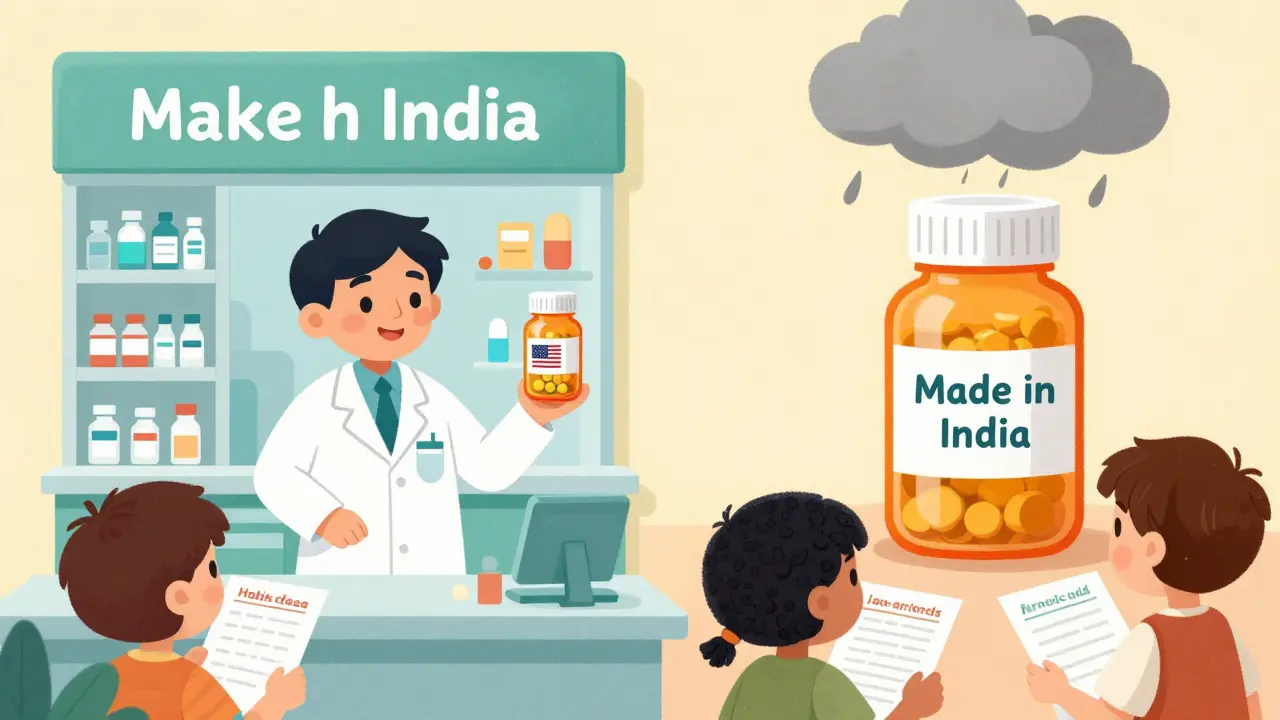
A 2018 study from Ohio State University dug into the FDA’s adverse event database. They compared generic drugs made in the U.S. versus those made in India. The results were alarming.
Indian-made generics had 54% more severe adverse events - including hospitalizations, disability, and death - than U.S.-made versions. For ciprofloxacin, the difference was even sharper: 62% higher rate of hospitalizations from Indian-made versions. This held true even after adjusting for how many pills were sold.
Why? Manufacturing standards vary. Quality control isn’t always consistent. And the FDA inspects only a fraction of foreign facilities each year. That doesn’t mean all Indian-made drugs are dangerous. But it does mean the country of origin isn’t just a label - it’s a safety factor.
What About the Long-Term? The Data Is Still Growing
Harvard researchers studied over 136,000 older adults on three blood pressure drugs - losartan, valsartan, and candesartan. They looked at ER visits and hospitalizations before and after generic versions hit the market. No spike in adverse events. No rise in hospitalizations. The numbers stayed flat.
But here’s the catch: this study only looked at serious events that led to hospital visits. It didn’t catch mild side effects - dizziness, nausea, fatigue - that might make someone stop taking the drug. And it didn’t track outcomes over 10 or 20 years.
Long-term safety studies are hard. They take time. They need huge populations. And they’re expensive. Most drug trials last 6-12 months. Real life? People take these pills for decades.
Who Should Be Careful?
Not everyone needs to worry. For most people taking common meds - antibiotics, statins, antihistamines - generics are just fine. The data supports it.
But if you’re on one of these, think twice before switching:
- Warfarin (blood thinner)
- Levothyroxine (thyroid)
- Lamotrigine (seizures, bipolar)
- Cyclosporine (organ transplants)
- Phenytoin (seizures)
- Inhalers, injectables, or topical creams (complex formulations)
These drugs have tight safety margins. Even small changes in how your body absorbs them can cause problems. Talk to your doctor before switching. Keep a log of how you feel. If something changes - fatigue, mood swings, heart rhythm, seizure frequency - don’t ignore it.
The Bottom Line: Trust, But Verify
The FDA says generics are safe. Most studies agree. But safety isn’t just about approval paperwork. It’s about real people, real bodies, and real time.
For the vast majority of patients, generics work just as well - and often better - because they’re affordable and easier to stick with.
But if you’re on a critical medication, or you’ve had a bad reaction after a switch, your experience matters. It’s not anecdotal - it’s data waiting to be understood.
Don’t assume all generics are the same. Don’t assume brand always means better. Ask your pharmacist: Who makes this? Ask your doctor: Is this one of the drugs where small changes matter?
And if you’ve had a bad experience? Report it. The FDA’s Adverse Event Reporting System (FAERS) is public. Your story could help someone else avoid the same mistake.
Medicine isn’t a one-size-fits-all system. The same pill can save one person and harm another. That’s not a flaw in generics. It’s a reminder that human biology is complex - and safety isn’t just about labels. It’s about attention, awareness, and asking the right questions.
8 Comments
Jasmine Bryant
I’ve been on generic levothyroxine for three years and never had an issue-but my aunt switched and her TSH went wild. She had to go back to Synthroid and now she’s stable. I never realized how much the filler chemicals could matter until she started listing all the weird side effects-brain fog, heart flutters, the whole deal. I guess it’s not just the active ingredient, huh?
Liberty C
Let’s be real-most people who swear by generics haven’t actually read the FDA’s bioequivalence guidelines. 80% to 125%? That’s not ‘equivalent’-that’s a gambling range. If your medication has a narrow therapeutic index, you’re essentially playing Russian roulette with your endocrine system. And don’t get me started on Indian-manufactured generics with questionable quality control. This isn’t ‘affordable healthcare’-it’s pharmaceutical roulette with a side of corporate greed.
shivani acharya
Oh wow so the FDA is just letting random factories in India make our life-saving pills? And you’re telling me this is normal? I mean, I know they make iPhones there too but at least those don’t make you have seizures or your heart stop. My cousin’s mom died after switching to a cheap generic warfarin-no one even told her it wasn’t the same brand. And now they want us to trust these pills with our lives? Please. The pharmaceutical companies are laughing all the way to the bank while we’re dying in our sleep. This is a cover-up. It’s all connected. Big Pharma owns the FDA. They own the doctors. They own the pharmacies. And they don’t care if you live or die as long as you keep buying.
Hilary Miller
My dad’s on generic statins and he’s never felt better. Affordable meds = consistent use. That’s the real win.
Margaret Khaemba
This is such a nuanced topic. I never thought about how the manufacturer matters more than brand vs generic. I had no idea authorized generics exist-same factory, same stuff, just cheaper. That’s wild. I wonder if pharmacies even know which version they’re dispensing? Maybe we should all start asking for the manufacturer name on the label. It’s not just about price-it’s about who’s behind the pill.
Malik Ronquillo
So generics are fine unless they’re not. And brand is better unless it’s not. And Indian-made is dangerous unless it’s not. And the FDA says one thing but real people say another. Honestly I just want to know who made my damn pill and if I can get the same one every time. Stop making this so complicated. I just need to not die.
Brenda King
I have epilepsy and switched to generic lamotrigine last year. Seizures went from monthly to daily. I begged my neurologist to switch me back. Took two weeks to get the brand. My life changed. I’m not exaggerating. I’m not paranoid. I’m just someone who lived it. Please, if you’re on anything with a narrow therapeutic window-don’t gamble. Ask for the brand. Or ask for the authorized generic. And if you’re a pharmacist? Tell your patients. This isn’t just science. It’s survival.
Chiraghuddin Qureshi
Bro I’m from India and we make like 40% of the world’s generics 😎 And yeah some factories are sketchy but most are legit-FDA inspects us every 2 years now. Also my uncle takes generic metformin and he’s running marathons at 70 🤘 So chill. Not all Indian generics = death pill. Also why are you all so scared? We’re not making pills out of dirt. We’re making medicine. With science. 🇮🇳💊