

The Quick Guide to Generic Equivalence
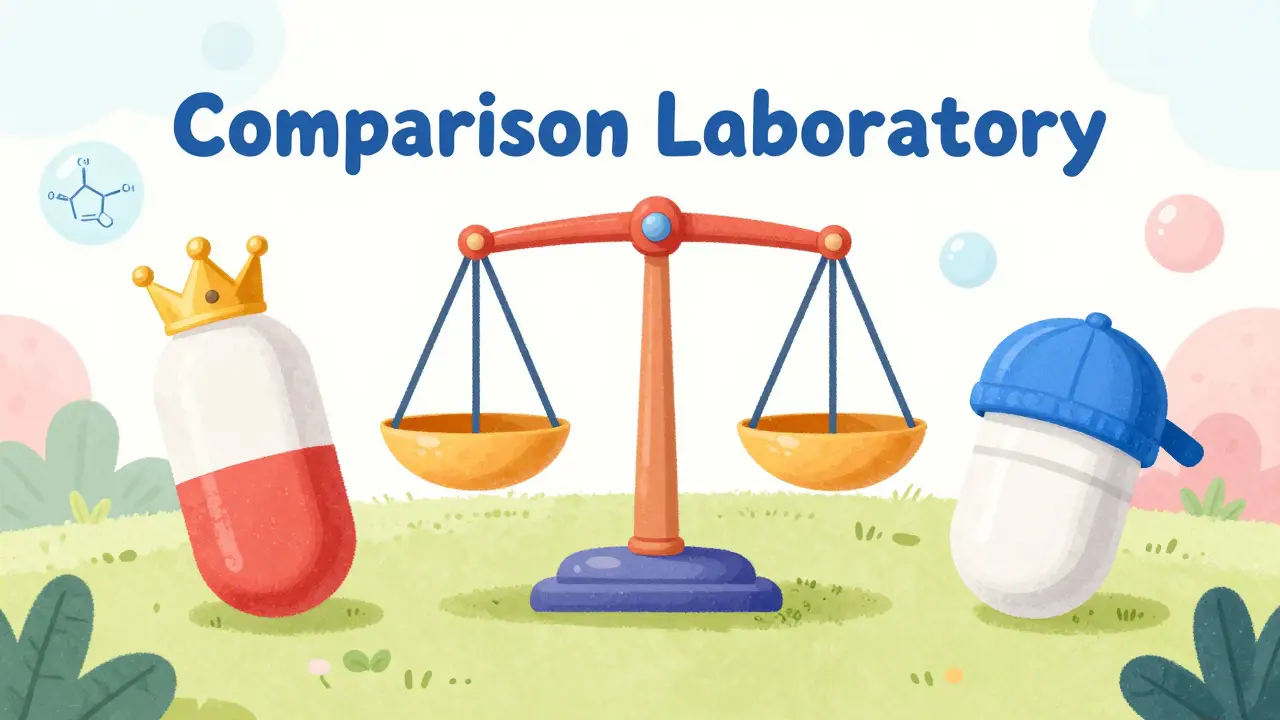
If you're in a rush, here is the bottom line: look for the AB rating. If a generic drug has an AB code, the FDA has determined it is therapeutically equivalent to the brand-name version. If it has a B code, it is pharmaceutically equivalent (same ingredients) but not therapeutically equivalent (it might be absorbed differently). If there is no code at all, it's either an over-the-counter (OTC) product or it has been discontinued.
What Exactly Makes a Drug "Equivalent"?
The FDA doesn't just take a manufacturer's word for it. To get that coveted AB rating, a generic drug must pass a strict five-part test. First, it must be approved as safe and effective. Second, it must be a Pharmaceutical Equivalent, meaning it has the exact same amount of the same active ingredient in the same dosage form and route of administration. Third, it must be Bioequivalent. This is the hard part. The manufacturer must prove the drug reaches the bloodstream at the same rate and to the same extent as the brand name. Fourth, the labeling must be adequate, and fifth, the drug must be made following Current Good Manufacturing Practice (cGMP) regulations. If a drug fails even one of these, it won't get an A rating.
Step-by-Step: How to Verify Equivalence in the Electronic Orange Book
The electronic version of the database is updated daily, making it the only reliable way to check current status. Here is the exact workflow to verify a generic drug:
- Start with the Brand Name: Go to the prescription (Rx) section of the Electronic Orange Book. Search using the proprietary (brand) name. This helps you identify the exact Active Ingredient.
- Run an Ingredient Search: Once you have the ingredient name, run a new search for all products containing that ingredient. This generates a list organized by how the drug is taken (e.g., oral tablet vs. injection).
- Locate the Reference Listed Drug (RLD): Look for the column labeled "RLD." The Reference Listed Drug is the brand-name drug the FDA uses as the benchmark. It will be marked with a "Yes."
- Check the TE Code: Look at the final column for the generic products (marked "No" in the RLD column). This is where you'll find the Therapeutic Equivalence (TE) code.
If you see "AB," you're gold. If you see "AB1" or "AB2," it just means there are multiple brand-name versions of the drug, and the number tells you which specific one the generic matches.
| Code | Meaning | Can it be substituted? |
|---|---|---|
| A | Therapeutically Equivalent | Generally, Yes |
| B | Not Therapeutically Equivalent | No (Bioequivalence issues) |
| AB | Same active ingredient + Bioequivalent | Yes (Standard for generics) |
| No Code | OTC or Discontinued | N/A |
The "Fine Print": Why an AB Rating Isn't Always a Guarantee
Here is the part that catches people off guard: the Orange Book is a federal scientific tool, but pharmacy laws are state-level. Even if a drug is AB-rated, your pharmacist might not be able to swap it automatically. This often happens with Narrow Therapeutic Index (NTI) drugs. These are medications where a tiny difference in dose or absorption can lead to a huge change in how the patient reacts-think of drugs like levothyroxine (Synthroid) or warfarin.
In these cases, some states require a doctor's specific authorization before a generic can be used, regardless of the AB rating. The Orange Book tells you the science, but your state board of pharmacy tells you the law.
Avoiding Common Mistakes
When using the database, it's easy to get tripped up. One of the biggest errors is confusing patent expiration dates with market exclusivity. Just because a patent expires doesn't mean a generic hits the market instantly; the FDA may grant the original company a period of exclusivity that keeps generics away for a few more years.
Another pitfall is relying on third-party websites. While sites like Drugs.com are helpful, they can lag behind the official FDA data by 24 to 72 hours. If you are dealing with a critical medication or a complex patent dispute, always go straight to the source at fda.gov.

The Future of Drug Verification
The way we verify drugs is changing. The FDA is moving toward making this data machine-readable through Structured Product Labeling (SPL). We're also seeing a move toward integrating the Orange Book with the "Purple Book," which handles biologics. In the coming years, most of this checking will happen in the background via API integrations in pharmacy software, meaning you won't have to manually search the database as often, but the core logic of the AB rating will remain the same.
Does the Orange Book cover over-the-counter (OTC) drugs?
No. The FDA does not provide therapeutic equivalence evaluations for OTC products. If you search for an OTC medication and see no TE code, that is normal.
What is the difference between a pharmaceutical equivalent and a therapeutic equivalent?
A pharmaceutical equivalent has the same active ingredient, strength, and dosage form. A therapeutic equivalent is a pharmaceutical equivalent that has also been proven to be bioequivalent, meaning it works the same way in the body.
Why does my generic have a code like AB1 instead of just AB?
This happens when there are multiple Reference Listed Drugs (RLDs) for the same ingredient. The number identifies which specific brand-name drug the generic is equivalent to.
Can a 'B' rated drug still be used?
Yes, but it cannot be automatically substituted for the brand name at the pharmacy. A doctor must specifically prescribe the 'B' rated product because it may not have the same clinical effect as the brand.
How often is the Orange Book updated?
The electronic version of the Orange Book is updated daily, ensuring that the newest approvals and discontinuations are reflected immediately.
Next Steps for Verification
If you are a patient, your best move is to ask your pharmacist: "Is this generic AB-rated in the Orange Book?" If you are a healthcare provider or pharmacy tech, spend 15-20 minutes with the FDA's Quick Reference Guide to get comfortable with the search parameters. If you run into a complex case involving patents or exclusivity that the database doesn't clearly explain, you can email the FDA's drug info team at [email protected] for official clarification.

14 Comments
Del Bourne
This is a great breakdown of a tool that most patients aren't even aware exists. It's really important to emphasize the difference between pharmaceutical and therapeutic equivalence because people often assume if the chemical name matches, the drug is identical, but the delivery mechanism can totally change the outcome.
Danielle Kelley
Typical government garbage. They tell you it's "equivalent" but the fillers and binders are different for a reason... they're testing things on us!
Benjamin cusden
The guide is basic at best. Anyone with a modicum of pharmacological knowledge already understands the RLD concept. The real issue here is the failure to address the nuances of bioequivalence windows and how the FDA's 80-125% rule allows for variances that can actually be clinically significant for certain patient populations.
Kathleen Painter
I think it's just wonderful that we have a way to bring transparency to the healthcare system, especially for those of us who are trying to manage chronic illnesses on a tight budget and need to make sure we aren't sacrificing quality for cost, though it is a bit daunting to navigate these databases if you aren't tech-savvy or used to medical jargon, so maybe we could all try to help our elderly neighbors figure this out so they don't get cheated by overpriced brand names when a perfectly good AB-rated generic is available right there in the pharmacy cabinet.
Victoria Gregory
Omg so helpful!! 🌟 I never knew about the AB rating thing!!! Definitely checking my meds now!! 💊✨
Laurie Iten
its interesting how we trust a code to define wellness... the distance between a brand and a generic is often just a matter of perception and a few cents
Rauf Ronald
Spot on. I've worked in pharmacy for years and seeing patients get confused by "B" rated drugs is common. Just a tip: if you're looking at the Orange Book and see a bunch of "NC" codes, that's just for products that haven't been evaluated yet or are brand new to the market.
Christopher Cooper
The mention of NTI drugs is a crucial detail. I wonder if the FDA is planning to move more drugs into that category as we get more precise data on patient variability. It would be fascinating to see a shift in how the Orange Book handles those narrow windows.
charles mcbride
This is such a positive resource for anyone looking to take control of their healthcare costs. Keep sharing this info!
Dhriti Chhabra
I appreciate the detailed explanation regarding the five-part test for AB ratings. It provides a great deal of reassurance regarding the safety standards maintained by the FDA.
Sarabjeet Singh
Good info. Useful for saving money.
Vivek Hattangadi
Totally agree with the point about third-party sites lagging! I always tell people to go to the official source because a 72-hour delay in drug recalls or status changes is way too long when your health is on the line.
Rupert McKelvie
Brilliant guide. It's these kinds of practical tools that actually empower the patient.
Ruth Swansburg
Excellent resource. Very clear. Extremely helpful.