

When you pick up a prescription, you might not think twice about whether it’s the brand-name drug or the generic version. But behind that simple choice lies a complex science: bioavailability and bioequivalence. These aren’t just buzzwords - they’re the reason generic drugs work just as well as brand-name ones, most of the time. Understanding how they’re measured and compared helps explain why some people notice a difference - and why most don’t.
What Bioavailability Really Means
Bioavailability tells you how much of a drug actually gets into your bloodstream after you take it. It’s not as simple as swallowing a pill and expecting 100% of it to work. Your body has hurdles. The drug has to survive your stomach acid, get absorbed through your gut, and then pass through your liver, where some of it gets broken down before it even reaches your blood. This is called first-pass metabolism.
For example, if a drug has 50% bioavailability, only half of the dose you take ends up circulating in your body. The rest is lost along the way. That’s why some drugs are given intravenously - it bypasses all those barriers and gives you 100% bioavailability. But for most pills, you’re working with less.
There are two types of bioavailability you need to know:
- Absolute bioavailability - compares how much of the drug reaches your blood when taken orally versus when given intravenously.
- Relative bioavailability - compares two different versions of the same drug, like a brand-name tablet versus a generic version.
The key numbers used to measure bioavailability are the AUC (area under the curve) and Cmax (maximum concentration). AUC tells you how much of the drug your body was exposed to over time. Cmax tells you how high your blood levels peak. Together, they paint a full picture of how the drug behaves in your system.
What Bioequivalence Is - and Why It Matters
Bioequivalence is where things get practical. It’s not about one drug. It’s about two. Specifically, it answers this question: Does the generic version deliver the same amount of active ingredient, at the same speed, as the brand-name drug?
Regulators like the FDA, EMA, and Health Canada don’t just accept claims. They require proof. That proof comes from clinical studies - usually done in healthy volunteers. The design is simple: one group takes the brand drug, another takes the generic. Blood samples are taken over 72 hours. Then, the AUC and Cmax values are compared.
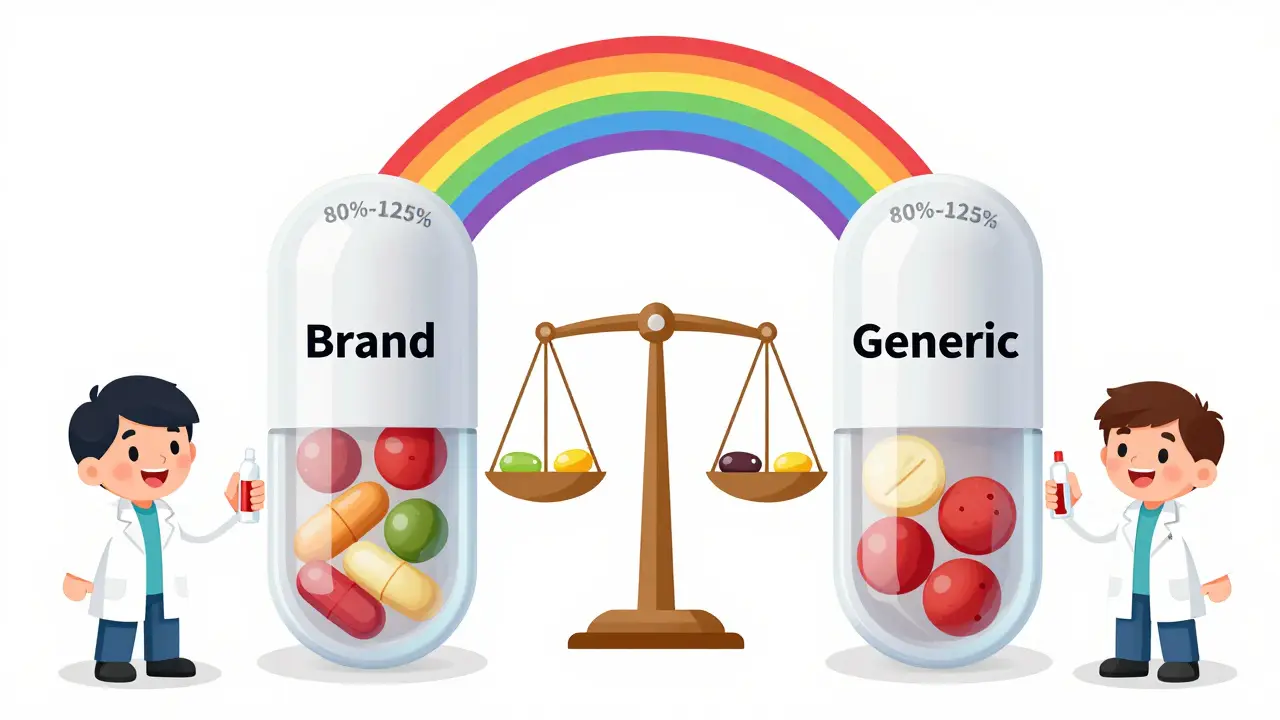
Here’s the rule: for two drugs to be considered bioequivalent, the 90% confidence interval of the ratio between the generic and brand must fall between 80% and 125%. That’s the 80/125 rule. It doesn’t mean they have to be identical. It means the difference is small enough that it won’t affect how well the drug works.
Why 80-125%? Because drug responses aren’t linear. A 20% difference in blood levels doesn’t mean a 20% drop in effect. The body handles drug levels in a multiplicative way, not additive. So, if a brand drug gives you a Cmax of 100 ng/mL, a generic at 80 ng/mL or 125 ng/mL is still within the safe, effective range.
Time to peak concentration (Tmax) is also measured, but it’s not held to the same strict limits. A few minutes’ difference in when the drug peaks? That’s normal. It might be because of how the pill breaks down in your stomach - not because it’s less effective.
Why Bioavailability ≠ Bioequivalence
It’s easy to mix them up. But here’s the clearest way to tell them apart:
- Bioavailability is about one drug product. It describes how well that specific pill, capsule, or liquid gets into your blood.
- Bioequivalence is about two products. It’s a head-to-head comparison to prove they’re interchangeable.
You can measure bioavailability for a brand drug alone. But bioequivalence? You can’t do it without the brand as your reference. The generic isn’t judged on its own. It’s judged against the original.
Think of it like two cars. Bioavailability tells you how much fuel each car uses per mile. Bioequivalence says: “Do these two cars use the same amount of fuel under the same driving conditions?” If yes - they’re bioequivalent.
When Bioequivalence Standards Aren’t Enough
Most generics are safe and effective. In fact, between 2010 and 2020, 99.7% of generics approved by the FDA met bioequivalence standards with no clinical issues reported. But there are exceptions.
Drugs with a narrow therapeutic index - like warfarin, levothyroxine, or phenytoin - need tighter controls. A small change in blood levels can mean the difference between too little effect and dangerous side effects.
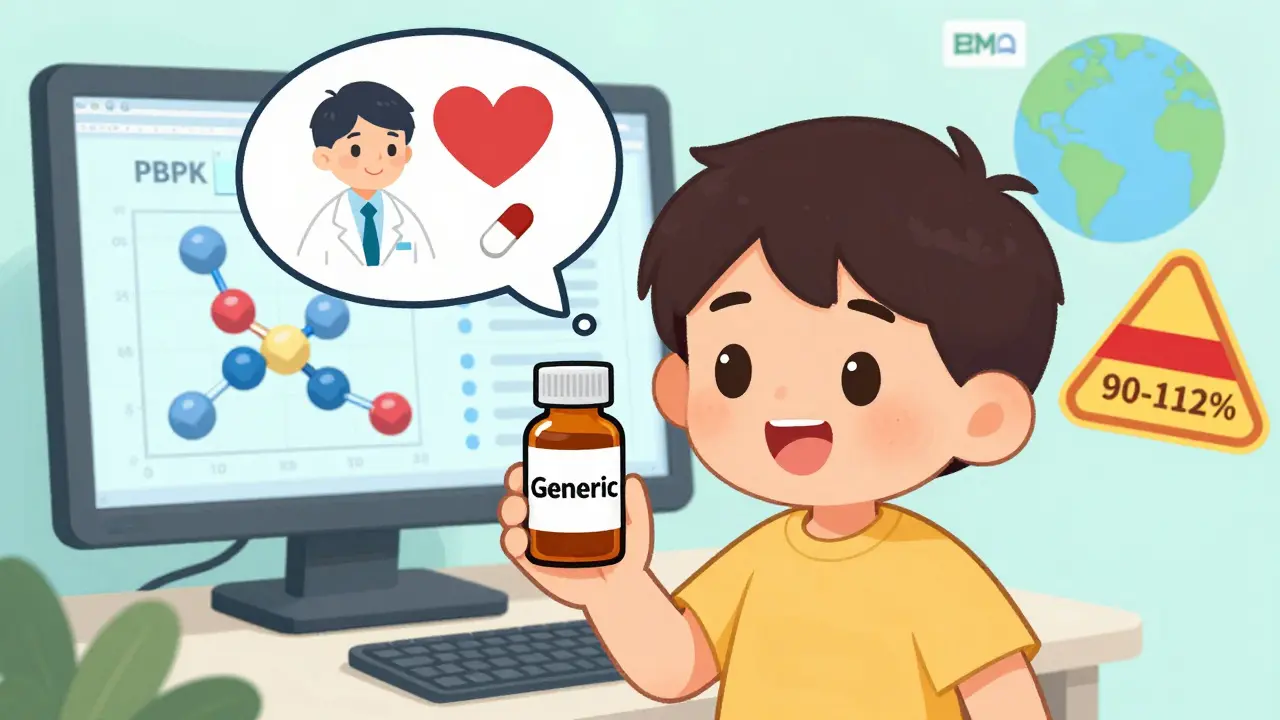
For warfarin, the FDA now requires a stricter range: 90-112% for AUC. That’s a much narrower window than the standard 80-125%. The same applies to some thyroid medications. If a generic levothyroxine product shows a 15% difference in Cmax, it gets rejected - even though that would pass for most other drugs.
Real-world data supports this. A 2023 survey from the American Pharmacists Association found that out of 1,247 patients switched from brand to generic antihypertensives, only 17 reported problems. Of those, only 4 had confirmed therapeutic differences. But in the case of levothyroxine, patient reports on forums like Reddit suggest a small but persistent issue - possibly because current bioequivalence standards don’t fully capture subtle differences in absorption patterns for this drug.
How Testing Is Done - And Why It’s Not Easy
Setting up a bioequivalence study sounds simple: give people a pill, draw blood, measure levels. But it’s not. These studies follow strict protocols:
- 24-36 healthy volunteers
- Randomized, crossover design (each person gets both drugs, in different orders)
- Fasting conditions to avoid food interference
- 12-18 blood draws over 72 hours
Even small things can throw off results. Take voriconazole - a fungal infection drug. A high-fat meal increased its absorption by 36%. So now, companies have to run two studies: one on an empty stomach, one after a fatty meal.
That’s why bioequivalence testing costs millions. It requires specialized labs, trained staff, and precise analytical tools. Contract research organizations say it takes 3-6 months just to design and approve a study before you even start recruiting volunteers.
The Bigger Picture: Why This All Matters
Generic drugs make healthcare affordable. In the U.S., they make up 91% of prescriptions but only 22% of drug spending. That’s billions saved every year.
But the system isn’t perfect. As complex drugs emerge - like inhalers, patches, or injectables - traditional blood tests may not capture how well they work. That’s why regulators are exploring new tools. The FDA is testing physiologically-based pharmacokinetic (PBPK) modeling, which uses computer simulations to predict how a drug behaves in the body. The EMA is also looking at in vitro dissolution testing - basically, seeing how well a pill breaks down in a lab setting - as a substitute for some human studies.
By 2027, experts predict 30% of bioequivalence assessments for complex generics will use these advanced methods. It’s not about replacing science - it’s about making it faster, cheaper, and more accurate.
What You Should Know as a Patient
Here’s the bottom line:
- Most generics are just as safe and effective as brand drugs.
- If you’re on a drug with a narrow therapeutic index - like warfarin or levothyroxine - talk to your doctor before switching.
- If you notice a change in how you feel after switching to a generic, don’t ignore it. It might not be your imagination - it could be a real difference in absorption.
- Regulators aren’t perfect, but they’re constantly improving. The 80/125 rule has worked for decades. But science evolves - and so do standards.
There’s no need to fear generics. But understanding how they’re tested helps you make smarter choices - and speak up when something feels off.
What’s the difference between bioavailability and bioequivalence?
Bioavailability measures how much of a single drug enters your bloodstream after you take it. Bioequivalence compares two different versions of the same drug - usually a generic and brand-name - to see if they deliver the drug at the same rate and amount. Bioavailability is about one product; bioequivalence is about two.
Why do some people say generics don’t work as well?
Most of the time, they do. But for drugs with a narrow therapeutic index - like levothyroxine or warfarin - even small differences in absorption can matter. While regulators require generics to meet strict standards, some patients report changes in symptoms after switching. This doesn’t mean the generic is faulty - it may mean that individual biology, adherence, or subtle formulation differences play a role. Always report changes to your doctor.
How do regulators test bioequivalence?
They conduct clinical studies in healthy volunteers. Each person takes both the brand and generic drug, in random order, under fasting conditions. Blood samples are taken over 72 hours. The key measurements are AUC (total exposure) and Cmax (peak level). The 90% confidence interval of the ratio between the two must fall between 80% and 125% for approval.
Is the 80/125 rule too loose?
For most drugs, no. The rule is based on decades of data showing that differences within this range don’t affect safety or effectiveness. But for narrow therapeutic index drugs, regulators apply tighter limits - like 90-112% for warfarin. Experts agree the standard rule works well overall, but ongoing research is refining it for complex drugs.
Can food affect bioequivalence?
Yes. Some drugs absorb differently when taken with food. For example, voriconazole’s absorption increases by 36% after a high-fat meal. That’s why regulators often require both fasting and fed-state studies. If a generic performs differently than the brand under the same conditions, it fails bioequivalence.



12 Comments
Kevin Y.
Really appreciate this breakdown - it’s easy to take generics for granted, but the science behind bioequivalence is fascinating. The 80/125 rule makes so much sense when you think about it multiplicatively rather than additively. I’ve worked in pharma logistics for over a decade, and seeing how tightly these studies are controlled really puts things in perspective. It’s not magic - it’s meticulous science.
Also, kudos for mentioning PBPK modeling. That’s where the future is headed. We’re already seeing it used in EU approvals for complex biologics. It’s faster, cheaper, and ethically better than relying solely on human trials.
And yes - food effects matter. I’ve seen generics fail because the brand was tested fasting and the generic wasn’t. One tiny variable can throw off the whole curve. Regulatory agencies are getting better, but there’s still room for improvement.
Raphael Schwartz
generic bs. brand works better. period. they cut corners. u think the fda cares? they dont. save money not save lives.
Rachele Tycksen
i switched my levothyroxine to generic and felt like a zombie for 3 weeks. my dr said 'it's the same' but... it wasn't. now i pay extra. worth it.
Grace Kusta Nasralla
It’s interesting how we reduce human physiology to AUC curves and confidence intervals. We measure what’s quantifiable - but what about the silent, unmeasured variables? The stress in the gut. The microbiome shifts. The emotional resonance of trust in a pill’s origin?
Perhaps bioequivalence is a statistical illusion. A comfort zone built for systems, not souls.
When a patient says, 'I feel different,' are we really listening - or just recalibrating the model?
Darlene Gomez
This is one of the most balanced, thoughtful pieces on generics I’ve read in years. Thank you.
I’m a pharmacist, and I’ve seen firsthand how the 80/125 rule protects patients - but also how exceptions need to be honored. That levothyroxine anecdote? It’s real. I had a patient who switched generics three times before finding one that didn’t make her heart race. We tracked her TSH levels - tiny differences, huge impact.
And yes, food matters. I once had a patient on voriconazole who took it with avocado toast. Her levels spiked. We had to adjust. It’s not about 'brand vs generic' - it’s about *individual* biology.
Let’s stop demonizing generics. But let’s also stop pretending they’re all identical. Nuance isn’t weakness - it’s precision.
Katie Putbrese
americans are so gullible. you think china or india makes these generics? nope. theyre made here. same factory. same machines. you just pay less. stop being suckers. its the same damn thing. dont let big pharma scare you into paying more.
Jacob Hessler
generic dont work. i tried em. i got sick. brand works. why? cause they dont cut corners. end of story.
Amber Gray
i hate when people say "it's the same" 😒 like my body doesn't know the difference. levothyroxine? nope. nope. nope. 🤦♀️💸
Danielle Arnold
so you're telling me a 20% difference in blood levels is 'fine'... but if my coffee is 20% weaker, I notice. hmm.
James Moreau
This is excellent. I’m from the Philippines, and we’re seeing a surge in generic access here - but without the same regulatory rigor. It’s scary. Your post highlights why standardized, transparent bioequivalence testing matters globally.
Not every country has the FDA. We need more education, not just cheaper pills.
J. Murphy
they test on healthy people. what about people with liver issues? diabetes? gut problems? none of that matters. just numbers on a screen. laughable.
Jesse Hall
Love this thread. Seriously. You guys are bringing up real stuff - not just noise.
As someone who’s been on warfarin for 12 years, I switched generics last year. My INR went haywire. Took 3 months to stabilize. My pharmacist said, 'It happens.' I said, 'Then why isn’t there a better system?'
Let’s keep pushing for better standards. Not to scare people off generics - but to make them *better.*
And hey - if you’ve had a bad experience, you’re not crazy. You’re a data point. Speak up. 🙌