

Antidepressant Side Effect Comparison Tool
Which antidepressant suits your needs?
This tool compares bupropion (Wellbutrin) and SSRIs (like Zoloft/Lexapro) based on your specific concerns. Remember: Always consult your doctor before making medication changes.
Bupropion vs SSRI Comparison
Bupropion
SSRIs
Personalized Recommendation
When choosing an antidepressant, the goal isn’t just to lift your mood-it’s to live better while you’re doing it. That’s why side effects matter more than most people admit. Two of the most common antidepressants-bupropion (Wellbutrin) and SSRIs like sertraline (Zoloft) or escitalopram (Lexapro)-work in completely different ways. And their side effect profiles? They’re not just different. They’re almost opposite.
How They Work (And Why It Matters)
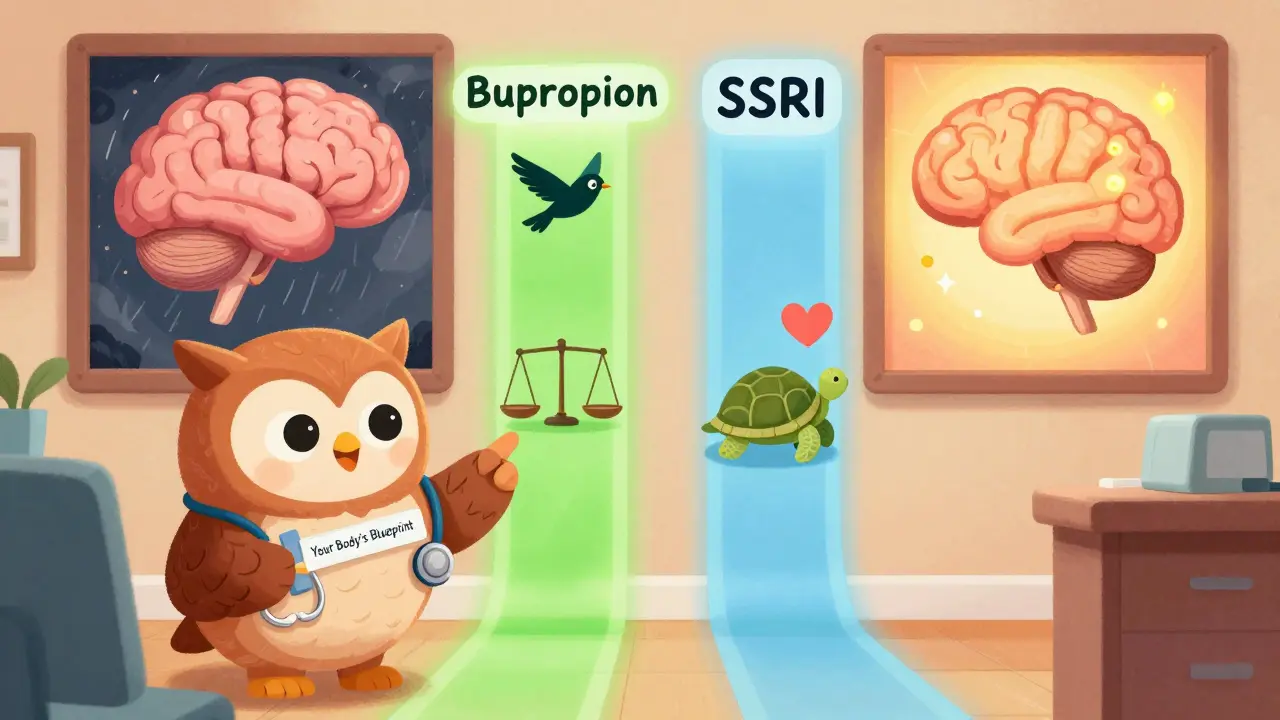
Bupropion doesn’t touch serotonin. Instead, it boosts norepinephrine and dopamine. That’s why some people say it feels more like being awake, focused, and energized-not numb. SSRIs, on the other hand, are designed to increase serotonin levels. That helps with mood, but it also comes with a long list of common side effects that can make daily life harder.
It’s not about which one is "better." It’s about which one fits your life. If you’re trying to avoid weight gain, or you’ve lost your sex drive on another medication, bupropion might be the switch you’ve been waiting for. If anxiety keeps you up at night, an SSRI might be the calmer choice.
Sexual Side Effects: The Biggest Difference
If you’ve ever taken an SSRI and noticed your libido disappeared, you’re not alone. Studies show between 30% and 70% of people on SSRIs experience sexual side effects. For paroxetine, that number jumps to over 70%. These aren’t rare complaints-they’re the number one reason people stop taking these medications.
Bupropion? Around 13% to 15% of users report sexual side effects. That’s less than half the rate of SSRIs. In one study, 67% of people who switched from an SSRI to bupropion saw their sex drive come back. Another found that adding bupropion to an SSRI reversed sexual dysfunction in 70-80% of cases.
Real people say it plainly: "Lost all interest in sex after 6 months" on Lexapro. "Within 3 weeks of switching to Wellbutrin, my libido returned to normal." These aren’t outliers. They’re the norm.
Weight Changes: Gain vs. Loss
SSRIs like paroxetine and sertraline often lead to weight gain. Over 6 to 12 months, people typically gain 2.5 to 3.5 kilograms. For someone already struggling with body image or metabolic health, that’s a heavy burden.
Bupropion does the opposite. Most people lose a little weight-about 0.8 to 1.2 kg over the same period. In a 24-week study, people on bupropion XL 400 mg lost an average of 7.2% of their body weight. That’s not just a side effect-it’s a therapeutic benefit for some.
On Drugs.com, 68% of bupropion users rate it positively, with comments like "No weight gain after 18 months" and "Finally feel awake during the day unlike when I took Zoloft." Meanwhile, 38% of negative SSRI reviews mention weight gain. It’s not a coincidence.
Sleep and Energy: Sedation vs. Activation
Many SSRIs make people feel drowsy. Paroxetine is especially known for this. If you’re already tired from depression, that might sound helpful. But if you need to stay sharp at work, drive safely, or care for kids, daytime sleepiness becomes a problem.
Bupropion is the opposite. It’s activating. Studies show it causes somnolence (drowsiness) at less than one-third the rate of SSRIs. That’s why it’s often chosen for people who work night shifts, have ADHD-like symptoms, or just want to feel more alert.
But here’s the catch: that same energy can backfire. Some people on bupropion report insomnia, restlessness, or jitteriness. One Reddit user wrote: "I lost the weight and got my sex life back-but now I can’t sleep past 4 a.m."
Anxiety: The Trade-Off
If you have anxiety along with depression, bupropion can be tricky. Its stimulating effects can make anxiety worse. In one study, 28% of people with comorbid anxiety stopped taking bupropion because their anxiety spiked. That’s nearly double the rate of people stopping SSRIs for the same reason.
SSRIs, despite their other side effects, are often the first choice for people with anxiety disorders. They calm the nervous system. That’s why 71% of patients with anxiety in a 2021 survey preferred SSRIs.
It’s not that bupropion "doesn’t work" for anxiety-it just doesn’t calm it. For some, it makes it worse. For others, the lack of sedation is exactly what they need.

Seizure Risk: The Hidden Red Flag
Bupropion carries a small but real risk of seizures. At 300 mg/day, it’s about 0.1%. At 400 mg/day, it jumps to 0.4%. That’s why it’s not prescribed to people with seizure disorders, eating disorders, or those who drink heavily or suddenly stop alcohol.
SSRIs? Their seizure risk is near zero-around 0.02% to 0.04%. That’s why they’re safer for people with neurological conditions.
Even more concerning: combining bupropion with SSRIs can raise seizure risk. There’s at least one documented case of a seizure in someone taking both, with no prior history. That’s why doctors require a washout period when switching-especially with fluoxetine, which stays in your system for days.
Blood Pressure and Heart Health
Bupropion can raise systolic blood pressure by 3 to 5 mmHg on average. That’s not huge, but if you already have hypertension, it matters. Monitoring every 2-4 weeks during the first few months is standard practice.
SSRIs, by contrast, tend to have neutral or even slightly lowering effects on blood pressure. For someone with heart disease or high blood pressure, that’s a big consideration.
Who Gets Prescribed What?
SSRIs make up about 70% of all antidepressant prescriptions in the U.S. Sertraline is the most common, followed by escitalopram and fluoxetine. Bupropion is fourth-around 10% of prescriptions. But its use is growing fast, especially for sexual dysfunction and weight management.
Off-label use of bupropion for low libido has tripled since 2010. That’s not because it’s a "magic pill." It’s because people are tired of trading their sex lives for mood stability.
What Happens When You Switch?
If you’re thinking about switching from an SSRI to bupropion, timing matters. For fluoxetine, you need a 2-week break because it sticks around so long. For others, a week is enough. Jumping straight from one to the other can cause serotonin syndrome-rare, but serious.
Also, don’t expect instant results. Mood improvements take 4-6 weeks. Side effects often show up faster. If you feel jittery or anxious after a few days, that’s normal. If it doesn’t ease up after two weeks, talk to your doctor.
What Do Real Users Say?
On Drugs.com, bupropion has a 7.4/10 rating from nearly 2,000 reviews. Positive comments focus on energy, weight loss, and restored libido. Negative ones mention insomnia, anxiety, and rare but scary side effects like tinnitus (ringing in the ears).
SSRIs like Lexapro have a 6.8/10 rating. The top complaints? Sexual dysfunction and weight gain. One user wrote: "Gained 25 pounds in one year. Felt like my body betrayed me."
When to Choose Bupropion
- You’ve had sexual side effects on SSRIs
- You’re worried about weight gain
- You need to stay alert during the day
- You don’t have anxiety or a seizure history
- You’re not on other meds that lower seizure threshold
When to Stick With SSRIs
- You have anxiety or panic disorder
- You have a history of seizures or eating disorders
- You’re on other medications that interact with bupropion
- You’re sensitive to stimulant-like effects
- Your blood pressure is already high
What’s New in 2026?
Pharmacogenetic testing is becoming more common. Some labs can now test your genes to predict whether you’re likely to have bad side effects from SSRIs. If your results show you’re a slow metabolizer of serotonin drugs, bupropion might be the better first choice.
A 2023 trial called GUIDED showed that using genetic testing to guide antidepressant choice improved remission rates by 14.2% compared to standard care. That’s not science fiction-it’s happening in clinics right now.
The future isn’t about finding the "best" antidepressant. It’s about matching the right drug to the right person. And side effects? They’re not just side notes. They’re the deciding factor.
Can bupropion help with SSRI-induced sexual dysfunction?
Yes. Studies show that switching from an SSRI to bupropion improves sexual function in about 67% of cases. Adding bupropion to an ongoing SSRI regimen also helps, with 70-80% of patients reporting improvement in open-label trials. It’s one of the most reliable fixes for this common side effect.
Does bupropion cause weight gain?
No-most people lose a small amount of weight on bupropion. On average, users lose 0.8 to 1.2 kg over 6-12 months. In longer studies, those taking 400 mg daily lost up to 7.2% of their body weight. This makes it a preferred option for people concerned about weight gain from other antidepressants.
Is bupropion safe if I have anxiety?
It can be risky. Bupropion’s stimulating effects may worsen anxiety in about 28% of people with comorbid anxiety disorders. SSRIs are generally better for anxiety because they calm the nervous system. If anxiety is a major part of your condition, bupropion may not be the best first choice.
How long does it take for bupropion to start working?
Mood improvements usually take 4 to 6 weeks, similar to SSRIs. But some side effects-like increased energy or insomnia-can appear within days. If you feel jittery or overly awake early on, that’s normal. If it lasts more than two weeks or becomes unbearable, talk to your doctor about adjusting your dose.
Can I take bupropion and an SSRI together?
Yes, but only under close medical supervision. Combining them can help with treatment-resistant depression or reverse sexual side effects. But it increases the risk of serotonin syndrome and seizures. One case report documented a seizure in a person taking both, with no prior history. Your doctor will monitor you closely and likely start with low doses.
What’s the seizure risk with bupropion?
At 300 mg per day, the risk is about 0.1%. At 400 mg, it rises to 0.4%. That’s higher than SSRIs, which carry a risk of only 0.02-0.04%. Bupropion is contraindicated in people with seizure disorders, eating disorders, or those who drink heavily. Never exceed 450 mg per day.
Why is bupropion less commonly prescribed than SSRIs?
SSRIs are prescribed more often because they’re seen as safer for a wider range of people, especially those with anxiety or neurological conditions. Bupropion’s seizure risk and potential to worsen anxiety limit its use. But it’s still the fourth most prescribed antidepressant in the U.S., and its use is growing as more patients demand options with fewer sexual and weight-related side effects.
Next Steps
If you’re considering a switch, start with your doctor. Bring your side effect history-not just your mood logs. Tell them what you can’t tolerate: the weight gain, the numbness, the sleepiness. That’s the data they need to make the right call.
There’s no perfect antidepressant. But there is a better one-for you. The key is matching the drug to your life, not just your diagnosis.


12 Comments
Ashley Karanja
Wow, this is one of the most nuanced takes on antidepressant side effects I’ve read in years. The way you framed it-not as a battle between drugs but as a calibration of life parameters-is profoundly human. I’ve been on sertraline for 3 years, and yes, my libido vanished like it was never there. But what no one tells you is how the emotional blunting creeps in too-you stop crying at movies, stop laughing at inside jokes, stop feeling anything except a quiet, persistent fog. Switching to bupropion felt like someone cracked open a window in a sealed room. I lost 10 pounds, woke up at 6 a.m. without an alarm, and yes-I started wanting to kiss my partner again. The insomnia? Still there. But I’d take sleepless nights over soul-dead mornings any day.
SWAPNIL SIDAM
Bro, I was on Lexapro for 8 months. Gained 18 lbs. Lost all interest in everything. Then I switched to Wellbutrin. Lost the weight. Got my spark back. But now I’m up at 3 a.m. staring at the ceiling thinking about quantum physics. Worth it.
Josh josh
wellbutrin made me feel like a robot with a caffeine addiction
George Rahn
One must not confuse pharmacological intervention with existential alignment. The SSRI is the opiate of the depressed masses-a chemical pacifier that commodifies emotional resilience into a pill. Bupropion, by contrast, is the Nietzschean antidote: it does not soothe the soul, it awakens the will. To choose an SSRI is to surrender to the hegemony of tranquility; to choose bupropion is to embrace the Dionysian chaos of being fully alive-even if that means sleepless nights, jittery hands, and the occasional existential scream into the void at 4 a.m. The body remembers what the mind forgets: vitality is not a side effect. It is the point.
Karen Droege
As a psychiatrist who’s prescribed both for over a decade, I can tell you: the real tragedy isn’t the side effects-it’s how rarely patients are given a real choice. We default to SSRIs because they’re ‘safer’ and easier to sell to insurance companies, not because they’re better for the person sitting across from us. I’ve had patients cry because they couldn’t have sex with their partner after 6 months on Zoloft. I’ve had others say they felt like a zombie during parent-teacher conferences. We need to stop treating depression like a one-size-fits-all spreadsheet. Bupropion isn’t ‘the alternative’-it’s a legitimate, evidence-backed pillar of treatment. And if you’re a woman of color or a working parent or someone with a body that’s been policed by society, the weight gain and sexual numbness aren’t just inconveniences-they’re traumas. This post? It’s a public service.
John Wippler
I switched from escitalopram to bupropion after 14 months of feeling like a ghost in my own life. The first week? I was a human jackhammer-twitchy, awake, buzzing. But by week three, I was cooking again. I started hiking. I remembered what my own voice sounded like. The insomnia? Still here. But now I use it to read philosophy instead of scrolling doomthreads. And yes, my sex drive came back-not because I wanted it to, but because I finally felt like I was living, not just surviving. SSRIs didn’t fix my depression. They just made it quieter. Bupropion made me feel like I could fight it.
Shweta Deshpande
Hi! I’m from India and I’ve been on bupropion for 6 months now. My doctor said it’s not common here, but I begged for it because I couldn’t take the weight gain from fluoxetine. I lost 5 kg, my energy is back, and I actually enjoy my job now 😊 But I do get anxious sometimes, especially before big meetings. I’ve learned to breathe through it. To anyone scared to switch: you’re not broken for wanting to feel alive. You’re just human. And your life matters more than the side effect chart.
Faisal Mohamed
The serotonin paradigm is a cultural construct masquerading as medical science. Bupropion’s dopaminergic activation doesn’t just treat depression-it reorients the individual’s ontological posture toward agency. The fact that 70% of SSRI discontinuations are due to sexual dysfunction reveals the latent narcissism of pharmacological normalization. We don’t want to be happy-we want to be potent. And potency, my friends, is not pharmacologically homogenized. It is wild, asymmetrical, and occasionally sleep-deprived. Bupropion doesn’t cure depression. It resurrects the self.
Kipper Pickens
From a clinical pharmacology standpoint, the seizure risk gradient with bupropion is dose-dependent and well-documented in the FDA’s Adverse Event Reporting System. The 0.4% risk at 400mg is statistically significant compared to SSRIs’ 0.02–0.04%. However, when stratified by comorbidities-particularly alcohol use disorder or eating disorders-the relative risk increases exponentially. This is why guidelines mandate thorough screening. Also, the interaction with fluoxetine’s long half-life is underappreciated in lay discourse. Washout periods aren’t arbitrary-they’re biochemically necessary.
Angie Thompson
Y’all are making this sound so dramatic 😅 I was on Zoloft for a year and gained 20 lbs and felt like a robot. Switched to Wellbutrin. Lost the weight, got my sex life back, and now I’m up at 3 a.m. making playlists 🎧 But honestly? I just wanted to feel like ME again. And I do. Even if I’m a little jittery. Worth it. 💪
bella nash
The empirical data presented herein is both statistically significant and clinically relevant. However, one must acknowledge the confounding variable of patient expectation bias. Those who actively seek bupropion due to prior SSRI-induced sexual dysfunction may report improved outcomes not solely due to pharmacological action, but due to cognitive reattribution of causality. Furthermore, the anecdotal evidence presented, while compelling, lacks the rigor of double-blind, placebo-controlled trials. Nevertheless, the trend is undeniable, and clinical intuition must not be dismissed outright.
Napoleon Huere
My brother took bupropion after his divorce. Said it made him feel like himself again-except he couldn’t sleep. He started writing poetry at 4 a.m. Then he started a podcast. Then he moved to Oregon. He’s happier now. Not because the drug fixed him-but because it gave him the energy to fix himself. SSRIs are for people who want to be calm. Bupropion is for people who want to be alive. And sometimes, that’s the only difference that matters.