
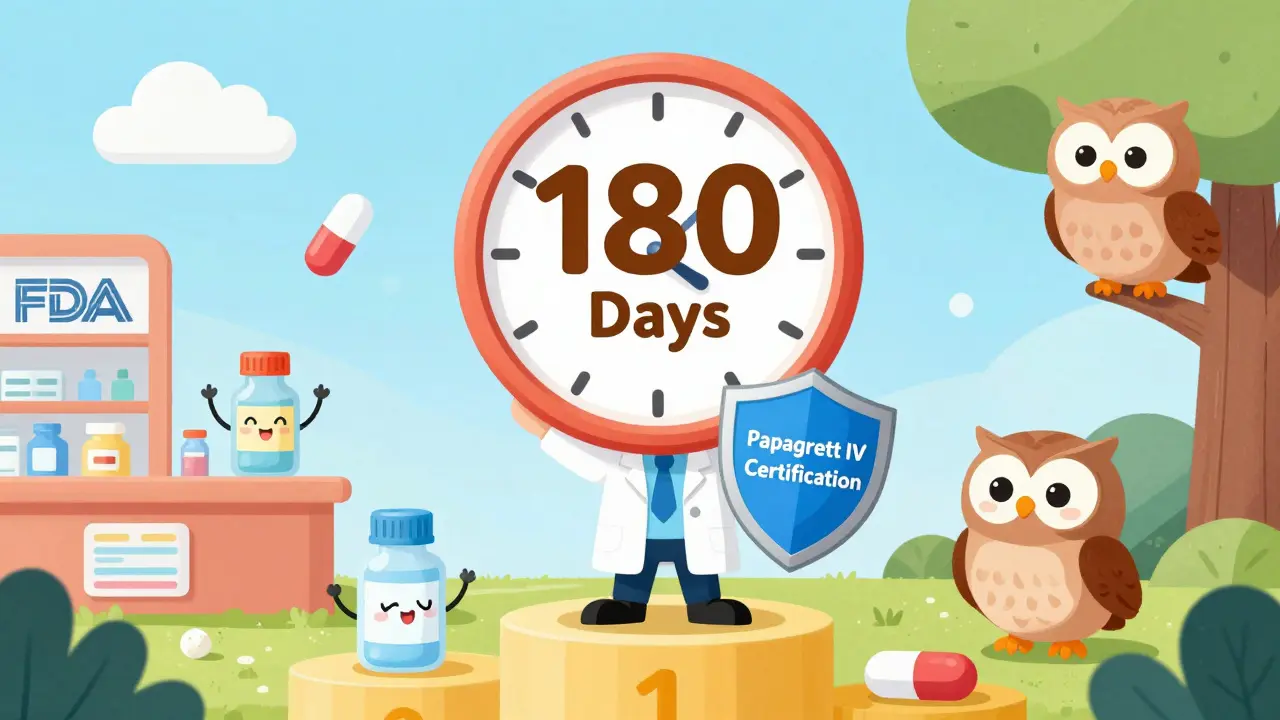
When a generic drug company challenges a brand-name drug’s patent and wins, it gets a powerful reward: 180 days of exclusive rights to sell the generic version. No other generic can enter the market during that time. This rule, part of the Hatch-Waxman Act of 1984, was meant to speed up access to cheaper drugs by giving a financial boost to the first company brave enough to fight a patent in court. But here’s the catch: the brand-name company can still launch its own version of the generic - called an authorized generic - at the same time. And when that happens, the whole incentive collapses.
How the 180-Day Exclusivity Rule Actually Works
The 180-day exclusivity period isn’t automatic. It only kicks in if a generic manufacturer files what’s called a Paragraph IV certification - basically, a legal notice saying, ‘This patent is invalid or we don’t infringe it.’ The brand-name company then has 45 days to sue. If they do, the FDA can’t approve the generic for up to 30 months while the lawsuit plays out. If the generic company wins, or the patent is thrown out, they get the clock.
The clock starts ticking the moment they begin selling the drug - not when the FDA approves it. That’s a key detail. Many companies have lost their exclusivity because they shipped the drug too early, or didn’t keep selling consistently. The FDA says 28% of first applicants between 2018 and 2022 lost part or all of their exclusivity due to mistakes like this.
This exclusivity isn’t just nice to have - it’s worth hundreds of millions. One study found that the first generic entrant could make $200-500 million in revenue during those six months if no one else is competing. That’s why companies spend $2-5 million just on legal fees to file a Paragraph IV challenge. It’s a high-stakes gamble.
What Is an Authorized Generic - and Why It Changes Everything
An authorized generic isn’t a copy. It’s the exact same drug, made by the brand-name company, sold in plain packaging with no brand name. No new FDA approval needed. No bioequivalence studies. Just a label change and a new price tag.
Before 2000, this was rare. But by 2015, about 60% of the time a generic got 180-day exclusivity, the brand-name company launched an authorized generic at the same time. That means the first generic isn’t alone anymore. It’s now competing against its own former parent company.
The results? Market share drops from around 80% to 50%. Revenue falls by 30-50%. Teva lost $287 million in one case when Eli Lilly launched an authorized generic of Humalog during Teva’s exclusivity window. That’s not an outlier - it’s the new normal.
The Legal Gray Zone: Is This Fair?
The Hatch-Waxman Act never said brand-name companies couldn’t do this. Legally, they’re allowed. But ethically? Many experts say it defeats the whole point.
The original idea was to give the first generic challenger a chance to recoup its legal costs and make a profit - a reward for taking on the risk. But if the brand-name company can just step in and undercut them, the incentive vanishes. The Federal Trade Commission has called this a ‘workaround’ that delays real competition. Between 2010 and 2022, the FTC filed 15 lawsuits against brand-name companies for allegedly using authorized generics to block generic entry.
Even the FDA agrees. In 2023, Commissioner Robert Califf told Congress the system creates ‘unintended disincentives for timely generic entry.’ He supported changing the law to stop authorized generics during the exclusivity period.

How Generic Companies Adapt - and Why It’s Getting Harder
Generic manufacturers aren’t sitting still. They’ve learned to negotiate. Today, 78% of first applicants include clauses in patent settlement deals that delay or block the brand from launching an authorized generic. These are called ‘reverse payment’ agreements - and they’re controversial. Courts have ruled some are anti-competitive, but many still slip through.
Smaller generic companies are getting squeezed. The cost of a Paragraph IV challenge - legal fees, manufacturing prep, regulatory filings - averages $3.2 million. If you’re a small firm and the brand can just flood the market with its own version, the risk doesn’t pay off. Many now avoid challenging patents unless they have a strong case or a deal in place.
One Reddit user in the r/pharmaceuticals community put it bluntly: ‘If you’re not a big player, you don’t even bother with Paragraph IV anymore. The risk is too high.’
What’s Being Done to Fix It?
There’s been a push in Congress for over a decade to close the authorized generic loophole. The Preserve Access to Affordable Generics and Biosimilars Act has been reintroduced multiple times since 2009. The latest version, S. 1665, would ban brand-name companies from selling authorized generics during the 180-day window.
If passed, it could increase first-generic revenues by 35%, according to the FTC. Industry analysts estimate that would make patent challenges worth $150-250 million more per drug - potentially increasing the number of challenges by 20-25%.
But the brand-name industry fights back. They argue authorized generics lower prices faster. A 2021 RAND study found that when an authorized generic enters alongside the first generic, drug prices drop 15-25% more than if only one generic is on the market. They say it’s good for patients.
Here’s the problem: the first generic still gets crushed. Even if prices drop faster, the company that did the hard work - the one that spent millions on litigation - gets almost nothing. The brand-name company still profits, just under a different label.
The Bigger Picture: Why This Matters for Patients
The U.S. generic drug market is worth $65 billion. It fills 90% of prescriptions but costs only 23% of total drug spending. Since Hatch-Waxman passed, it’s saved the healthcare system $2.2 trillion.
But the system is fraying. In 2000, it took an average of 28 months for multiple generics to enter the market after the first one. By 2022, that dropped to just 9 months - not because more companies are entering, but because authorized generics are being used to fragment the market early.
When the first generic gets undercut, it can’t invest in the next challenge. Smaller companies go out of business. Fewer patents get challenged. The pipeline slows. Patients still wait longer for the lowest prices.
It’s not about stopping innovation. It’s about making sure the reward goes to the right people. The law was supposed to reward the challenger, not the challenger’s former owner.
What’s Next?
The legal battle isn’t over. Courts are still deciding whether reverse payment deals violate antitrust laws. Congress is still debating the Preserve Access Act. The FDA is watching closely. And generic manufacturers are building teams of lawyers, regulators, and commercial experts just to navigate the 180-day window.
For now, the system works - but only if you’re big enough to play the game. For everyone else, the promise of Hatch-Waxman is fading.
If you’re a patient, you get cheaper drugs sooner - but only because the system is broken in a way that lets the brand-name company keep winning.
What triggers the 180-day exclusivity clock for a generic drug?
The clock starts when the first generic applicant begins commercial marketing - meaning the drug is both FDA-approved and physically shipped to customers. Simply getting approval isn’t enough. If a company delays shipping or stops selling, they can lose part or all of their exclusivity.
Can a brand-name company launch an authorized generic before the 180-day exclusivity period begins?
Yes. Brand-name companies can launch authorized generics as soon as the first generic’s ANDA is approved - even before the 180-day clock starts. The exclusivity period only blocks other generic manufacturers, not the original brand. This is legal under current law.
Why do generic companies still file Paragraph IV certifications if authorized generics undermine exclusivity?
Because sometimes they don’t. If the brand-name company doesn’t launch an authorized generic, the first generic can capture up to 80% of the market. Many companies now negotiate settlements that delay or block authorized generic entry. About 78% of first applicants include such terms in their patent deals.
Are authorized generics the same as regular generics?
No. Authorized generics are identical to the brand-name drug - same manufacturer, same ingredients, same factory. Regular generics are made by different companies and must prove bioequivalence through testing. Authorized generics skip that step entirely.
Has Congress ever tried to ban authorized generics during exclusivity?
Yes. The Preserve Access to Affordable Generics and Biosimilars Act has been introduced in every Congress since 2009. It would prohibit brand-name manufacturers from selling authorized generics during the 180-day exclusivity period. It has never passed, but support is growing, especially after FTC and FDA recommendations in 2022-2023.
How much does it cost to file a Paragraph IV certification?
On average, it costs between $2 million and $5 million in legal fees alone. When you add regulatory preparation, manufacturing setup, and consulting, total costs can reach $3.2 million or more. Smaller generic companies often can’t afford this without a guaranteed payoff.

8 Comments
Herman Rousseau
This whole authorized generic loophole is such a scam. The brand companies are basically laughing all the way to the bank while the real risk-takers get wiped out. I’ve seen it firsthand - small generics go under, and the price drops? Still not enough to make it worth it for the next challenger. Hatch-Waxman was supposed to be a win for patients, not Big Pharma’s legal team.
Johnnie R. Bailey
It’s a classic case of institutional capture. The law was designed to incentivize disruption, but the system got gamed by the very people it was meant to discipline. The authorized generic isn’t competition - it’s a Trojan horse wearing a white coat. The FTC’s right to call it a workaround. What’s sad is how normalized it’s become. We’ve stopped seeing it as a betrayal of the public interest because we’re too numb to be outraged anymore.
Vikrant Sura
lol why are we even debating this. brand companies own the patents, they own the factories, they own the FDA contacts. of course they’ll use every loophole. the real issue? we let them write the rules.
Ajay Brahmandam
Man, I used to work at a small generic firm. We filed a Paragraph IV on a diabetes med - spent 3 mil, waited 2 years. Then boom - the brand dropped their own version the same day. We sold 12% of what we projected. My boss cried in the parking lot. Now we only chase patents where the brand is too lazy to bother with an authorized generic. It’s not strategy anymore - it’s survival.
Tarun Sharma
The legal framework governing generic drug market entry requires structural reform to align incentives with public health objectives. The current regulatory architecture permits anticompetitive conduct under the guise of market normalcy.
Aliyu Sani
yo the system is rigged. brand name = same drug, same factory, diff label. generic = same drug, diff factory, 6 months of legal hell. and the one who did the work gets middle fingered. FDA knows. congress knows. but no one’s got balls to change it. patients pay, but the real losers? the scrappy startups who actually tried.
Gabriella da Silva Mendes
Oh my god I can’t believe people are still mad about this? Like, if you’re not big enough to fight Big Pharma, maybe you shouldn’t be in pharma?? The market rewards winners. The brand company didn’t break any laws - they just played better. And honestly? Lower prices faster = more patients get meds. Stop crying about fairness and start thinking about outcomes. Also, 🤡
Jim Brown
The philosophical underpinning of the Hatch-Waxman Act rests upon a foundational premise: that risk, when undertaken in service of public welfare, must be met with commensurate reward. The authorized generic - while legally permissible - represents a profound erosion of this moral contract. It transforms a mechanism designed to incentivize challenge into a vehicle for strategic predation. The FDA’s recent acknowledgment of unintended disincentives is not merely bureaucratic candor - it is a moral reckoning. To permit the architect of the patent to profit from the destruction of the challenger is not free market economics; it is institutionalized injustice dressed in regulatory language. Congress must act, not because it is politically expedient, but because it is ethically non-negotiable.