
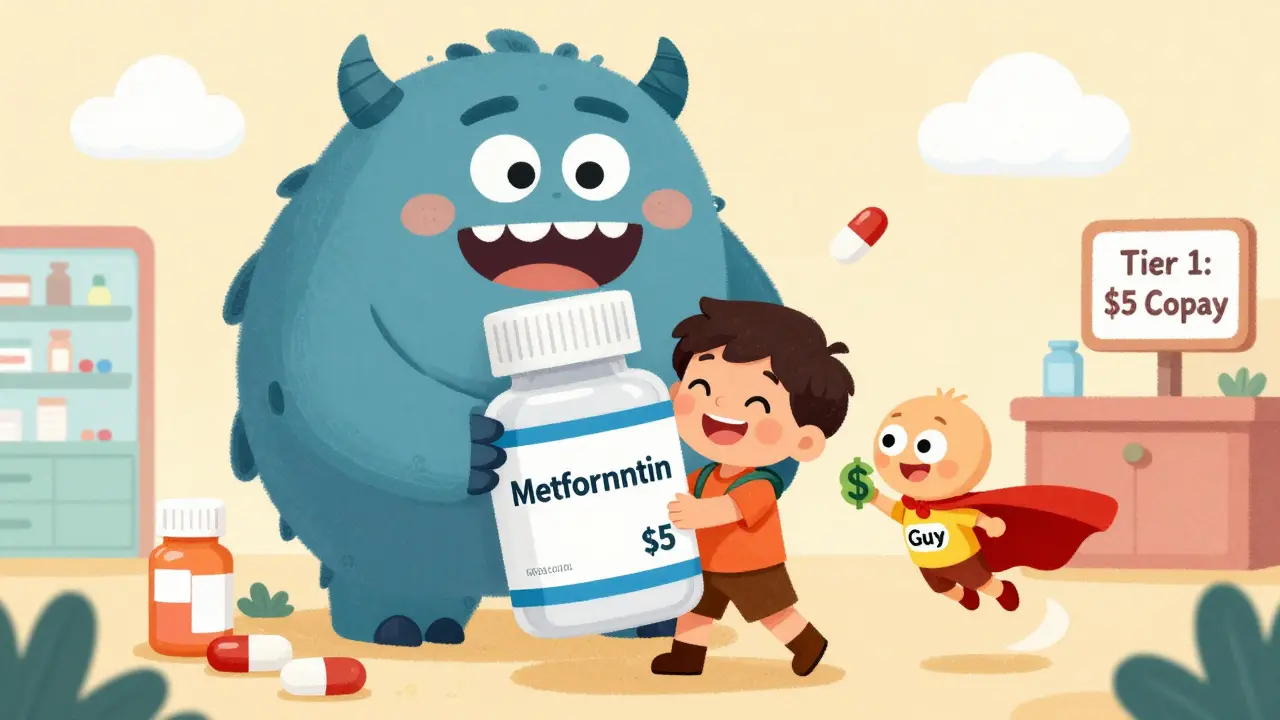
When you’re switching health plans, the biggest mistake most people make? They focus only on monthly premiums and ignore what really affects their wallet: generic drug coverage. If you take even one regular medication - like metformin for diabetes, lisinopril for blood pressure, or levothyroxine for thyroid function - your out-of-pocket costs for those drugs can swing by hundreds or even thousands of dollars depending on the plan’s formulary. And it’s not just about whether the drug is covered. It’s about which tier it’s in, which manufacturer makes it, and which pharmacy you use.
What Exactly Is a Formulary Tier?
Every health plan organizes medications into tiers. Think of it like a pricing ladder. The lower the tier, the less you pay. In most plans, Tier 1 is reserved for generic drugs - the cheapest, most common versions of brand-name medications. These are chemically identical to their brand-name counterparts but cost a fraction of the price. The government requires marketplace plans to use a four-tier system, with Tier 1 exclusively for generics. That’s not optional. It’s mandated.But here’s where it gets messy: not all plans follow the same rules. Some have three tiers. Others have five. Medicare Part D plans often split generics into two sub-tiers: preferred and non-preferred. A preferred generic might cost you $5. A non-preferred one? $35. Same active ingredient. Same effect. Totally different price tag. And if your plan moves your medication from Tier 1 to Tier 2 without warning? You’ll see a shockingly higher bill the next time you refill.
Why Generic Drugs Are Your Best Friend (If Covered Right)
Generics make up 90% of all prescriptions filled in the U.S., but they account for only 23% of total drug spending. That’s because they’re cheap to produce and widely available. But here’s the catch: if your plan doesn’t cover them well, you’re paying more than you should.Take Silver Standardized Plans (SPDs) on the health insurance marketplace. These are designed to help people with ongoing medication needs. In 2026, most of these plans waive your deductible for Tier 1 generics and charge a flat $10-$20 copay - no matter how much you’ve spent on other medical care. That’s huge. If you’re on a high-deductible plan without this protection, you might have to pay the full $1,500-$3,000 deductible before your generic drugs even kick in. That means you’re paying full price out of pocket for months.
Medicare Part D has its own twist. In 2025, the out-of-pocket cap for prescription drugs will be $2,000. But before that cap kicks in, your costs depend heavily on whether your generic is on the plan’s preferred list. Some plans offer $0 copays for preferred generics. Others charge $10-$15. And if your drug isn’t preferred? You could be looking at $30-$50 per prescription.
How Your Location Changes Everything
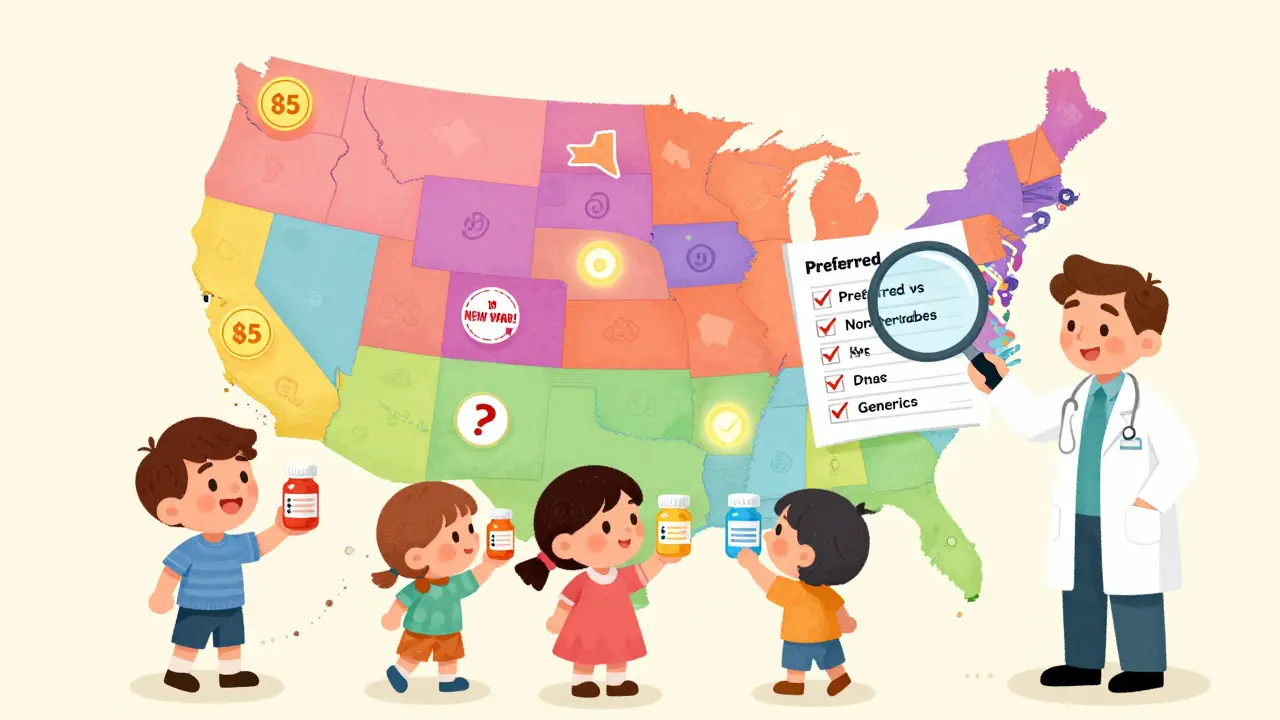
It’s not just about the plan. It’s about the state you live in. California requires insurers to set a separate $85 outpatient drug deductible before generics kick in. New York? No deductible at all for generics - just a flat $75 copay for specialty drugs, but generics are often free. DC has a $350 drug deductible. Texas? No state-level rules, so you’re at the mercy of the insurer’s design.Why does this matter? Because if you’re switching plans, you can’t just assume your current coverage will transfer. A plan that worked fine in Texas might leave you paying 300% more in California if it doesn’t account for the state’s separate drug deductible. And if you’re on a Medicare Advantage plan, your state’s rules might override the plan’s default structure.
Manufacturer Matters - Even for Generics
Here’s a fact most people don’t know: two different companies can make the exact same generic drug - say, metformin - and your plan might cover one but not the other. If your current plan covers metformin made by Manufacturer A (Tier 1, $5 copay), and your new plan only covers metformin from Manufacturer B (Tier 2, $25 copay), you’re suddenly paying five times more. And you won’t know until you fill the prescription.This happens all the time. Generic manufacturers change. Pharmacies switch suppliers. Plans update formularies. A 2023 Reddit thread with 147 real cases showed that 63% of unexpected cost spikes came from this exact scenario. You think you’re getting the same drug. You’re not. You’re getting a different version - and your plan treats it like a brand-name drug.
Pharmacy Networks Can Triple Your Costs
Even if your drug is on Tier 1, if you use a pharmacy outside the plan’s network, you could pay 300-400% more. Some plans have narrow networks. Others only cover retail pharmacies. Mail-order options might be cheaper - but only if you’re willing to order in bulk. And if you’re in a rural area? Your nearest preferred pharmacy might be 40 miles away.OptumRx data from 2023 shows that consumers who didn’t check their pharmacy network before switching plans ended up paying $120 for a $30 generic - because they filled it at a non-preferred pharmacy. That’s not a mistake. That’s avoidable.
How to Check Your Generic Coverage Before Switching
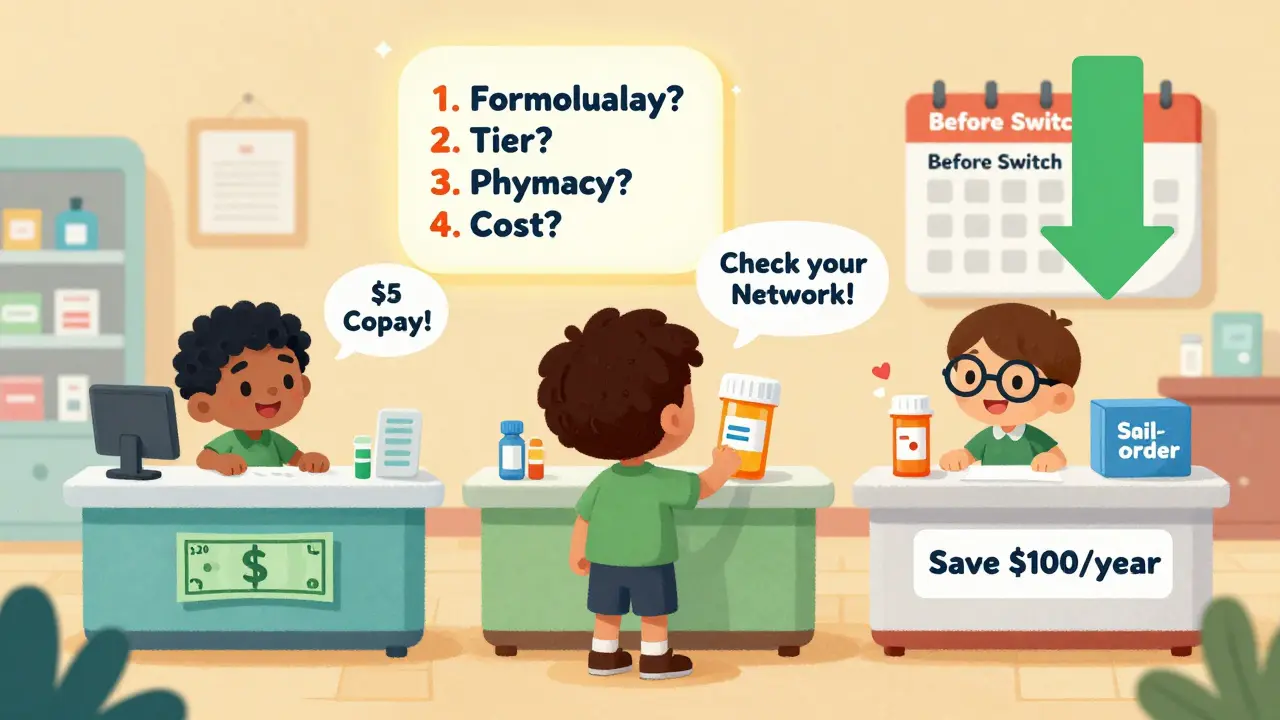
Don’t guess. Don’t rely on customer service reps who read from a script. Do this:- Get the full formulary list - not just the summary. Look for your exact drug name, strength (e.g., 500mg, not just “metformin”), and manufacturer.
- Check the tier - Is it Tier 1? Tier 2? Is it labeled “preferred” or “non-preferred”?
- Verify the pharmacy network - Which pharmacies are in-network? Is mail-order an option? What’s the cost difference?
- Calculate your annual cost - Multiply your monthly copay by 12. Add any deductible you’ll need to meet first. Compare it to your current plan.
CMS says people who complete all four steps cut unexpected drug costs by 73%. That’s not a small number. That’s life-changing.
Tools That Actually Work
Use the right tools. The Medicare Plan Finder (on Medicare.gov) lets you enter your exact medications and see real-time costs across all Part D plans. It’s accurate, updated daily, and free. For marketplace plans, Healthcare.gov’s plan selector has a built-in prescription cost calculator. eHealthInsurance’s tool processes over a million queries a month - and it shows you the difference between preferred and non-preferred generics side by side.Insurer-specific tools - like those on Blue Cross or UnitedHealthcare’s sites - are often more accurate than third-party ones. They pull direct data from the plan’s formulary. Use them. Even if you’re not enrolled yet.
What Experts Are Warning About
Dr. Karen Pollitz from KFF says the biggest win for generic drug users since the Affordable Care Act was the elimination of deductibles for Tier 1 drugs in Silver SPD plans. “It’s saved low-income families over $1,200 a year,” she says. But she also warns: “High-deductible plans with integrated prescription deductibles look cheap on paper - until you need your meds.”The Medicare Rights Center found that 15% of beneficiaries lose coverage for their generics during annual plan changes - especially those taking blood pressure or diabetes drugs. And the American Pharmacists Association says 68% of people switching plans don’t check if their specific formulation is still covered. That’s like buying a new car and not checking if it takes regular or premium gas.
The Bottom Line
Switching health plans isn’t about finding the lowest premium. It’s about finding the plan that covers your medications at the lowest cost. If you take generics - and most people do - your formulary tier, pharmacy network, and state rules matter more than your deductible or co-insurance. A $10/month difference in copays adds up to $120/year. A $20 copay instead of $5? That’s $180. And if you’re on three meds? That’s $540. Add in a deductible you didn’t know about? You’re looking at $1,500+ in extra costs.Don’t wait until you’re at the pharmacy counter to find out. Do the math. Check the formulary. Know your pharmacy. And if your plan doesn’t make it easy to find this info? That’s a red flag. You deserve a plan that doesn’t hide the real cost of your care.
What’s the difference between a generic and a brand-name drug?
A generic drug contains the same active ingredient, dosage, and intended use as its brand-name counterpart. The only differences are in inactive ingredients (like fillers or dyes), packaging, and price. Generics are required by the FDA to be bioequivalent - meaning they work the same way in your body. They’re not cheaper because they’re less effective. They’re cheaper because they don’t carry the研发 costs of the original drug.
Can a generic drug be moved to a higher tier without notice?
Yes. Plans can change their formularies during the year - though major changes usually happen during annual open enrollment. But even small changes - like switching which manufacturer’s version they cover - can move your drug from Tier 1 to Tier 2. Most insurers send a notice if a drug is removed or moved, but if you’re not checking your formulary regularly, you might not see it. Always verify your medications at the start of each year.
Why does my insurance cover one generic but not another?
Insurance plans negotiate prices with manufacturers. If one company offers a better discount, the plan will favor their version - even if both drugs are chemically identical. This is called “therapeutic interchange.” It’s legal, common, and often hidden. You might think you’re getting the same drug, but you’re not. Always check the manufacturer name on your prescription label and match it to your plan’s formulary.
Are there any government rules protecting generic drug coverage?
Yes. The Affordable Care Act requires marketplace plans to include a four-tier formulary with generics in Tier 1. The Inflation Reduction Act of 2022 caps insulin copays at $35/month and will cap total out-of-pocket drug spending at $2,000 for Medicare Part D in 2025. Some states also have their own rules - like California’s $85 drug deductible or New York’s waiver of deductibles for generics. These rules vary widely, so knowing your state’s policies is essential.
What should I do if my generic drug is no longer covered?
First, ask your doctor if there’s an alternative generic on your plan’s formulary. If not, request a formulary exception - most plans allow this if the drug is medically necessary. You’ll need documentation from your doctor explaining why a different drug won’t work. If the exception is denied, you can appeal. Meanwhile, check if the drug is covered under a different plan during open enrollment. Never stop taking your medication without consulting your provider.


12 Comments
Dennis Santarinala
Man, I didn't realize how much my $5 metformin could turn into $35 just because my plan switched manufacturers. I thought generics were generics. Turns out, it's like buying the same phone but with a different charger that costs 6x more. 😅
Steph Carr
So let me get this straight - we're being charged extra for the same drug because of which company slapped a different label on it? That’s not capitalism. That’s a magic trick with a pharmacy receipt. 🤡
Geoff Forbes
Ugh. Another post about how the system is rigged. But honestly? People just need to stop being lazy. If you’re on meds, you owe it to yourself to read the formulary. It’s not hard. You don’t need a PhD. Just open the PDF. Stop blaming insurers - you’re the one who didn’t check.
Oliver Calvert
For those in the UK: this is why we have the NHS. No tiered generics, no formulary games. You get what you need. The US system is a masterpiece of complexity designed to extract money. Not healthcare. Money.
Philip Blankenship
I switched plans last year and didn’t check my pharmacy network. Ended up paying $110 for a $25 generic because I went to the CVS near my gym. Turns out, it was out-of-network. My pharmacist just shrugged and said, 'That’s how it is.' I felt like I’d been scammed by a vending machine. Now I use mail-order. It’s cheaper, slower, but at least I’m not getting robbed.
Also, if your plan doesn’t let you see the full formulary online? Run. Don’t walk.
Liam Earney
It’s insane, isn’t it? I mean, I’ve been on the same medication for 12 years - same dose, same everything - and yet, every year, I’m hit with a new surprise cost. Last year, they switched from Teva to Mylan. Same pill. Same box. Different price tag. I cried. Not because I’m weak - because I’m tired. Tired of being treated like a cash register with a pulse. I don’t need motivation. I need stability. And the system refuses to give it.
My doctor says, 'Just switch.' But what if I’m stable? What if changing meds means headaches? Dizziness? Worse sleep? It’s not a game. It’s my life. And I’m tired of playing by rules that change every time I blink.
Sam Pearlman
Wait - so you’re telling me I can’t just assume my insurance covers my drug because it says 'generic'? That’s like buying a 'laptop' and then finding out it’s a Chromebook with 2GB RAM. I feel like I’ve been scammed my whole life. And now I’m supposed to be a formulary detective? What happened to 'just take your pill'?
Also - anyone else’s plan suddenly decide that metformin is now 'non-preferred' right after you maxed out your deductible? Classic.
PRITAM BIJAPUR
As someone from India where generics are sold for pennies at local pharmacies, I find this entire system absurd. Here, a 30-day supply of lisinopril costs ₹20 (~$0.24). In the U.S., it’s $10-$50 depending on which invisible hand is controlling the price? This isn’t healthcare. It’s a casino where the house prints the rules. And we’re all forced to play.
My cousin in Texas pays $40/month. My aunt in Delhi pays $0.10. Same molecule. Same biology. Same body. But one is a luxury. The other is a right. That’s not capitalism. That’s moral bankruptcy.
And yet - we’re told to be grateful for 'affordable' insurance? Grateful for $15 copays? I’d rather pay $2 and not have to beg a system to let me live.
Jonathan Ruth
Stop complaining. If you can’t afford your meds, get a second job. Or move to a state with better rules. Or stop being so dependent on pills. Maybe if you ate better or exercised you wouldn’t need them. This isn’t a crisis. It’s a lifestyle choice.
Also, 'formulary' isn’t a dirty word. Look it up. It’s not rocket science. You’re not a victim. You’re just lazy.
Kancharla Pavan
You people are so entitled. You think you deserve free medicine? You think the government owes you a $5 copay? Newsflash - you didn’t earn this. You didn’t build this. You didn’t pay for this. The system is designed to protect the greedy, not the needy. If you’re on metformin, you’re probably overweight. If you’re on lisinopril, you probably eat too much salt. Fix your life. Don’t ask for a handout. Take responsibility.
And if you’re too lazy to read the formulary? Then you deserve to pay $35. You’re not a patient. You’re a burden.
Logan Hawker
The real issue here is the perverse incentive structure baked into the U.S. pharmaceutical supply chain - a confluence of PBMs, formulary tiering, and therapeutic substitution protocols that create opaque arbitrage opportunities for insurers and manufacturers, while externalizing cost burdens onto the patient-consumer. The regulatory capture is palpable, and the lack of price transparency violates the principle of informed consent. Until we deconstruct the PBM monopolistic architecture and mandate real-time, algorithmic formulary visibility - we’re not solving healthcare. We’re just rearranging deck chairs on the Titanic.
Also - have you checked if your pharmacy is OptumRx? Because if so, you’re already being nickel-and-dimed.
Brenda K. Wolfgram Moore
I’ve been on the same plan for 5 years. Last year, my $5 generic jumped to $28. I called customer service. They said, 'We updated the formulary.' I asked for documentation. They sent a PDF with 47 pages. I read it. I cried. I called my doctor. She said, 'I’m sorry, I didn’t know either.' So now I’m paying out of pocket. I’m not rich. I’m not lazy. I’m just tired. And I’m done waiting for someone else to fix this. I’m switching plans. Again. And I’m reading every word this time. No more assumptions.