
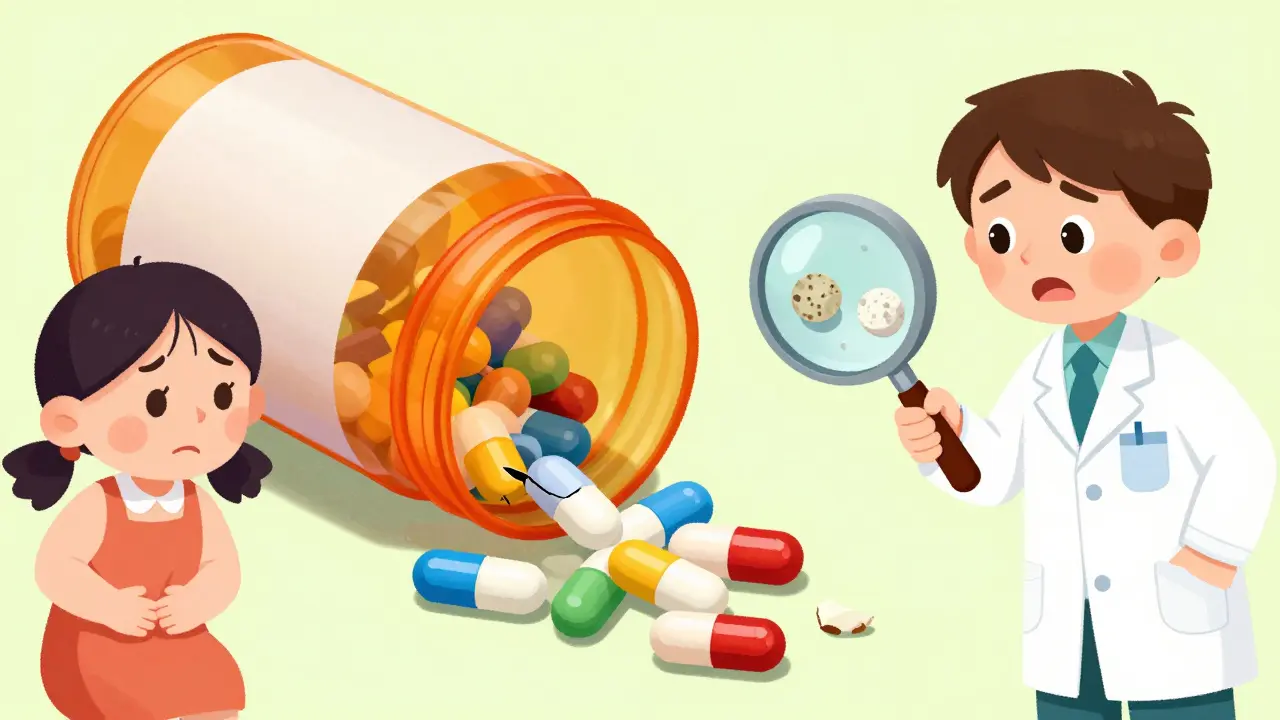
When you pick up a generic pill, you expect it to work just like the brand-name version. But what if that pill is cracked, unevenly colored, or contains the wrong amount of active ingredient? These aren’t rare mistakes-they’re common manufacturing issues that happen far more often than most people realize. In 2023, 12% of all generic drugs were recalled due to quality problems, compared to just 5% for branded drugs. And it’s not just about looks. These defects can mean the difference between a drug working-or failing to work at all.
What Exactly Are Generic Drug Manufacturing Defects?
Manufacturing defects in generics aren’t random accidents. They’re systemic failures tied to how these drugs are made. Unlike branded drugs, which often have dedicated production lines and higher quality budgets, generics are made under extreme pressure to cut costs. That pressure leads to corners being cut-sometimes in ways that directly affect safety.
Here are the most frequent defects:
- Capping: The top or bottom of a tablet splits off. Happens when compression force is too high or the granules are too dry-common in hydrophobic drugs like certain blood pressure pills.
- Lamination: Layers of the tablet peel apart. Often occurs when tablet presses run too fast (over 40 rotations per minute) or pre-compression is skipped.
- Sticking: Drug material clings to the metal punch heads during compression. This is especially bad for APIs with low melting points (below 120°C) when moisture levels creep above 4%.
- Mottling: Uneven coloring. Not just cosmetic-it can signal poor mixing of ingredients, which means some pills have too much drug, others too little.
- Weight variation: Tablets vary more than ±5% from target weight. The USP limit is strict: if more than 12.7% of a batch falls outside this range, it’s a failure. This is the leading cause of therapeutic inequivalence.
- Particulate contamination: Tiny particles in injectables. A major issue in sterile generics, often from poor cleaning of equipment or substandard raw materials.
These aren’t theoretical concerns. In 2023, the FDA received over 1,800 patient reports of visible tablet defects-from chipping to discoloration. Pharmacists reported that 42% of patients complained about how their generic pills looked or felt. One pharmacist on Reddit described a batch of metformin ER tablets that crumbled in the bottle. Another noted patients switching between different generic levothyroxine brands and reporting heart palpitations or fatigue. These aren’t placebo effects. They’re real, measurable changes in how the body responds.
Why Are Generics More Prone to Defects?
It’s not because generic manufacturers are careless. It’s because the business model forces them into a corner.
Branded drug makers spend 15-18% of production costs on quality assurance. Generic makers? Only 8-10%. Why? Because they’re competing on price. A single generic tablet might sell for pennies. To make a profit, companies squeeze every cost out of production. That means:
- Using older tablet presses that haven’t been upgraded in 20 years.
- Running machines at maximum speed to produce more units per hour.
- Sharing production lines between different drugs-increasing the risk of cross-contamination.
- Reducing staff training hours and skipping routine equipment calibration.
Here’s the data: 57% of generic manufacturing facilities failed FDA inspections in 2023. For branded manufacturers? Just 28%. And it’s not just the U.S. The European Medicines Agency reported similar numbers-37% of generic applications were rejected in 2023 due to manufacturing flaws, up from 29% in 2019.
Complex generics are the worst offenders. Inhalers? 18.2% defect rate. Modified-release tablets? 14.7%. Even simple immediate-release tablets have a 9.3% defect rate. That’s 1 in 10 pills that might not deliver the right dose.
How Defects Affect Real Patients
It’s easy to think, “So the pill looks funny. So what?” But when a tablet has inconsistent dosing, the consequences aren’t minor.
Take warfarin, a blood thinner. A 5% variation in dose can mean the difference between preventing a stroke and causing a bleed. In 2021, a study in JAMA Internal Medicine found that 7.3% of generic warfarin applications failed bioequivalence tests-not because of the formula, but because of manufacturing inconsistency.
Another example: levothyroxine for hypothyroidism. Even small changes in absorption can throw off hormone levels. Patients switching between generic versions have reported fatigue, weight gain, and heart rhythm issues. Hospital formulary committees in 2023 recorded that nearly 10% of generic substitution requests were denied because of documented quality concerns.
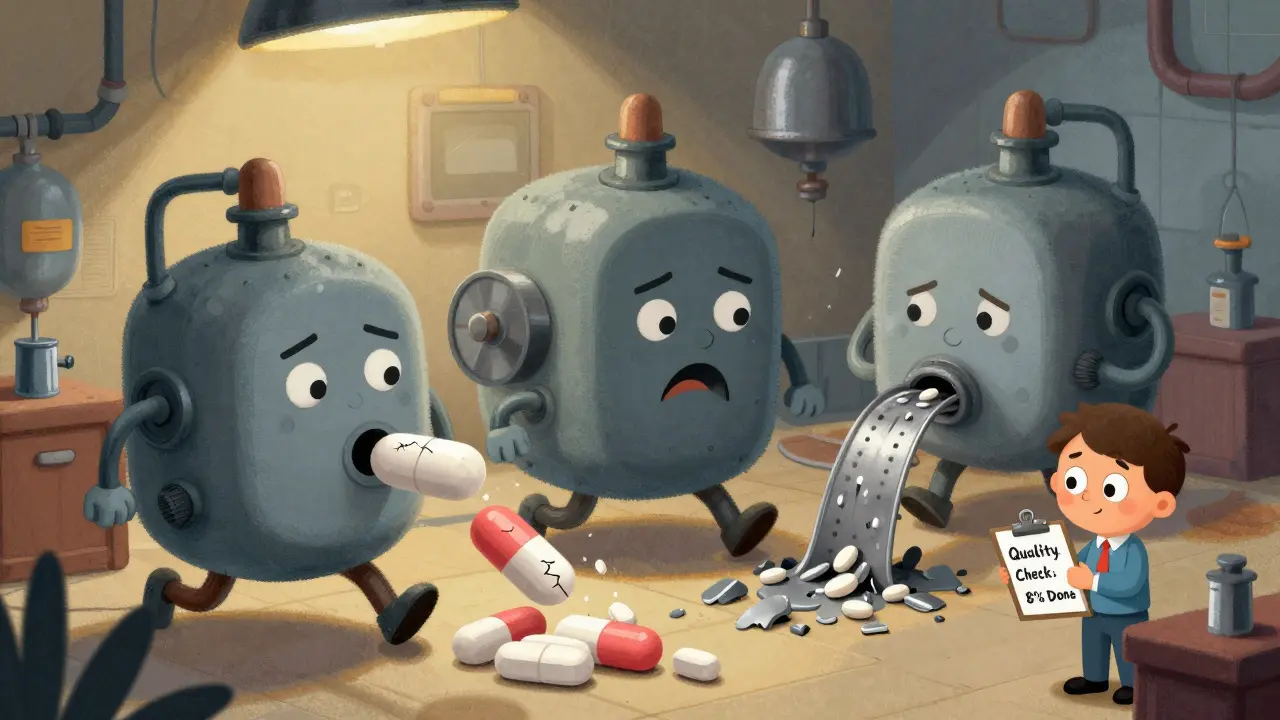
And it’s not just oral tablets. Injectable generics-like antibiotics or chemotherapy drugs-are especially dangerous. Particulate contamination can cause inflammation, blockages in blood vessels, or even sepsis. In 2022, a batch of generic vancomycin was recalled after reports of patients developing severe allergic reactions. The cause? Metal shavings from corroded mixing tanks.
What’s Being Done to Fix It?
There’s hope-but progress is slow.
The FDA launched its Emerging Technology Program in 2023 to help manufacturers adopt continuous manufacturing. Unlike old batch methods (where a batch of 50,000 pills is made all at once), continuous manufacturing produces pills one after another in a sealed, monitored system. Early adopters have cut defect rates by 65%. Sandoz and Dr. Reddy’s are now using AI-powered vision systems that scan 600 tablets per minute, catching defects as small as 0.1 mm. These systems detect 92% of flaws-far better than human inspectors, who miss about 30%.
Also, the 2024 Drug Supply Chain Security Act now requires track-and-trace for high-risk generics. Early results show a 22% drop in counterfeit-related defects.
But the biggest hurdle? Money. The Generic Pharmaceutical Association estimates it would take $28.7 billion to upgrade all U.S. generic manufacturing facilities to modern standards. In 2023, the industry invested just $1.2 billion. That’s a gap of $27.5 billion.
Without major investment, McKinsey & Company predicts 15-20% of generic manufacturers will exit the market within five years-not because they’re unethical, but because they can’t afford to keep up.
What Patients and Providers Can Do
You can’t control how a drug is made. But you can take steps to protect yourself:
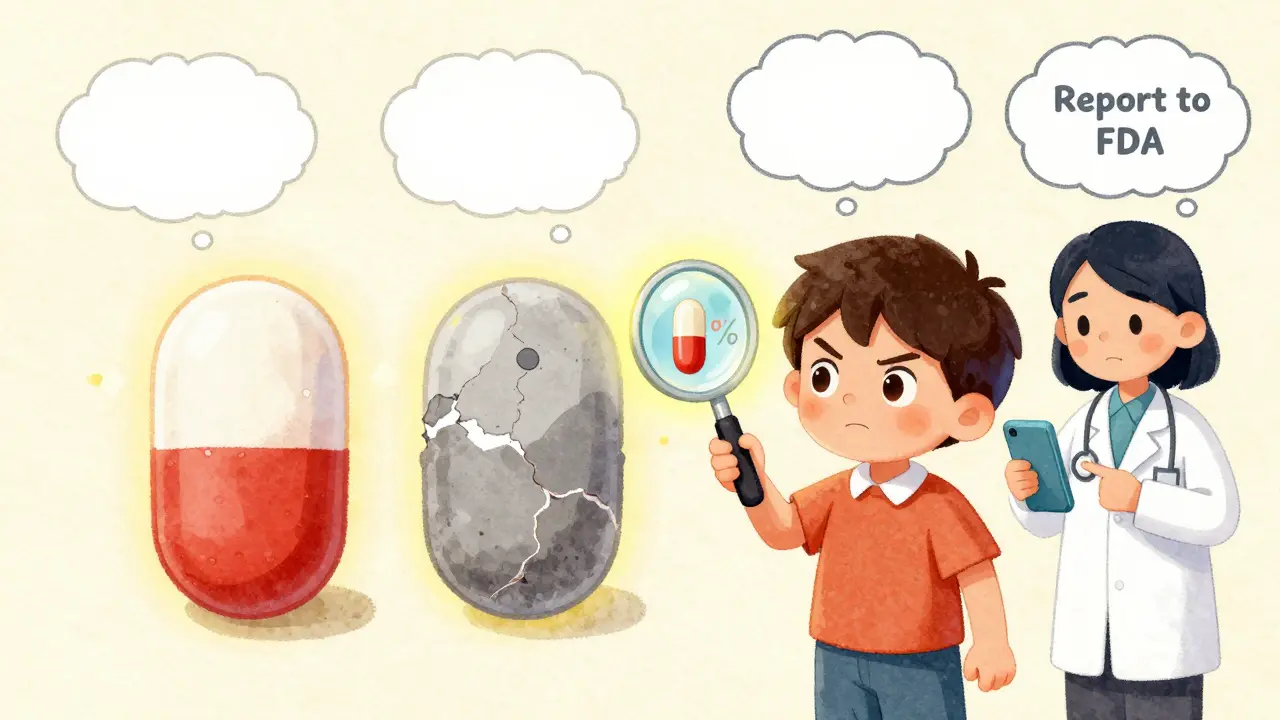
- Check the pill appearance. If your generic looks different-color, shape, markings-ask your pharmacist. A change might mean a new manufacturer.
- Track side effects. If you notice new symptoms after switching generics, report them. The FDA’s MedWatch system takes patient reports seriously.
- Ask about the manufacturer. Some companies have far better quality records. Teva, for example, had a 0.8% batch rejection rate in 2023. Smaller firms averaged 3.2%.
- Don’t assume “generic = same.” Bioequivalence tests only prove average absorption. They don’t guarantee every single pill is identical.
- Speak up to your doctor. If you’ve had issues with a generic, ask if the brand-name version is covered by your insurance. Many insurers will approve it if you document repeated problems.
Pharmacists are on the front lines. In a 2023 survey, 68% said they’d seen quality issues in the past year. If your pharmacist says, “I’ve never seen this batch before,” take it seriously.
The Bigger Picture
Generics make up 90% of prescriptions in the U.S. But they account for only 23% of spending. That’s the trade-off: more access, less quality control. The system works-until it doesn’t. When a batch of insulin or seizure medication fails, the consequences are life-or-death.
The good news? Technology is catching up. AI, continuous manufacturing, and real-time monitoring are finally bringing generic production into the 21st century. But until manufacturers are financially able to invest in quality-not just compliance-the risks will remain.
For now, awareness is your best defense. Know what to look for. Ask questions. Report problems. Your health depends on it.
Are generic drugs always safe?
Most generic drugs are safe and effective. But quality defects do occur-and they’re more common than many realize. The FDA and EMA report that 12% of generic drugs face recalls due to manufacturing issues, compared to 5% for branded drugs. Defects like inconsistent dosing, contamination, or tablet splitting can lead to treatment failure or adverse reactions. While the majority of generics meet standards, vigilance is key.
What are the most dangerous manufacturing defects?
The most dangerous defects are those that affect dosage accuracy. Weight variation over ±5%, particulate contamination in injectables, and improper sterilization can lead to overdose, underdose, or infection. For example, a 10% underdose in an antibiotic can allow bacteria to survive and develop resistance. A 10% overdose in a blood thinner can cause internal bleeding. Cosmetic defects like mottling or chipping may seem harmless, but they often signal deeper mixing or compression problems.
Why do some generic pills look different than others?
Different manufacturers use different inactive ingredients, compression settings, or dyes. A change in appearance doesn’t always mean a problem-but it can. If you’ve been taking the same generic for years and suddenly notice a new color, shape, or marking, it’s likely a new supplier. Ask your pharmacist to confirm the manufacturer. If you experience new side effects after the switch, report it.
Can I tell if a generic drug is defective just by looking at it?
You can spot some defects-cracked tablets, uneven coloring, powdery residue, or pills that crumble easily. But many serious issues, like low active ingredient content or microscopic contamination, are invisible. A tablet can look perfect and still deliver the wrong dose. That’s why weight variation testing and lab analysis are critical. If you suspect a problem, don’t rely on sight alone. Contact your pharmacist or report it to the FDA’s MedWatch system.
What should I do if I think my generic drug is defective?
Stop taking the medication. Contact your pharmacist or doctor immediately. Keep the packaging and remaining pills. Report the issue to the FDA through MedWatch (medwatch.fda.gov) or your country’s equivalent. If you’re experiencing symptoms like dizziness, nausea, or unusual fatigue after switching generics, mention the timing. Many patients don’t realize their symptoms are linked to drug quality-your report helps regulators track patterns and initiate recalls.


11 Comments
Sanjana Rajan
Ugh, I swear my generic metformin tastes like chalk now. Last month it was fine, now it’s this gritty powder that sticks to my tongue. I’ve been skipping doses because I’m scared I’m not getting the right amount. My pharmacist just shrugged and said, ‘It’s still the same drug.’ No it’s not. It’s a different factory’s garbage.
Ryan Voeltner
The systemic underinvestment in generic manufacturing is a public health crisis disguised as cost savings. While branded pharmaceuticals benefit from robust QA infrastructure, generics operate on razor-thin margins that incentivize compliance over quality. This is not a failure of individual manufacturers but of a market structure that prioritizes price over patient safety.
Shameer Ahammad
Let me tell you something-FDA inspections are a joke. They show up once every three years, and the plant cleans up for two weeks before they come. Meanwhile, the machines are running 24/7, operators are working 12-hour shifts with no training, and the quality control guy is just eyeballing the tablets. I worked in a generic plant in Hyderabad. We’d mix two different batches together just to hit the weight target. Nobody cared. The FDA? They give out ‘warning letters’ like candy. Then they let you keep selling.
And don’t even get me started on the raw material suppliers. Some of the API comes from China, and half of it’s got impurities that don’t even show up on standard HPLC tests. You think your blood pressure med is working? It’s probably just placebo with extra sugar.
Manish Singh
I’ve been on generic levothyroxine for 10 years. Switched brands last year because my insurance changed. Suddenly I was exhausted, gaining weight, heart racing. I thought it was stress or menopause. Turned out my TSH jumped 30%. I went back to the old brand-my numbers normalized in two weeks. My doctor said, ‘It’s bioequivalent.’ But bioequivalent doesn’t mean identical. It means ‘close enough for a statistical average.’ Not good enough for someone who needs precision.
Nilesh Khedekar
you know what this really is? big pharma’s secret plan. they let generics be crappy so people start complaining and then they push you back to the brand name pills. that’s how they make their money. they want you to pay $500 for a pill that costs 2 cents to make. the whole system is rigged. i saw a video on youtube where a guy cracked open a generic pill and it was like 80% filler. i’m not taking any more. i’m switching to herbal stuff. turmeric for diabetes. garlic for blood pressure. natural is better. they can’t patent garlic.
Stephen Habegger
This is such an important topic. I’ve seen patients struggle with inconsistent generics and no one listens. The system needs to change-but awareness is the first step. Thank you for laying this out so clearly.
Justin Archuletta
My mom’s generic blood thinner changed last year-she ended up in the ER. Now she only takes the brand. Insurance won’t cover it unless we appeal. Took 3 months. She’s fine now. But why should we have to fight just to get a safe pill?
Kal Lambert
Continuous manufacturing is the future. AI scanning 600 tablets per minute? That’s insane. We’re talking 92% detection vs. 70% for humans. If every plant did this, defect rates would drop overnight. The problem isn’t tech-it’s money. And politics. Why isn’t this mandatory?
cara s
As someone who works in a hospital pharmacy, I can tell you that the variability in generic tablets is terrifying. We had a batch of generic clindamycin last month where 17% of the tablets were underweight. We pulled the entire lot. Patients had reported nausea and diarrhea-no one connected it until we checked the batch logs. The manufacturer claimed it was ‘within acceptable tolerance.’ But tolerance for what? For a 15% failure rate? That’s not acceptable. That’s negligence. And we’re supposed to just hand these out and say, ‘Hope for the best.’
Meanwhile, the FDA’s guidance documents are 20 years old. The equipment they’re inspecting? Often older than the inspectors. We need real-time monitoring, not quarterly audits. We need penalties that hurt-not fines that are a rounding error on a billion-dollar profit margin.
Amadi Kenneth
Wait wait wait-I think I know what’s REALLY going on. The government is using these defective generics to control the population. Low-dose meds = less effective treatment = more chronic illness = more people on disability = easier to manage. It’s all connected. They don’t want you healthy. They want you dependent. That’s why they allow the cheap pills. That’s why they ignore the recalls. That’s why they shut down whistleblowers. I’ve got friends who work in labs-they’ve seen the data. It’s not incompetence. It’s intentional.
jared baker
Don’t take bad pills. If your generic looks weird or you feel off, switch back. Talk to your doc. Ask for the brand. Insurance usually says no at first-but if you push, they’ll cover it. I’ve done it three times. Worth it.