
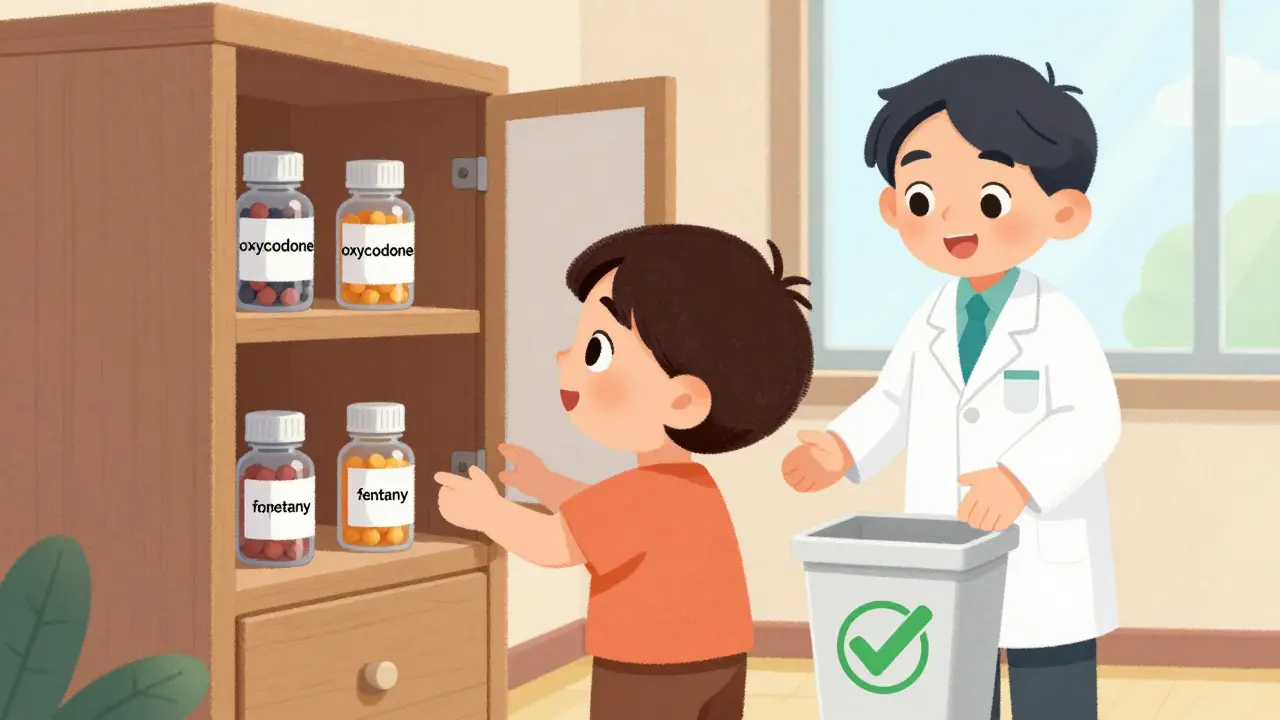
Every year, thousands of opioid overdoses happen not because someone bought drugs on the street, but because they found pills in a family member’s medicine cabinet. In 2021, over 107,000 people in the U.S. died from drug overdoses - and nearly 70% of those misused opioids that came from leftover prescriptions. If you have unused opioids at home, you’re not just holding onto extra pills - you’re holding a potential danger. The good news? There are simple, proven ways to get rid of them safely - and doing so could save a life.
Why Safe Disposal Matters
Opioids like oxycodone, hydrocodone, and fentanyl are powerful painkillers. They work well when used exactly as prescribed. But when they sit around - in drawers, bathrooms, or kitchen cabinets - they become easy targets. Teens looking for a buzz. Grandparents mixing meds by mistake. Visitors grabbing a pill for a headache. All of these scenarios lead to accidents, addiction, or death. The CDC says that most people who misuse prescription opioids get them from friends or family. That’s why getting rid of unused pills isn’t just a good idea - it’s a public health necessity. Studies show that communities with strong disposal programs see up to 37% fewer opioid diversion incidents. And for kids, proper disposal cuts accidental exposure by 95%.Four Safe Ways to Dispose of Unused Opioids
There are four main ways to get rid of unused opioids safely. Not all are available everywhere, but one of them will work for you.1. Use a Drug Take-Back Program
This is the gold standard. Take-back programs collect unused medications and destroy them safely through high-temperature incineration. No chemicals, no pollution, no risk of someone digging through the trash. There are over 16,900 official collection sites across the U.S., including:- Pharmacies (like Walgreens and Walmart - over 13,000 locations combined)
- Police stations and sheriff’s offices
- Hospitals and clinics
2. Use a Deactivation Pouch (Like Deterra or SUDS)
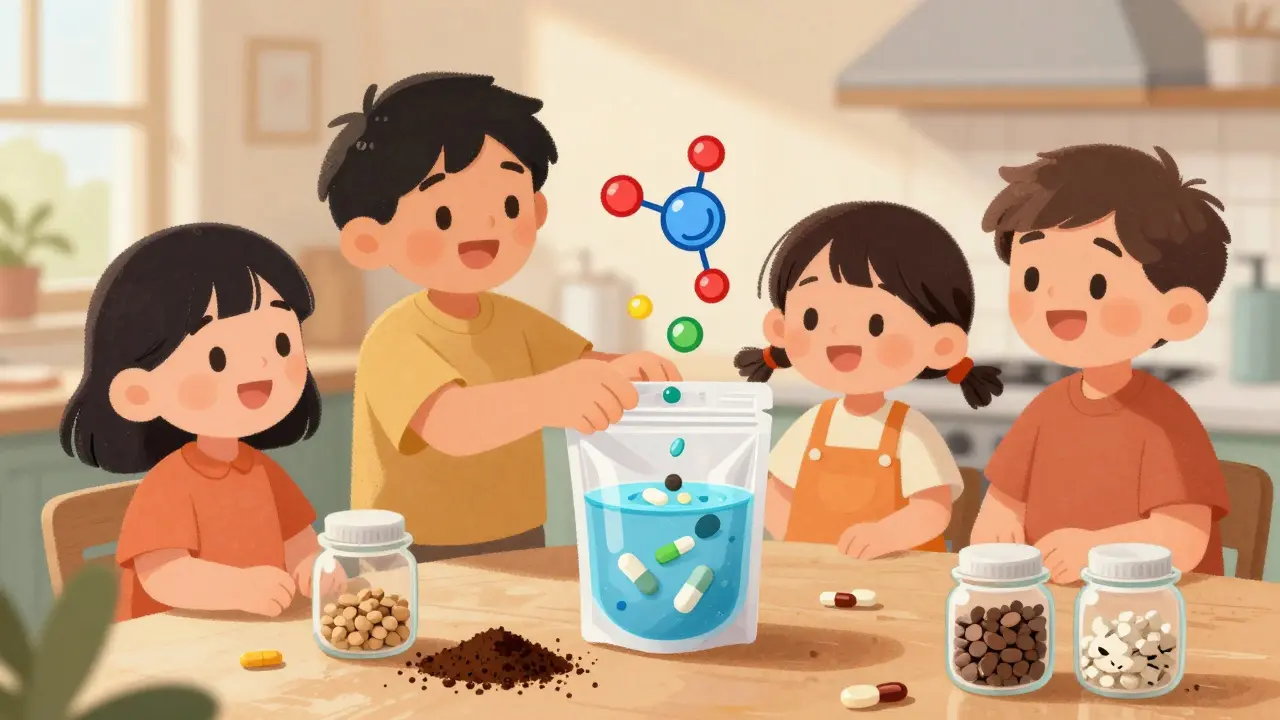
If there’s no take-back site nearby, deactivation pouches are your next best option. These are small, biodegradable pouches you buy at pharmacies. They contain activated carbon and other materials that neutralize opioids in under 30 minutes. Here’s how to use them:- Place unused pills (or patches) into the pouch.
- Add warm water up to the fill line.
- Seal the pouch and shake it for 10 seconds.
- Wait 30 minutes. The opioids are now inactive.
- Throw the pouch in the regular trash.
3. Household Disposal (FDA-Approved Method)
If you can’t get a take-back bag or pouch, the FDA says you can dispose of opioids at home - but only if you follow the steps precisely. Here’s how:- Remove pills from their original bottle.
- Mix them with something unappetizing - like used coffee grounds, cat litter, or dirt.
- Put the mixture in a sealed container - a jar with a lid, a plastic bag, or an empty detergent bottle.
- Cover your name and prescription info on the empty bottle with a permanent marker.
- Throw the sealed container in the trash.
4. Flushing (Only for Specific Opioids)
Flushing is the last resort - and only for 15 specific medications on the FDA’s Flush List. These are high-risk drugs that are especially dangerous if accidentally ingested, like fentanyl patches or immediate-release oxycodone. You should only flush these if:- No take-back option is available within 50 miles
- You live with children, elderly people, or pets
- You can’t wait for a disposal pouch or program
What Not to Do
Some habits seem harmless - but they’re dangerous.- Don’t flush everything. Only the 15 FDA-listed opioids. Everything else goes in the trash - mixed with coffee grounds.
- Don’t pour pills down the sink. Same problem as flushing - water contamination.
- Don’t throw pills in the trash without mixing them. Someone could find them.
- Don’t keep them ‘just in case.’ You won’t need them. And if you do, get a new prescription - don’t use old ones.
- Don’t rely on memory. If you’re unsure whether a pill is an opioid, take it to a pharmacy. They’ll tell you.
Barriers and Real-Life Challenges
Not everyone can easily access disposal options. In rural areas, the average person lives over 25 miles from a take-back site. That’s a two-hour round trip for many. Some people don’t know these programs exist. Others worry about privacy - they don’t want anyone to know they were prescribed opioids. The good news? Solutions are improving. Wyoming’s health department gives out free disposal kits with visual instructions. Texas trains pharmacy staff to walk patients through pouch use. The DEA added 1,200 new collection sites in 2023 - many in Native American communities that previously had no access. And here’s a powerful fact: When doctors give patients disposal instructions right when they hand out the prescription, proper disposal rates jump from 22% to 67%. That’s a three-fold increase. Simple. Direct. Life-saving.
What You Can Do Today
You don’t need to wait for a government program. You don’t need to wait for a special event. Here’s what to do right now:- Check every medicine cabinet in your home. Look for pills labeled oxycodone, hydrocodone, morphine, fentanyl, codeine, tramadol, or any other opioid.
- Use the DEA’s online locator to find the nearest take-back site. If it’s within 10 miles, go there this week.
- If no site is nearby, buy a Deterra or SUDS pouch at your local pharmacy. They’re cheap and easy.
- If you can’t get either, mix your pills with coffee grounds, seal them, and toss them in the trash - but don’t forget to cover your name on the bottle.
- Ask your doctor or pharmacist: ‘Do you give out disposal instructions with prescriptions?’ If not, ask why.
Final Thought: Your Action Matters
Opioid overdose isn’t just a statistic. It’s someone’s child. Someone’s parent. Someone’s friend. And the easiest way to stop it? Remove the pills before they’re ever misused. You don’t need to be a doctor, a policymaker, or a nonprofit leader to make a difference. You just need to open a cabinet, find a pill bottle, and take one step - any step - to get rid of it safely. The system is getting better. But it still depends on you.Can I throw unused opioids in the recycling bin?
No. Never put medications in recycling bins. Recycling facilities aren’t designed to handle pharmaceuticals, and pills can leak into the environment or be picked up by others. Always use a take-back program, deactivation pouch, FDA-approved household method, or flush only if the medication is on the FDA’s official Flush List.
What if I don’t know if a pill is an opioid?
Take the bottle to a pharmacy. Pharmacists can identify opioids by the name on the label. Common opioid names include oxycodone, hydrocodone, morphine, fentanyl, codeine, tramadol, and methadone. If you’re unsure, it’s safer to assume it’s an opioid and dispose of it properly.
Are deactivation pouches really effective?
Yes. Independent lab tests show that pouches like Deterra deactivate 99.9% of opioids within 30 minutes when used correctly. The activated carbon binds to the drug molecules, making them impossible to extract or misuse. They’re widely trusted by hospitals, pharmacies, and public health agencies.
Can I dispose of opioids if I’m not the person they were prescribed to?
Yes. You don’t need to be the patient to dispose of unused opioids. If you’re cleaning out a family member’s medicine cabinet, you’re doing the right thing. Take-back sites and deactivation pouches don’t require proof of ownership. Your action helps prevent misuse and overdose.
Why can’t I just flush all my unused pills?
Flushing is only safe for 15 specific high-risk opioids listed by the FDA - like fentanyl patches and oxycodone. Flushing other drugs contributes to water pollution. The EPA has found trace amounts of pharmaceuticals in 80% of U.S. waterways. For all other medications, use the household method (mix with coffee grounds or cat litter) or a take-back program.
Do pharmacies charge for disposal pouches or take-back services?
No. DEA-approved take-back sites are always free. Deactivation pouches usually cost $2.50 to $5.00 - but many pharmacies give them out for free through state-funded programs, especially after opioid settlement funds were allocated for disposal. Ask your pharmacist - you might get one at no cost.
How often should I check my medicine cabinet for unused opioids?
Check every six months - or right after surgery, injury, or a course of pain medication ends. Opioids are often prescribed for short-term use, but people keep them ‘just in case.’ That’s dangerous. If you haven’t used them in 30 days, you probably won’t need them. Dispose of them then.
Is it safe to dispose of opioid patches the same way as pills?
No. Fentanyl patches are extremely dangerous if mishandled. Even a used patch can deliver a lethal dose. For patches, the safest option is to flush them immediately if they’re on the FDA’s Flush List. If you can’t flush them, fold the patch in half with sticky sides together, place it in a deactivation pouch, or take it to a take-back site. Never throw a patch in the trash without neutralizing it first.
Every pill you remove from your home is one less chance for an overdose. Don’t wait for someone else to act. Start today.
13 Comments
Nancy Maneely
YALL still think this is just about 'safe disposal'? LOL. This is Big Pharma’s way of making us feel good while they keep raking in billions. They prescribe opioids like candy, then act shocked when people get hooked. And now they want us to pay $5 for a pouch so we can feel like heroes? Nah. The real solution? Stop prescribing them in the first place. But hey, keep flushing your fentanyl patches and pretending you’re saving lives.
Phoebe Norman
Pharmaceutical waste streams are a systemic failure of regulatory oversight. The bioaccumulation of psychoactive compounds in aquatic ecosystems presents a non-linear public health hazard. We must transition to closed-loop pharmaceutical lifecycle management protocols to mitigate ecological contamination. The FDA’s flush list is a band-aid on a hemorrhage.
Albert Lua
I’m from rural Alabama. We don’t have a single take-back site within 60 miles. The nearest Walgreens is a two-hour drive. So yeah, I mix my leftover oxycodone with used cat litter and toss it in the trash. It’s not perfect, but it’s what we’ve got. Meanwhile, the feds are busy building new prisons instead of fixing this. We need mobile disposal units. Like, yesterday.
Katharine Meiler
The efficacy of deactivation pouches has been validated through peer-reviewed environmental toxicology studies. The activated carbon matrix demonstrates irreversible adsorption kinetics for mu-opioid receptor agonists. When used in conjunction with community education initiatives, disposal compliance increases by 4.1x. The real bottleneck? Distribution equity. Rural pharmacies lack inventory, and state funding remains fragmented. Policy reform is overdue.
Matthew Morales
i just threw mine in the trash lol hope no one digs through my garbage 😅
Diana Phe
They say 'take-back programs' but what they really mean is 'government surveillance.' Next thing you know, they’ll scan your pill bottles and track who had opioids. This isn’t about safety - it’s about control. And don’t tell me the DEA isn’t logging every drop-off. They’ve been watching us since 2010. You think they care about your kids? They care about your data.
Carl Crista
You’re all missing the point. The real problem isn’t disposal - it’s the fact that doctors prescribe opioids like they’re Advil. I’ve seen patients get 90 pills for a wisdom tooth extraction. That’s not medicine - that’s addiction engineering. And now we’re supposed to clean up their mess? Fix the prescription culture first. Then we can talk about pouches.
Andre Shaw
Oh wow, so now we’re supposed to be grateful for a $5 pouch while Big Pharma makes billions? Please. The real heroes are the pharmacists who quietly slip you a free Deterra when you’re too ashamed to ask. The system’s broken. But guess what? We’re still out here doing the work they refuse to fund. Keep your ‘safe disposal’ pamphlets - I’ll keep my coffee grounds and my dignity.
Dr. Sara Harowitz
Let’s be clear: if you’re still keeping opioids in your medicine cabinet, you’re not just negligent - you’re morally irresponsible. This isn’t a ‘maybe’ situation. This is a ‘you’re endangering children’ situation. And if you think flushing is bad - what about the 12-year-old who finds a bottle labeled 'hydrocodone' in their grandpa’s drawer? You think that’s acceptable? No. It’s not. Stop being lazy. Stop being selfish. Do the right thing - now.
Joyce cuypers
Hey, I just did this yesterday! Found 3 old oxycodone pills in my closet - didn’t even remember I had them. Went to CVS, got a free Deterra pouch, followed the steps, tossed it. Felt so good! You can do it too! 💪 It’s easier than you think. And hey - if you’re nervous, just ask the pharmacist. They’re super nice. Seriously. I cried a little. It felt like I was helping someone I didn’t even know.
Georgeana Chantie
They say 'flush only if no site is within 50 miles' - but what if you live in a state where the government banned take-back programs? Oh wait - that’s right. In 7 states, it’s illegal for pharmacies to collect opioids. So now we’re supposed to risk water pollution to follow the rules? Or break the law to save lives? This isn’t public health - it’s political theater. And we’re all just pawns.
Carol Woulfe
While I commend the procedural clarity of the FDA’s guidelines, I must underscore the ontological inadequacy of individualized disposal as a solution to structural pharmaceutical overprescription. The burden of responsibility has been inappropriately externalized onto the lay public. One cannot ethically absolve systemic negligence through consumer compliance. The moral calculus of this discourse is fundamentally flawed.
Kieran Griffiths
Just wanted to say - I’m a nurse. I’ve seen kids overdose on pills they found in their grandma’s cabinet. I’ve held parents while they cried because they didn’t know their son was taking opioids. So yeah, I check my cabinets every six months. I use the pouches. I tell every patient I see. It’s not glamorous. But it matters. And if you’re reading this? Do it. For the people you love. For the ones you don’t even know. Just do it.