
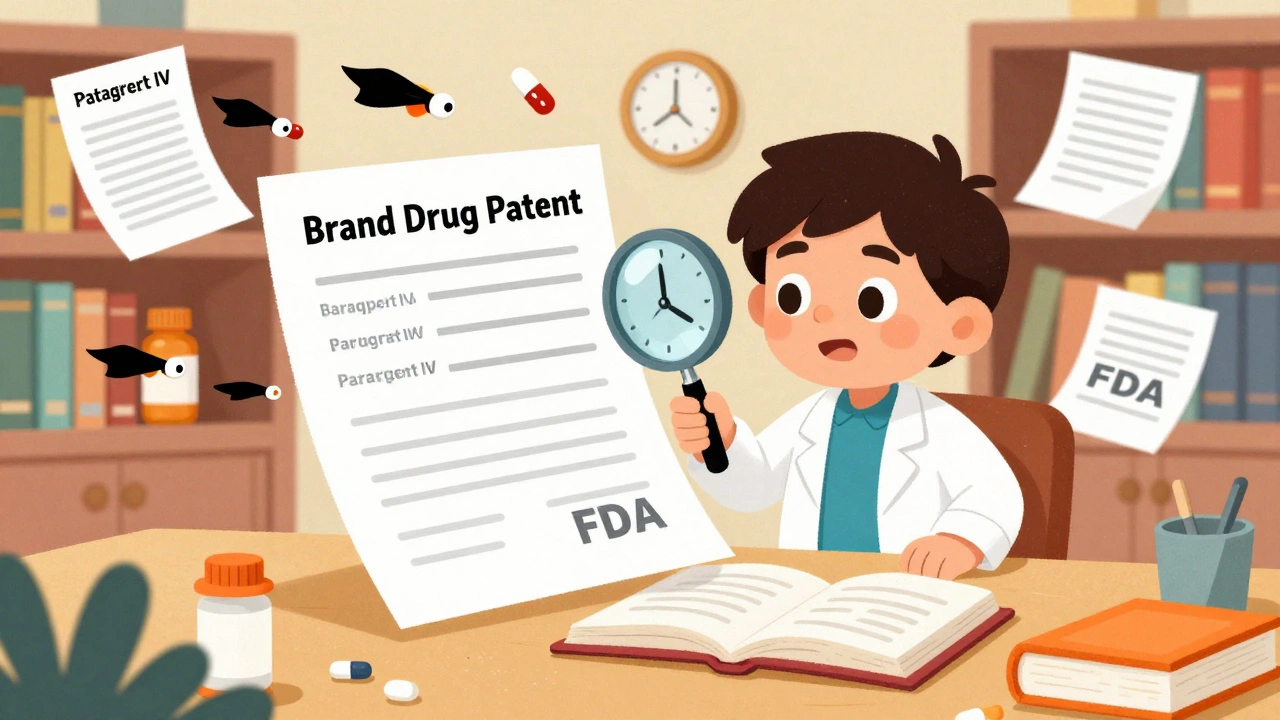
When a brand-name drug’s patent is about to expire, the race to bring out a cheaper generic version begins. But it’s not just a matter of copying the pill and hitting the market. There’s a legal battlefield called Paragraph IV certification-a powerful, high-stakes tool built into U.S. drug law that lets generic manufacturers challenge patents head-on. This isn’t a loophole. It’s the law. And it’s how billions in savings for patients happen.
What Exactly Is Paragraph IV?
Paragraph IV isn’t a court case or a regulation. It’s a specific type of filing made by a generic drug company when it submits its application to the FDA. Every generic drug maker must file an Abbreviated New Drug Application, or ANDA. Inside that application, they have to say something about the patents listed for the brand-name drug in the FDA’s Orange Book. Most choose Paragraph III: they just wait until the patent expires. But the ones who want to get there first? They file Paragraph IV. Paragraph IV says: "We believe this patent is invalid, unenforceable, or our drug won’t even infringe it." That’s it. Simple words. But they trigger a legal earthquake. Under the Hatch-Waxman Act of 1984, this isn’t just a statement-it’s an artificial act of infringement. That means the brand company gets the right to sue. And they almost always do. The system was designed to force a showdown: innovation protected, but competition guaranteed.The 45-Day Clock and the 30-Month Stay
Once the generic company sends its Paragraph IV notice, the brand-name company has exactly 45 calendar days to file a patent infringement lawsuit. If they don’t act in that window, the generic can move forward without delay. But if they do? The FDA can’t approve the generic for 30 months. That 30-month clock doesn’t start when the notice is filed. It starts when the brand company receives it. That tiny detail matters. Some generic companies time their filings to delay the brand’s response window. Others rush to file early to lock in first-to-file status. This stay is the brand’s biggest shield. It buys time. But it’s not forever. If the court rules in favor of the generic before 30 months are up, approval happens immediately. If the brand wins? The generic waits until the patent expires.Why the Lawsuit Matters More Than the Patent
Most people think patent validity is decided by the USPTO. But in Paragraph IV cases, it’s federal judges in district courts who decide. And they don’t look at the patent in isolation. They look at the language-the claims. Claim construction, also called a Markman hearing, is where the case is often won or lost. A patent might say, "A tablet containing 20 mg of active ingredient, coated to release over 12 hours." The generic might use a 20 mg tablet that releases over 10 hours. Is that infringement? The court decides. If the judge says the claim covers "10 hours or more," the generic loses. If they say it only covers "12 hours exactly," the generic wins. Most Paragraph IV cases hinge on this. A 2020 Pharma-IQ analysis found that claim construction was the deciding factor in over 70% of outcomes. The brand company’s patent might look strong on paper. But if the language is vague, overly broad, or based on minor tweaks, it’s vulnerable.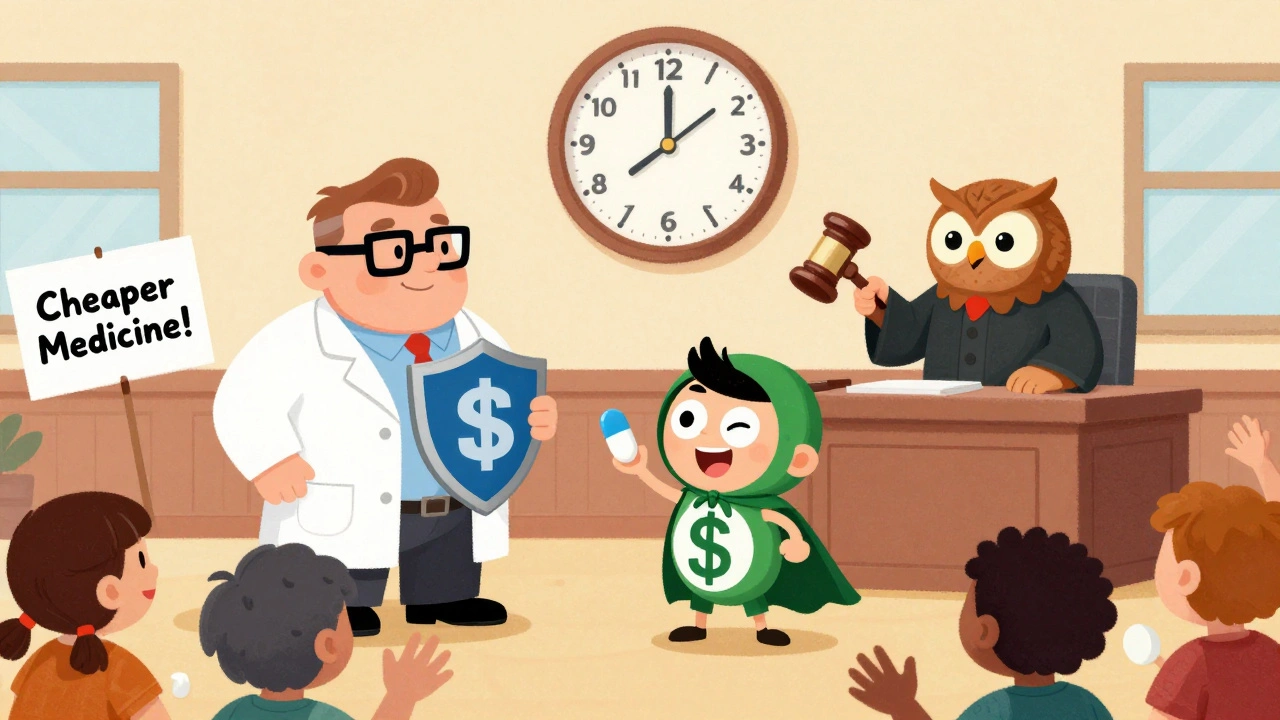
The 180-Day Exclusivity Prize
Why would a generic company risk millions in legal fees? Because the payoff is huge. The first company to file a successful Paragraph IV certification gets 180 days of exclusive market access. During that time, no other generic can enter. The first filer can set the price-usually 20% to 40% below the brand drug. And because they’re the only option, pharmacies and insurers buy it. Evaluate Pharma found that during this 180-day window, the first filer captures 70% to 80% of the entire generic market. That’s why companies fight so hard to be first. In 2014, the FTC reported that 87% of Paragraph IV filers aimed for first-to-file status. Some even team up with other generics to share costs and split the exclusivity. Others go solo, betting everything on one patent. The stakes? When Barr Labs beat Eli Lilly’s Prozac patent in 2000, they captured $1.2 billion in sales during their exclusivity period.Who Wins? Who Loses?
The data shows Paragraph IV works-but it’s not fair. According to UNC’s 2021 study of 1,783 cases from 1985 to 2010, generics win about 65% of the time. That’s a high success rate. But it’s not because the patents are weak. It’s because generics pick their fights carefully. They don’t challenge every patent. They target the ones that are easiest to knock down: older patents with obvious prior art, vague claims, or patents filed just before expiration. Teva’s 2019 win against Pfizer’s Lyrica patent is a textbook example. The patent covered a specific way to use the drug. Teva proved the method was already known. The court agreed. Generic versions flooded the market. But when brand companies stack patents-called "patent thickets"-it gets harder. AbbVie’s Humira had over 100 patents listed in the Orange Book. Multiple Paragraph IV challenges failed because each patent covered something different: a formulation, a delivery device, a method of use. Even if one was weak, another blocked entry. The Congressional Research Service found that between 2015 and 2020, 72% of new drugs had three or more Orange Book patents. In 1995, it was just 38%. That’s not innovation. That’s strategy.Costs, Risks, and the Pay-for-Delay Trap
Paragraph IV isn’t cheap. The average cost per case? $7.8 million, according to Winston & Strawn’s 2022 analysis. That’s not including manufacturing prep, which can cost another $15-25 million. Many generics spend $2.3 million just on pre-filing research. And if they lose? The penalties can be brutal. Mylan was hit with a $1.1 billion judgment in 2017 for willfully infringing Novartis’ Gleevec patent. That’s not a typo. One mistake can bankrupt a company. Then there’s pay-for-delay. Before 2013, it was common: brand companies would pay generics to delay entry. The FTC estimated that in 2002 alone, these deals cost consumers $3.5 billion. The Supreme Court shut it down in FTC v. Actavis, calling it "antitrust liability." But the tactics evolved. Now, instead of cash, brands offer exclusive licensing deals, co-marketing agreements, or supply contracts. The FTC says these are still anti-competitive.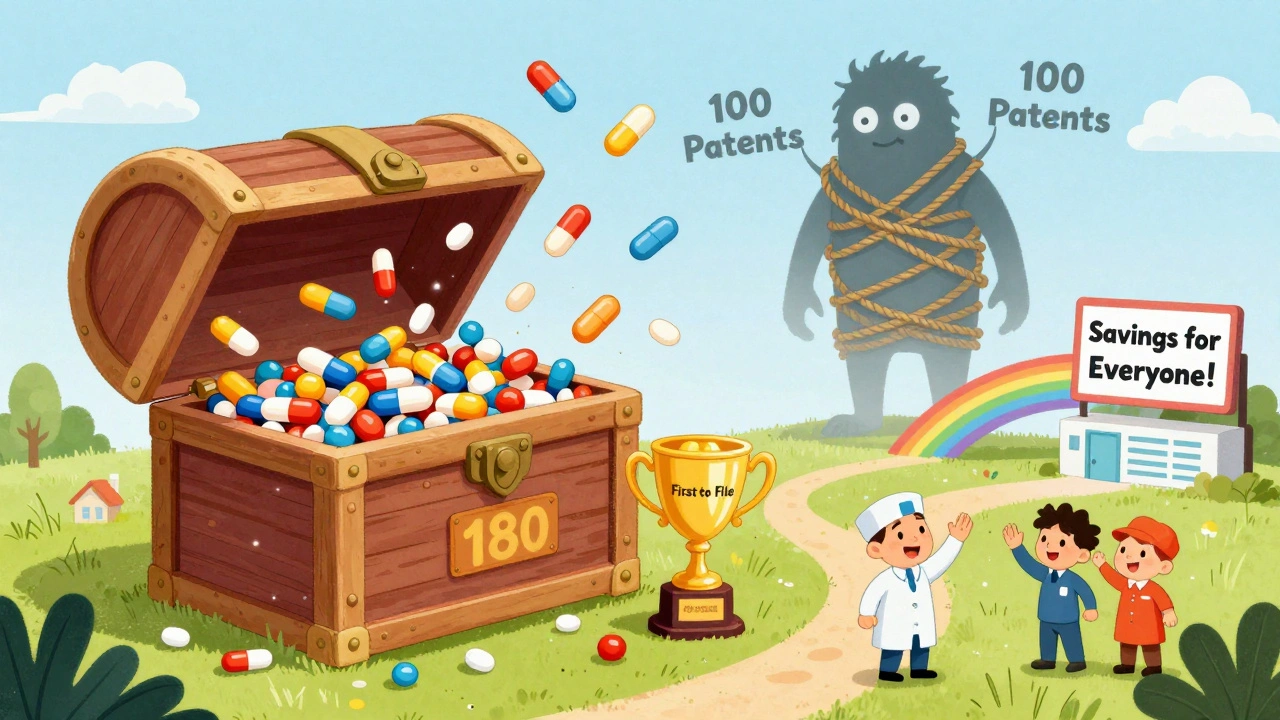
What’s Changing Now?
The system is under pressure. The FDA’s 2022 rule on citizen petitions cracked down on brand companies using regulatory filings to delay generic approval. The 2023 CREATES Act forced brands to provide drug samples to generics for testing-something they used to withhold to stall development. The Inflation Reduction Act of 2022 lets Medicare negotiate drug prices. That changes the game. If a brand knows the government will cap its price anyway, why spend $10 million to delay a generic? Some companies are already cutting back on patent thickets. Meanwhile, more generics are teaming up with patent offices. In 2022, 47% more Paragraph IV cases were paired with Inter Partes Review (IPR) challenges at the USPTO. That’s a new tactic: use the patent office to weaken the patent, then use the courts to clear the path.Why This Matters to You
You don’t need to be a lawyer to understand this. Paragraph IV is why your $400 brand-name pill became a $15 generic in six months. It’s why insulin prices dropped 80% after generics entered. It’s why people with chronic conditions can afford their meds. Between 2009 and 2019, generic drugs that entered through Paragraph IV saved U.S. consumers $1.68 trillion. That’s more than the GDP of Australia. The system isn’t perfect. Patent thickets, legal costs, and delays still hurt. But without Paragraph IV, generics wouldn’t have a legal foot in the door. It’s the only tool that forces the balance between innovation and access.What’s Next?
The FTC is pushing for reform. They want to limit how many patents can be listed in the Orange Book. They want to stop evergreening-where companies tweak a drug just to reset the clock. And they want faster court timelines. For now, the system still works. It’s messy. It’s expensive. But it delivers results. Every Paragraph IV filing is a gamble. But when it pays off? Millions of people get cheaper medicine. And that’s the real win.What is a Paragraph IV certification?
A Paragraph IV certification is a legal statement filed by a generic drug manufacturer with its FDA application, claiming that a brand-name drug’s patent is invalid, unenforceable, or won’t be infringed by the generic version. This triggers a patent lawsuit from the brand company and can lead to early generic market entry.
How does Paragraph IV speed up generic drug approval?
Paragraph IV allows a generic company to challenge a patent before it expires. If the generic wins the lawsuit, the FDA can approve the drug immediately-even if the patent hasn’t expired yet. This bypasses the usual wait until patent expiration, cutting years off the timeline to generic availability.
Why do brand companies sue after a Paragraph IV filing?
Under the Hatch-Waxman Act, a Paragraph IV certification is treated as an act of patent infringement. Brand companies have 45 days to sue to block approval. If they do, the FDA must delay approval for up to 30 months while the case is resolved. This gives them time to defend their patents.
What is the 180-day exclusivity period?
The first generic company to file a successful Paragraph IV certification gets 180 days of exclusive rights to sell its version of the drug. During this time, no other generic can enter the market. This incentive drives competition and often leads to the biggest price drops.
Are Paragraph IV challenges always successful?
No. About 65% of Paragraph IV challenges succeed in court, according to a 2021 study. Success depends on the strength of the patent, the quality of the legal argument, and whether the generic can prove non-infringement or invalidity. Many cases settle before trial, especially when the patent is weak.
How does Paragraph IV differ from biosimilar patent disputes?
Biosimilars, which are complex biological drugs, operate under a different law (BPCIA) and don’t have a fixed 30-month stay or 180-day exclusivity. Instead, they go through a multi-step "patent dance" process with no guaranteed timeline. The process is longer and more uncertain than Paragraph IV, making generic entry slower for biologics.


10 Comments
Kyle Flores
I used to pay $600 for my dad's blood pressure med. Now it's $12. I don't know the legal stuff, but I know my wallet breathes easier. Thanks to these guys who fight in court so we don't have to.
Olivia Hand
Paragraph IV is basically the legal equivalent of sneaking into a locked room with a crowbar and saying, 'This lock is garbage.' And then the owner sues you… but the judge nods like, 'Yeah, you’re right, it is.'
It’s wild how a 3-sentence filing can drop a $10B drug to pennies. The system’s rigged, but at least the rigging works for the people sometimes.
Desmond Khoo
Bro. This is why I can afford my diabetes meds. 😭😭😭
My mom cried when she saw the price drop. Like… actual tears.
Somebody spent millions in court so I could buy insulin without choosing between rent and pills.
Thank you to every generic company that dared to say 'nah, that patent’s trash.' 🙏💊
Louis Llaine
So let me get this straight - the system is designed so that a billion-dollar pharma company can pay lawyers to delay a $15 pill by 30 months… and we call this 'innovation'?
Meanwhile, the guy who invented the drug is retired in the Caymans and the generic makers are the real heroes.
Also, 'patent thickets'? More like patent spam.
Jane Quitain
OMG I just learned this and I’m so inspired!! 💪
Like, who knew that filing a paper could change lives??
Generics are unsung heroes!!
I’m gonna tell my friends!!
And maybe even write my rep??
Wait, do I have to spell ‘Paragraph IV’ right?? 😅
Ernie Blevins
65% win rate? That’s not luck. That’s the patents being garbage.
Brand companies file patents on the color of the pill.
They patent breathing.
It’s not a system. It’s a scam with a law book.
Nancy Carlsen
My cousin in Puerto Rico couldn’t afford her asthma inhaler until generics came in. 🌎❤️
This isn’t just law - it’s dignity.
Thank you to everyone who fights for access. You’re making the world less cruel.
And yes, I cried reading this. 😭
Ashley Farmer
I used to think patent law was boring. Then I realized it’s the reason my kid can take ADHD meds without us going broke.
It’s not sexy, but this stuff? It’s life or death.
Thank you for explaining it so clearly.
Sadie Nastor
Wait so if a generic wins… they get 180 days to charge 20-40% less… but no one else can enter?
That feels… kinda unfair? Like, why not let everyone compete right away?
Just wondering 😊
Olivia Hand
That’s the trade-off. The 180-day window is the only thing that makes the $7M legal bill worth it.
If anyone else could jump in immediately, no one would ever risk filing.
It’s a carrot. Messy, but necessary.
Still… yeah, it’s weird they get a monopoly on cheap medicine.