
Why digital tools are changing how patients learn about their health
Most people don’t get clear instructions when they’re diagnosed with a chronic condition. A diabetes diagnosis, for example, often comes with a stack of papers, a 10-minute chat with a doctor, and the feeling that you’re on your own. That’s where digital tools step in. In 2025, apps and e-learning platforms are no longer optional extras-they’re essential for helping patients understand their conditions, manage medications, and make smarter daily choices. The difference isn’t just convenience. It’s outcomes. Studies show patients who use structured digital education tools are 40% more likely to stick to treatment plans and 32% less likely to be hospitalized.
What works best for patient education in 2025
Not all apps are built the same. Some feel like games. Others feel like textbooks. The best ones for patient education do three things: they’re simple, they adapt to your pace, and they don’t require a tech degree to use.
Khan Academy Kids might sound like it’s only for children, but its design principles are what make it powerful for adults too. It breaks complex topics-like how insulin works or what high blood pressure does to your arteries-into short, visual lessons. No jargon. No walls of text. Just clear animations and real-life examples. It’s free, works offline, and doesn’t track you. That’s rare in health tech.
Snorkl is one of the most underrated tools for patient education. It listens to how you describe your symptoms and watches how you move or hold a pill bottle. Then it gives feedback-not just corrections, but explanations. A patient with COPD might say, “I feel short of breath after walking to the mailbox.” Snorkl doesn’t just say “use your inhaler.” It shows a video of the correct breathing technique, compares it to what the user did, and suggests a practice routine. Teachers use it. So do physical therapists. And now, more clinics are using it to supplement discharge instructions.
Deck.Toys lets clinics build interactive lessons without coding. A heart failure clinic might create a 5-minute pathway: watch a video about fluid intake, drag-and-drop foods into “safe” or “avoid” piles, answer three quick questions, then record a voice note explaining why they chose what they did. That kind of active learning sticks. One study from Johns Hopkins found patients who completed Deck.Toys lessons retained 70% more information after 30 days than those who just read brochures.
Real-world examples: How patients are using these tools
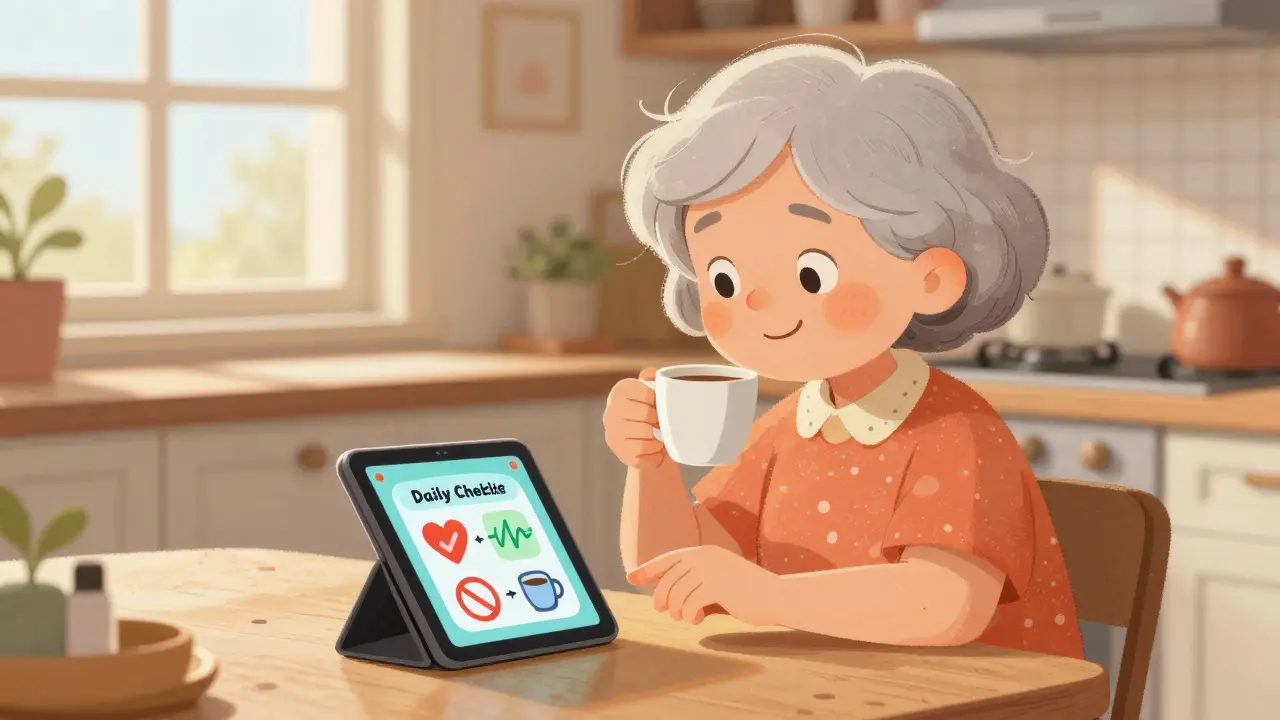
Sarah, 68, was diagnosed with atrial fibrillation last year. Her doctor gave her a pamphlet. She threw it out. Then her nurse sent her a link to a custom Deck.Toys lesson on managing AFib. It had a daily checklist: “Did you take your blood thinner? Did you check your pulse? Did you avoid caffeine after 2 p.m.?” She did it every morning while drinking coffee. Within three months, her ER visits dropped from twice a month to once every six weeks.
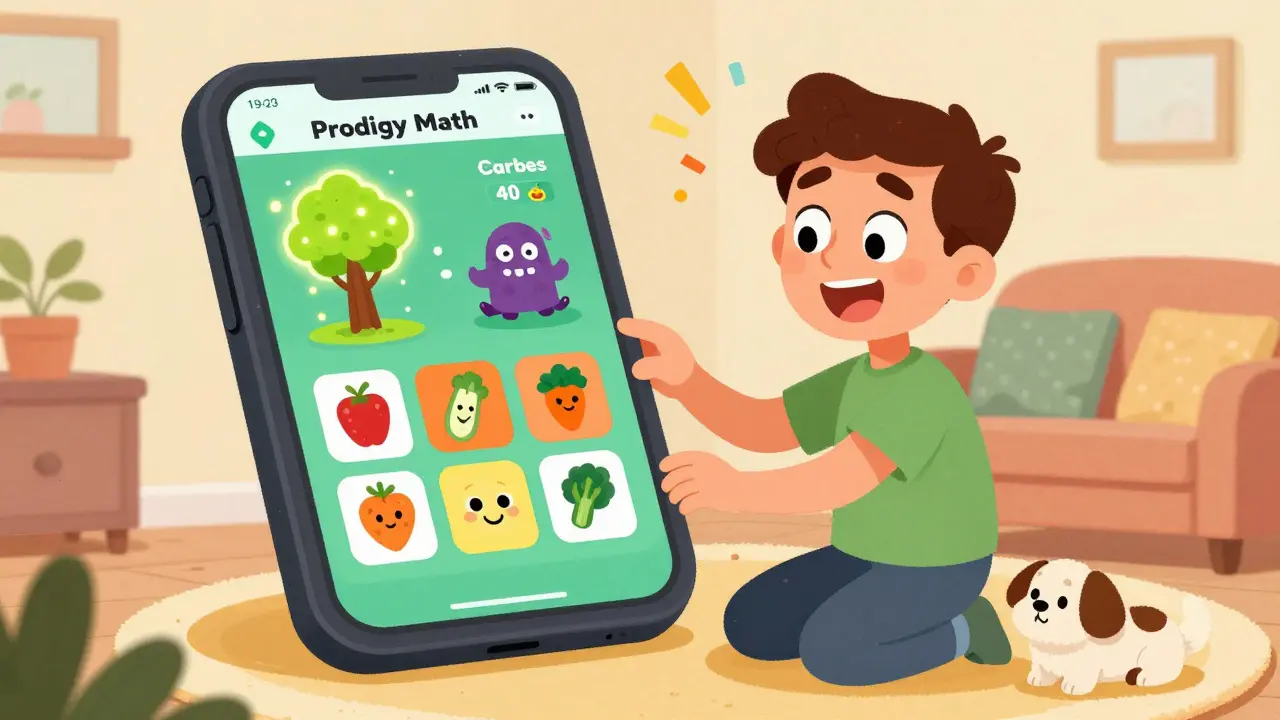
Carlos, 42, has type 2 diabetes. He used to check his sugar once a week-when he remembered. His clinic enrolled him in a program using Prodigy Math-yes, the same app kids use for math. But the version for adults teaches glucose patterns like a game. Each level is a day. Eating too many carbs? You lose health points. Walking 10,000 steps? You unlock a new recipe. He didn’t realize he was learning until he started making better choices without thinking about it.
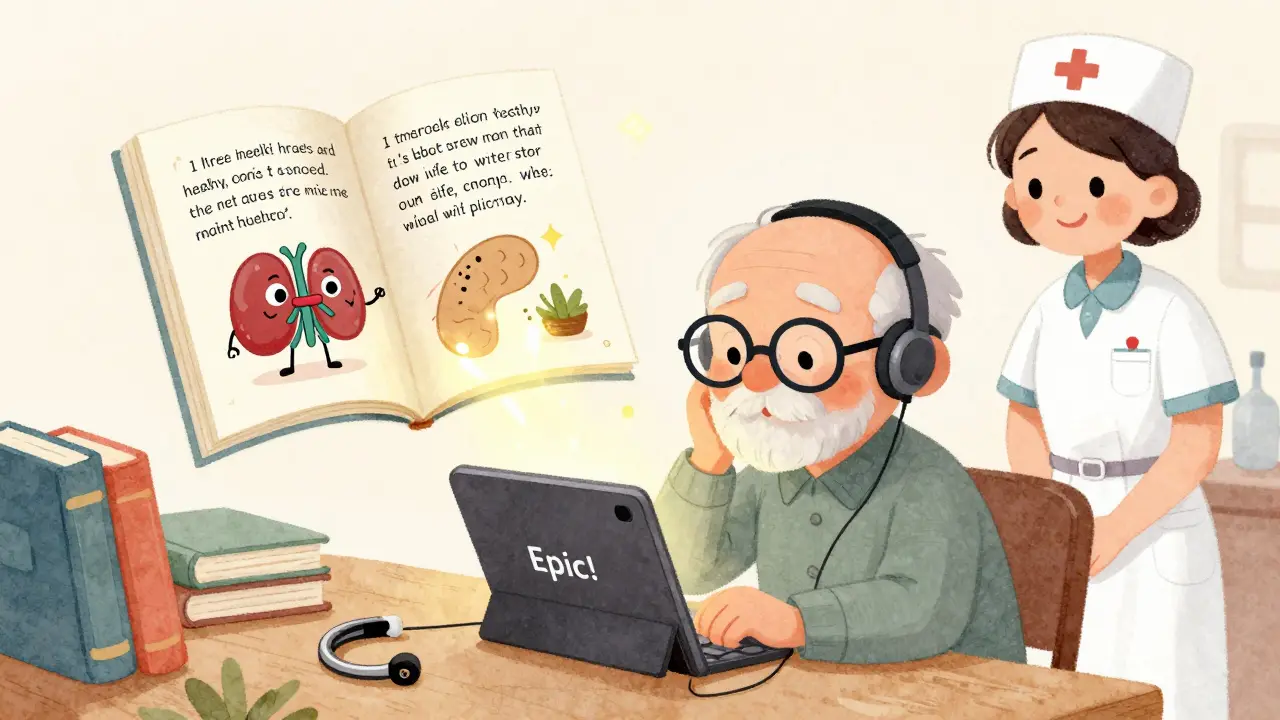
For older adults or those with low literacy, Epic! is a game-changer. It’s a digital library with 40,000+ health books, many with read-aloud features. A patient with dementia or dyslexia can listen to a story about kidney disease while following along with highlighted text. Vanderbilt University found this improved understanding by 31% for patients who struggled with reading.
What to avoid: The traps in patient education apps
Not every app labeled “health education” is helpful. Some are just marketing in disguise.
Kahoot! is fun. But using it for patient education? It turns learning into a race. Who can answer fastest? That rewards memory over understanding. A patient might memorize “take metformin with food” but not know why. Speed doesn’t save lives-understanding does.
Prodigy Math’s game elements can backfire too. One patient told his doctor he spent 45 minutes battling monsters in the app instead of finishing his diabetes lesson. The rewards-virtual coins, badges-distracted from the real goal: managing his health.
And then there’s the privacy issue. In 2025, 74% of U.S. school districts had to tweak edtech tools to meet health privacy rules. The same applies to patient apps. If an app asks for your email, location, or health data without explaining why, walk away. Look for tools that follow HIPAA or GDPR standards. If they don’t say it clearly, they’re not trustworthy.
How clinics and providers are using these tools
The best results happen when digital tools are part of a plan-not a replacement for care.
Clinics in rural areas, where specialists are scarce, are using Snorkl and Deck.Toys to train patients between visits. A nurse spends 10 minutes setting up a personalized lesson. The patient does it at home. Then, during the next appointment, the doctor asks, “What did you learn from the video about your meds?” That’s real engagement.
Google Classroom is quietly becoming a hub for patient education. Hospitals are creating private classrooms for groups of patients with the same condition-diabetes, COPD, post-surgery recovery. They post videos, quizzes, and live Q&A sessions. Patients can comment, ask questions, and see others’ experiences. It builds community. And community reduces isolation, which is a huge factor in recovery.
And then there’s NotebookLM, Google’s AI tool for creating custom learning materials. A clinic can upload a patient’s lab results, medication list, and doctor’s notes-and NotebookLM generates a plain-language summary. “Your creatinine level is high, which means your kidneys are working harder. Here’s what that means for your diet.” It’s not perfect, but it’s a huge time-saver for providers who are overwhelmed.
Cost, access, and the digital divide
Free tools like Khan Academy Kids and Epic! are lifelines for people without insurance or money. But they’re not enough. Many patients still lack devices, reliable internet, or digital literacy.
One hospital in Ohio started lending out tablets pre-loaded with health apps to patients who needed them. They also paired each device with a 30-minute tech help session. Within six months, 82% of those patients were using the tools regularly. That’s the key: access alone doesn’t work. Support does.
Meanwhile, expensive platforms like WeVideo or advanced AI tutors are great for big hospitals-but useless for small clinics. The real winners in 2025 are the tools that work on a basic smartphone, need no installation, and don’t require Wi-Fi. That’s why Snorkl and Deck.Toys are gaining ground. They’re built for real life, not tech demos.
What the future holds
By 2027, AI tutors will handle 30% of basic patient education, according to Gartner. That means you might get a chatbot that explains your blood pressure meds at 2 a.m.-and remembers your questions from last week.
But the biggest shift isn’t technological. It’s cultural. More patients are demanding to be partners in their care. They want to understand, not just obey. And digital tools are finally catching up to that need.
The future of patient education isn’t about more apps. It’s about better ones. Ones that listen. That adapt. That don’t talk down to you. That meet you where you are-whether that’s a smartphone in your pocket or a tablet at the clinic.
How to start using digital tools for patient education
- Ask your provider: “Do you recommend any apps or online lessons for my condition?”
- Start with free, simple tools: Khan Academy Kids for basics, Epic! for reading support, Snorkl for symptom tracking.
- Don’t use anything that feels confusing or scary. If it takes more than 5 minutes to understand, it’s not right for you.
- Use it daily for at least 15 minutes. Consistency beats intensity.
- Share what you learn with your care team. That’s how you turn information into action.
Health isn’t just about pills and procedures. It’s about understanding. And digital tools, when chosen well, make that understanding possible-for everyone, no matter their age, income, or education level.
Are patient education apps safe for my health data?
Not all are. Look for apps that say they follow HIPAA (in the U.S.) or GDPR (in Europe). Free apps like Khan Academy Kids and Epic! don’t collect personal health data. Paid tools should explain exactly what they store and why. If an app asks for your medical records without a clear reason, avoid it. Always check the privacy policy before signing up.
Can I use these tools if I’m not tech-savvy?
Yes. The best patient education tools are designed for people who aren’t tech experts. Khan Academy Kids uses simple icons and voiceovers. Snorkl works with your voice and camera-no typing needed. Epic! has a read-aloud button. If a tool feels complicated, ask your clinic for help. Many now offer free tech support sessions just for patients.
Do I need a smartphone to use these tools?
Most work on any device with internet: smartphones, tablets, even older laptops. Some, like Snorkl and Deck.Toys, work directly in your browser-no app download needed. If you don’t have a smartphone, many clinics offer tablets to borrow. Libraries and community centers often have free access too.
How do I know if a tool is actually helping me?
Track two things: your confidence and your actions. After using a tool for two weeks, ask yourself: Do I understand my condition better? Am I taking my meds on time? Am I making better food choices? If yes, it’s working. If you’re still confused or skipping steps, try a different tool. Not every app fits every person.
Can these tools replace my doctor?
No. They’re meant to support you between visits. An app can explain how your medication works, remind you to check your blood sugar, or show you exercises. But only your doctor can adjust your treatment, order tests, or diagnose new problems. Think of digital tools as your personal health coach-not your replacement provider.
12 Comments
Kristen Russell
Snorkl is a game changer. My mom used it after her COPD diagnosis and actually started doing her breathing exercises without being reminded. No more guilt trips from the nurse.
Dusty Weeks
prodigy math for diabetics?? 😂 i thought that was just for 8 year olds. but honestly… it worked. i didn’t even realize i was learning until my sugar stopped spiking at 3am. 🍬🎮
Paul Ong
Free tools are the real MVPs. No subscription. No tracking. Just help. Why are we still letting big health tech companies charge for what should be basic public knowledge?
sharad vyas
In my village in India, we have no smartphones. But we have radio. What if health lessons were broadcasted like folk stories? Simple. Slow. Repeatable. Maybe that’s the real innovation.
Bryan Anderson
I’ve seen clinics use Google Classroom for post-op groups. The quietest patients become the most engaged when they can read others’ experiences anonymously. Community heals in ways apps can’t replicate.
Heather Josey
Too many tools assume patients are tech-literate. But what about someone who’s never sent an email? The real success stories aren’t the ones with the fanciest apps - they’re the ones where a nurse sat down for 30 minutes and walked them through one tool. Tech is useless without human touch.
Snorkl’s voice feedback? Brilliant. But only if someone teaches the patient how to turn it on. That’s the missing step in most rollout plans.
Health education isn’t about the tool. It’s about the moment someone realizes they’re not alone in this. That’s why I’m skeptical of anything that removes the clinician entirely.
Richard Thomas
There’s a deeper philosophical question here that nobody’s asking: If we outsource understanding to algorithms, are we eroding our capacity for medical literacy? We used to memorize our meds. Now we tap a notification. We used to ask our doctors why. Now we Google it. And what happens when the algorithm is wrong? Or biased? Or trained on data that doesn’t include people like us?
These tools are helpful, yes. But they’re also seductive. They make compliance feel like progress. But real health isn’t about checking boxes in an app - it’s about building a relationship with your own body, over time, with patience, with discomfort, with failure.
I worry we’re trading depth for convenience. We’re turning healing into a gamified experience - and that’s not just reductive, it’s dangerous. A heart attack doesn’t care if you earned a badge today.
Let’s not confuse efficiency with enlightenment. The most powerful tool in patient education is still a human voice saying, ‘I see you. I’m here with you.’ Everything else is just scaffolding.
Lee M
Let’s be real - most of these apps are just corporate rebranding of old educational models. Khan Academy Kids? It’s a child’s app repackaged. Deck.Toys? It’s a drag-and-drop PowerPoint with a fancy name. And don’t get me started on NotebookLM - it’s GPT-4 with a lab coat. We’re not innovating. We’re just slapping ‘health’ on existing tech and calling it breakthrough.
The real problem? No one’s fixing the root cause: doctors have 7 minutes per patient. No app can fix that. Only systemic change can. Stop selling apps as solutions. Start demanding longer appointments and better training for providers.
Sally Denham-Vaughan
My aunt used Epic! to listen to a story about kidney disease while she cooked. She said it felt like her granddaughter was reading to her. That’s the magic. Not the tech - the connection.
Andy Heinlein
Just tried Snorkl with my dad’s heart failure. He didn’t say much. But after the feedback video, he looked at me and said, ‘Huh. So that’s why I’m supposed to sit up like that.’ No lecture. No jargon. Just a video. That’s all it took.
Todd Nickel
The most overlooked factor in all this is cognitive load. Patients aren’t just managing a chronic condition - they’re managing fear, grief, financial stress, family expectations, and often, multiple comorbidities. Adding another app to their phone isn’t helpful if it adds another mental burden. The best tools don’t ask for more attention - they reduce it. Snorkl and Deck.Toys work because they’re frictionless. They don’t demand engagement. They just quietly offer clarity when you need it. That’s the quiet revolution.
Compare that to Kahoot! - which turns learning into performance anxiety. Or Prodigy Math - which rewards distraction with virtual coins. We’re designing for dopamine, not dignity. The goal shouldn’t be to make patients ‘engaged.’ It should be to make them feel capable. And sometimes, that means giving them space, not another screen.
Real patient education isn’t about pushing content. It’s about removing barriers. The barrier isn’t knowledge. It’s overwhelm.
Ann Romine
My sister has dyslexia. She cried when she found Epic! because for the first time, she could understand her own diagnosis without someone reading it to her. That’s not tech. That’s justice.