
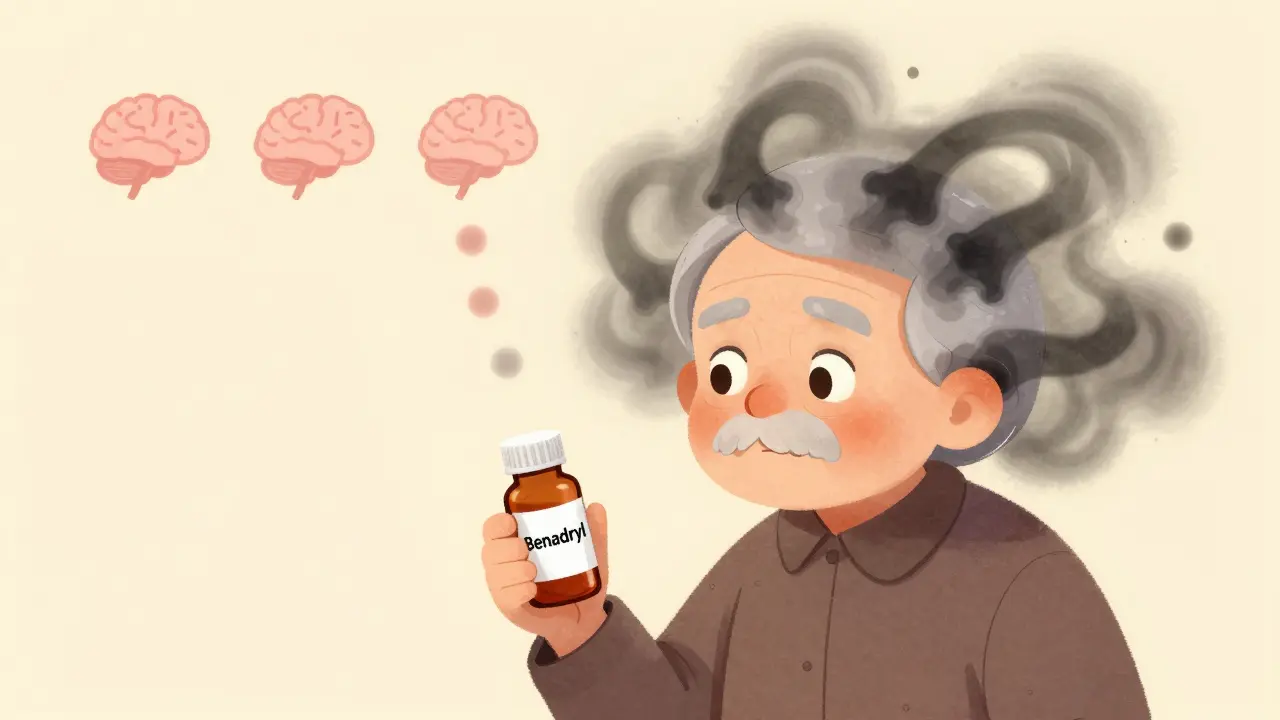
Many older adults take medications that quietly harm their brains. These aren’t rare or experimental drugs - they’re common prescriptions and over-the-counter pills you’ve probably heard of: diphenhydramine for sleep, oxybutynin for bladder control, amitriptyline for pain or depression. What most people don’t know is that these drugs block a key brain chemical called acetylcholine. When taken long-term, especially in combination, they build up what’s called anticholinergic burden - and that burden is linked to faster memory loss, confusion, and higher dementia risk.
What Exactly Is Anticholinergic Burden?
Anticholinergic burden isn’t about one drug. It’s the total effect of all the medications you take that interfere with acetylcholine, a neurotransmitter critical for memory, attention, and learning. The brain relies on acetylcholine to keep neural signals flowing, especially in areas like the hippocampus and cortex - the same regions that go quiet in Alzheimer’s disease. Doctors use a scoring system called the Anticholinergic Cognitive Burden (ACB) scale to measure this. Each drug gets a score: 1 for mild, 2 for moderate, and 3 for strong anticholinergic effects. If you’re taking three drugs with a score of 1, your total burden is 3. If you’re on one strong drug like amitriptyline (score 3) and two mild ones like loratadine (score 1) and oxybutynin (score 2), your total is 6 - a level linked to measurable brain changes. The science is clear: higher ACB scores mean worse outcomes. A 2015 study tracking over 3,400 older adults found that those taking high-burden medications for three years or more had a 54% higher chance of developing dementia compared to those who took them for less than three months. Even people who seemed cognitively normal at the start showed signs of decline after just one year on these drugs.How These Drugs Change Your Brain
It’s not just memory that suffers. Brain scans from the 2016 JAMA Neurology study showed that older adults on moderate-to-high anticholinergic medications had 4% less glucose use in the temporal lobe - the same area that lights up in early Alzheimer’s. Less glucose means less energy for brain cells to work properly. MRI scans from the Indiana Memory and Aging Study found something even more alarming: people on anticholinergics lost brain volume faster. Their brains shrank by an extra 0.24% per year compared to those not taking these drugs. That’s like losing the volume of a walnut every year - not because of aging, but because of medication. These changes show up in tests too. In the ASPREE trial of nearly 20,000 people over 70, each point increase in ACB score meant:- 0.15-point greater yearly decline on word association tests (executive function)
- 0.08-point greater yearly decline on verbal memory tests
- Only a tiny 0.05-point drop in processing speed
Drugs That Carry the Highest Risk
Not all anticholinergics are created equal. Some are worse than others. The top offenders, based on prescription data and clinical impact, include:- Diphenhydramine (Benadryl, Tylenol PM, Advil PM) - used for sleep or allergies. Score: 3. Accounts for nearly 1 in 5 high-burden prescriptions.
- Oxybutynin (Ditropan, Oxytrol) - for overactive bladder. Score: 3. Still widely prescribed despite safer alternatives.
- Amitriptyline - a tricyclic antidepressant used for nerve pain and depression. Score: 3. Often kept on long-term even when newer options exist.
- Hydroxyzine (Atarax) - for anxiety or itching. Score: 3.
- Chlorpheniramine - found in many cold and allergy meds. Score: 2.

What Happens When You Stop?
Here’s the good news: the damage isn’t always permanent. In the 2019 DICE trial, 286 older adults with high anticholinergic burden had their medications carefully reduced over 12 weeks. Their cognitive scores improved by 0.82 points on the MMSE - a noticeable shift in daily function. Many caregivers report similar results. One woman on AgingCare.com wrote: “My mom was confused all the time. She couldn’t remember names, got lost in her own house. We stopped her oxybutynin - within two weeks, she was herself again.” The brain doesn’t bounce back overnight. It takes 4 to 8 weeks for acetylcholine levels to normalize. But recovery is real. The key is doing it safely, under supervision. Stopping cold turkey can cause withdrawal symptoms like nausea, sweating, or increased heart rate - especially with antidepressants or bladder meds.Why Doctors Keep Prescribing Them
If the risks are so clear, why are these drugs still everywhere? Partly because they work - fast. Oxybutynin stops urgent bathroom trips. Diphenhydramine knocks you out. Amitriptyline dulls chronic pain. For doctors short on time, it’s easier to write a prescription than to search for alternatives. A 2022 study found that only 39% of nursing home residents with high anticholinergic scores had their meds reviewed within three months of being flagged. Primary care doctors say they need an average of 23 minutes per patient to do a full medication review - but most appointments are 15 minutes or less. There’s also a lack of awareness. Many clinicians still think anticholinergics are “safe for seniors” because they’ve been used for decades. The American Geriatrics Society’s 2023 Beers Criteria says clearly: avoid strong anticholinergics in older adults. But guidelines don’t always reach the front lines.
What You Can Do Right Now
If you or a loved one is over 65 and taking any of these medications, here’s what to do:- Make a list - write down every pill, patch, and liquid you take, including OTCs and supplements.
- Check the ACB score - use the free American Geriatrics Society ACB Calculator app (launched in 2024) to score each drug. It’s quick and free.
- Ask your doctor - “Is this medication necessary? Is there a non-anticholinergic alternative?”
- Don’t stop suddenly - especially with antidepressants or bladder meds. Work with your provider on a taper plan.
- Look for alternatives - For sleep: try melatonin or sleep hygiene. For bladder issues: pelvic floor therapy or mirabegron (Betmiga). For pain: acetaminophen or physical therapy instead of amitriptyline.
What’s Changing in 2026
The tide is turning. The FDA now requires updated warning labels on all anticholinergic medications. The European Medicines Agency banned dimenhydrinate in dementia patients. Pharmaceutical companies are shifting: Pfizer’s solifenacin (VESIcare) replaced older bladder drugs with less brain penetration. Johnson & Johnson pulled its long-acting oxybutynin in 2021. The National Institute on Aging is funding a $14.7 million study called CHIME, which will track 3,500 seniors over four years to see if reducing anticholinergic burden slows cognitive decline. Early results could change guidelines again. Experts now say anticholinergic burden is one of the top 10 modifiable risk factors for dementia - potentially responsible for 10-15% of cases. That’s not a small number. It’s preventable.Final Thought
Medications are meant to help. But when they quietly steal memory, attention, and independence, it’s time to ask: is the trade-off worth it? For many older adults, the answer is no. With awareness, better tools, and smarter prescribing, we can protect the brain as we care for the body.Can over-the-counter sleep aids like Benadryl cause dementia?
Yes. Diphenhydramine, the active ingredient in Benadryl and many sleep aids, has a strong anticholinergic rating (ACB score 3). Long-term use - even just a few years - is linked to increased dementia risk. A 2015 study found that people who took it daily for three years or more had a 54% higher chance of developing dementia than those who used it briefly. Many seniors don’t realize these OTC pills carry the same brain risks as prescription drugs.
Are there safe alternatives to oxybutynin for overactive bladder?
Yes. Mirabegron (brand name Betmiga) is a non-anticholinergic option that works differently - it relaxes the bladder muscle without blocking acetylcholine. Pelvic floor physical therapy, timed voiding, and bladder training can also be effective. In fact, the 2023 European Association of Urology guidelines now recommend these non-drug options as first-line treatments for older adults. Solifenacin (VESIcare) is another drug with lower brain penetration, but mirabegron is preferred for cognitive safety.
How long does it take to recover cognitive function after stopping anticholinergics?
It usually takes 4 to 8 weeks for brain acetylcholine levels to rebound, but full improvement can take up to 12 weeks. In the DICE trial, participants saw measurable cognitive gains after 12 weeks of medication reduction. Some people notice clearer thinking within days, especially if they were taking high-dose diphenhydramine. But recovery isn’t instant - patience and consistency matter. Don’t expect overnight results, but don’t give up if progress is slow.
Can antidepressants like amitriptyline cause memory problems in seniors?
Absolutely. Amitriptyline has the highest anticholinergic rating (ACB score 3) and is one of the most common culprits behind unexplained confusion in older adults. It’s often prescribed for nerve pain or depression, but safer options exist - like SSRIs (e.g., sertraline, escitalopram) that don’t block acetylcholine. A 2022 study found that switching from amitriptyline to sertraline improved memory scores in 70% of older patients within six months. Always ask if your antidepressant is necessary and if a non-anticholinergic option is available.
Why don’t doctors always tell patients about these risks?
Many doctors simply aren’t trained to check for anticholinergic burden during routine visits. A 2021 survey of over 1,200 family doctors found that only 37% felt they had enough time to review all medications properly. Also, some believe these drugs are “harmless” because they’ve been used for decades. But guidelines from the American Geriatrics Society have warned since 2012 that these drugs increase dementia risk. Patient awareness is growing - but the system hasn’t caught up yet. It’s up to you to ask.
Is there a tool I can use to check my medications for anticholinergic risk?
Yes. The American Geriatrics Society launched a free mobile app called the ACB Calculator in early 2024. You can enter your medications - including over-the-counter ones - and it instantly gives you a total anticholinergic burden score using the latest ACB scale version 3.0. It’s available on iOS and Android. You can also use the online version at ags.org/ACBcalculator. No login required. It’s the easiest way to know if your meds might be hurting your brain.



15 Comments
RAJAT KD
This is exactly why my grandfather stopped Benadryl after I showed him the ACB calculator. He went from forgetting his keys to remembering my birthday. Simple fix, massive difference.
Aron Veldhuizen
Let me guess - you’re one of those people who thinks every drug is a poison and every doctor is a criminal. The brain isn’t some sacred temple that crumbles at the sight of diphenhydramine. People have been taking these meds for decades and still lived full lives. Correlation isn’t causation, and your fearmongering is just as dangerous as the drugs you’re condemning.
Darren McGuff
As a geriatric pharmacist, I’ve seen this play out too many times. One woman on 5 anticholinergics - sleep aid, bladder med, antidepressant, allergy pill, and a muscle relaxer. Total ACB score of 10. She was diagnosed with ‘early dementia.’ We tapered her down over 8 weeks. Within 3 months, her MMSE score jumped from 22 to 28. She started recognizing her grandchildren again. It’s not magic - it’s pharmacology. But no one tells patients this because it’s easier to prescribe than to problem-solve.
Catherine Scutt
Ugh. My aunt took oxybutynin for 7 years and blamed her memory loss on ‘getting old.’ Then she switched to mirabegron and suddenly remembered where she put her glasses, who her pastor was, and that she had a cat. Like, wow. Why do people think brain fog is just part of aging? It’s not. It’s medicine.
Jeffrey Hu
Actually, the ACB scale has been criticized for oversimplifying. Some drugs with a score of 3 have negligible CNS penetration - like topical anticholinergics. And the 54% dementia risk increase? That’s from a study that didn’t control for comorbidities like hypertension or diabetes, which are way bigger risk factors. Don’t blame the meds. Blame the lack of holistic care.
Jacob Paterson
Oh wow. So now we’re blaming the elderly for being dumb because they took a sleep aid? Maybe they’re forgetful because they’re lonely, bored, or depressed - not because of oxybutynin. You people act like every senior is a walking pharmacology exam. Meanwhile, real problems - isolation, poor nutrition, lack of exercise - get ignored. Fix the system, not the pills.
Jenci Spradlin
Been a nurse for 22 years. I’ve seen it: grandmas on Benadryl every night for 15 years, then get labeled ‘demented.’ We pull the meds, give them melatonin and a bedtime routine - boom, they’re back. Funny how the brain remembers how to work when you stop poisoning it. Just sayin’.
Phil Kemling
There’s a deeper question here: why do we outsource our biological maintenance to chemistry? We’ve turned aging into a medical problem to be solved with pills, rather than a human experience to be lived with care. The real tragedy isn’t the anticholinergic burden - it’s that we’ve lost the patience to sit with discomfort, to listen to the body without reaching for a bottle. We medicate our loneliness, our insomnia, our incontinence - and then wonder why our minds are foggy. Maybe the problem isn’t the drugs. Maybe it’s the culture that made us believe we needed them in the first place.
Elisha Muwanga
This is what happens when you let academics and activists dictate medicine. The FDA is now requiring warning labels on drugs that have been safely used for 60 years? That’s not science - that’s performative outrage. My father took amitriptyline for 20 years and died at 89 with a full head of hair and a sharp wit. You want to blame drugs? Blame the fact that people aren’t eating right or walking enough. Stop weaponizing pharmacology.
Lindsey Wellmann
MY GRANDMA WAS A WALKING PHARMACY 🙃 I gave her the ACB app and she cried because she realized she’d been taking 5 brain-slowing meds for 10 years. We cut them down slowly - now she’s baking pies again, remembers my kids’ names, and even started a book club. 🥹 I’m not crying, you’re crying. #MedicationWakeUpCall
Drew Pearlman
I know people who’ve been on these meds for decades and are sharper than most 30-year-olds. I also know people who never took a single anticholinergic and still got dementia. This isn’t a simple equation. The brain is complex. Reducing meds might help some, but it’s not a magic bullet. We’re treating a symptom of a broken system - the lack of time, care, and human connection - as if it’s a chemical imbalance. That’s the real tragedy.
Chris Kauwe
Anticholinergic burden is a well-documented neuropharmacological phenomenon, not a viral trend. The longitudinal data from the ASPREE and DICE trials are methodologically sound, with robust controls. The effect size for cognitive decline is clinically significant - not marginal. The fact that this is still controversial among laypeople speaks to the failure of translational medicine. We need better physician education, not anecdotal hero stories.
Pooja Kumari
I just lost my mom to dementia. She was on diphenhydramine for sleep, oxybutynin for bladder, and amitriptyline for pain. I didn’t know any of this was connected. I thought she was just slipping away. Now I feel like I failed her. I didn’t ask the right questions. I trusted the doctors. I thought meds were helping. But they were stealing her. I wish I’d known sooner. I wish someone had told me. I’m so angry. And so sad.
tali murah
Let’s be honest - this post is just another ‘meds are evil’ clickbait piece disguised as science. The real dementia epidemic? It’s caused by processed food, sedentary lifestyles, and social isolation. But you won’t see a 20-minute video about ‘eat less sugar and call your neighbor’ because it doesn’t sell fear. This isn’t about brain health - it’s about profit-driven fearmongering. Stop monetizing old age.
Diana Stoyanova
Hey - if you’re reading this and you’re over 65, I want you to know this: your brain is still capable of healing. It’s not too late. I watched my dad go from confused and withdrawn to laughing at memes again after we stopped his meds. It took months. There were setbacks. But he came back. You are not your diagnosis. You are not your prescription. You are still here - and you still matter. Don’t give up. Ask the question. Check the score. Talk to someone. You’ve got this. 💪❤️