
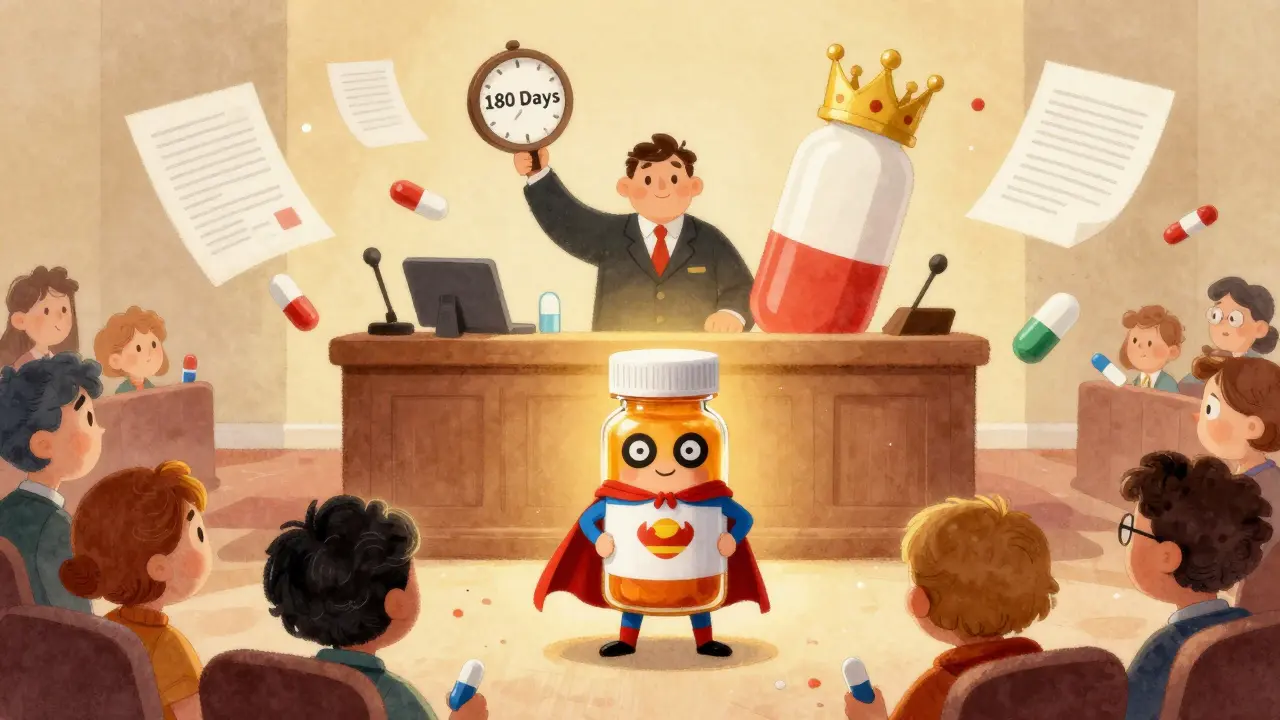
When a brand-name drug’s patent runs out, you’d expect generic versions to flood the market right away-cheaper, just as effective, and available to anyone who needs them. But that’s not how it works. In the U.S., a single generic company can block every other generic from entering the market for 180 days-even if the patent was weak or should’ve expired years ago. This isn’t a loophole. It’s the law. And it’s called 180-day exclusivity.
What Exactly Is 180-Day Exclusivity?
It’s a reward built into the Hatch-Waxman Act of 1984, a law designed to balance two things: encouraging drug companies to invent new medicines, and letting cheaper generics reach patients faster. The catch? The only way a generic company gets this 180-day monopoly is by being the first to challenge a brand-name drug’s patent in court. Here’s how it works: A generic manufacturer files an Abbreviated New Drug Application (ANDA) with the FDA. But instead of saying, “Our drug is the same,” they file a Paragraph IV certification. That’s a legal notice saying: “Your patent is invalid, or we don’t infringe it.” If they’re the first to do this, they lock in the 180-day exclusivity window. No other generic can get FDA approval for the same drug until that clock runs out. This isn’t just paperwork. It’s a high-stakes gamble. Filing a Paragraph IV certification often means getting sued by the brand-name company. Legal battles can last years. The generic company spends millions. But if they win-or even if the brand settles-their reward is 180 days where they’re the only generic on the market. During that time, they can charge almost as much as the brand did. And they make back their legal costs, plus a huge profit.When Does the Clock Start?
The 180-day clock doesn’t start when the FDA approves the drug. It doesn’t even start when the court rules. It starts on the earliest of two things:- The day the generic company starts selling the drug commercially
- The day a court says the patent is invalid or not infringed
Who Gets the Prize? It’s Not Always Who You Think
Being the “first applicant” sounds simple. But it’s not. The FDA has to decide who submitted the first substantially complete ANDA with a valid Paragraph IV certification. That means the application has to be fully filled out-not missing forms, not missing data. If it’s incomplete, the FDA can say, “Not first.” Another company might have filed later but with a perfect application. They become the first. And it gets messier. What if two companies file on the same day? The FDA has rules for that too. Sometimes, the first to submit the application electronically wins. Sometimes, it’s based on the time stamp. Other times, it’s a legal battle in court. There have been lawsuits over who got there first by minutes. And then there’s forfeiture. The 2003 Medicare Modernization Act added rules that can strip away exclusivity. If the first applicant doesn’t market the drug within 75 days of FDA approval-or if they don’t start selling within 30 months of their ANDA submission-they lose the exclusivity. But even that’s not foolproof. The FDA has issued guidance on what counts as “marketing.” One 2018 letter clarified that if a company ships a small batch for distribution but doesn’t publicly advertise it, that might not count. So companies play a game of legal interpretation.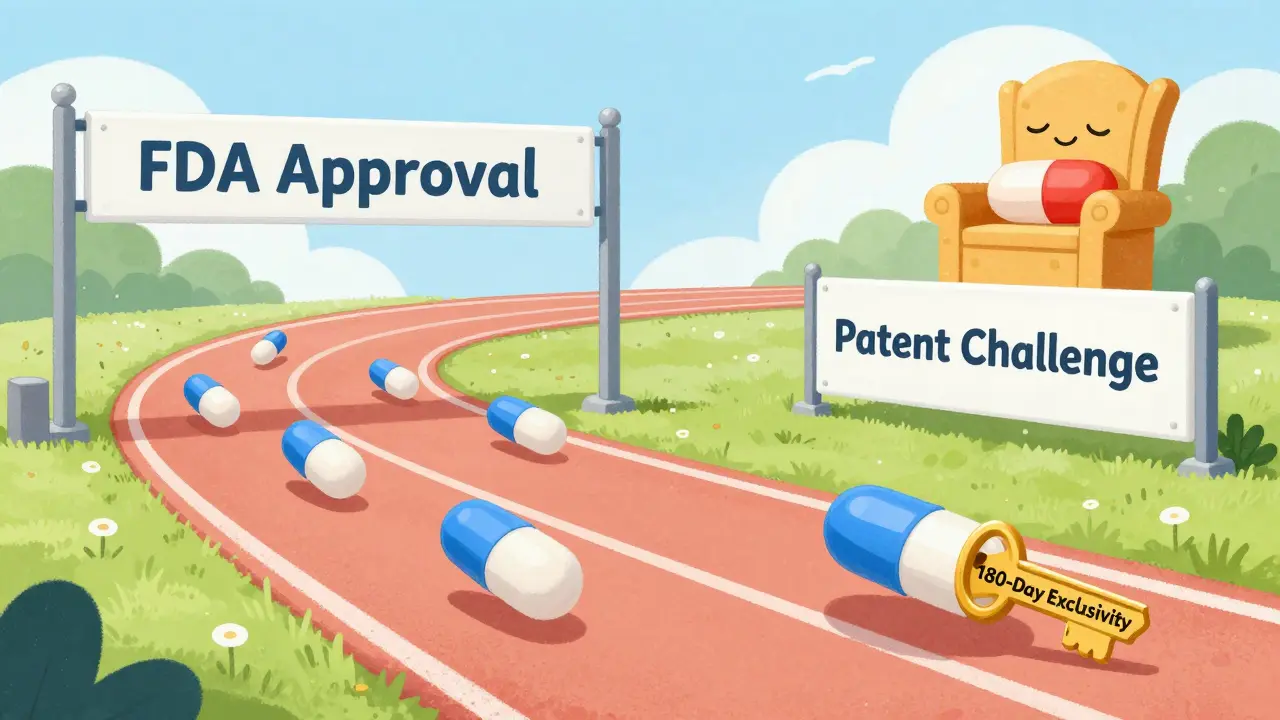
Why This Matters for Patients and Prices
The goal of Hatch-Waxman was to get generics to market fast and lower drug costs. And it worked. In 1984, generics made up about 19% of prescriptions. Today, they make up over 90% by volume. That’s saved the U.S. healthcare system more than $1.7 trillion in the last decade. But 180-day exclusivity has turned into a double-edged sword. When the first generic company launches, prices drop fast-sometimes by 80% or more. That’s good. But if that company delays launch, prices stay high. And in some cases, the brand-name company and the first generic strike a deal: “You don’t launch, and we’ll pay you not to.” These are called “pay-for-delay” agreements. Courts have ruled some of them illegal, but they still happen. The result? Patients wait longer for affordable drugs. Pharmacists can’t substitute generics. Insurance companies pay more. And the company that won the exclusivity lottery makes millions-sometimes billions-on a single drug. Take the case of a popular cholesterol drug. The patent expired in 2016. The first generic filed a Paragraph IV challenge in 2014. The brand sued. The case dragged on for three years. The generic didn’t launch until 2019. That’s three years of no competition. The brand kept its high price. The first generic then had 180 days of monopoly. By the time other generics came in, the brand had already lost most of its market share. But patients paid more than they should’ve for years.How Is This Different From Other Exclusivities?
The FDA gives other types of exclusivity too. A new chemical entity gets five years. A new clinical study gets three. Pediatric studies can add six months. But those are about data, not patents. They prevent generics from even applying for approval. The 180-day exclusivity is different. It’s about patent challenges. Only one company gets it. And it’s not about protecting innovation-it’s about incentivizing attacks on it. That’s why it’s called a “winner-takes-all” system. Compare that to biosimilars, the generic version of biologic drugs like insulin or cancer treatments. Under the BPCIA, the first interchangeable biosimilar gets 12 months of exclusivity. But multiple companies can qualify as “first” if they meet the criteria. There’s no single winner. That’s a fairer system. But for small-molecule drugs-most pills and injections-it’s still one company, one shot, 180 days.
What’s Changing? What’s Next?
The FDA knows the system is broken. In March 2022, they proposed major changes:- Exclusivity should only last 180 days after the first generic actually sells the drug
- If a company launches more than five years before the patent expires, they get 270 days instead
- If multiple companies are first, only one gets the first 90 days; others get approval on day 91
What Does This Mean for Generic Manufacturers?
For generic companies, it’s a high-risk, high-reward game. You need:- A legal team that understands patent law
- A regulatory team that knows FDA submission rules
- Millions in cash to fund litigation
- The nerve to bet everything on one drug
Final Thought: Is This Fair?
The 180-day exclusivity rule was meant to speed up access to cheap drugs. It did that-for some drugs, for some patients. But it also created a system where a single company can hold up competition for years. Where patent challenges become legal chess matches instead of tools for public health. Where the winner doesn’t just get a reward-they get a market lock. Patients don’t care who filed first. They just want the drug to be affordable. And right now, the law isn’t always on their side.What triggers the 180-day exclusivity clock for generic drugs?
The clock starts on the earliest of two dates: the day the first generic company begins selling the drug commercially, or the day a court rules that the challenged patent is invalid or not infringed. It does not start when the FDA approves the drug or when the patent expires.
Can a generic company lose its 180-day exclusivity?
Yes. Under the Medicare Modernization Act of 2003, a first applicant can forfeit exclusivity if they fail to market the drug within 75 days of FDA approval, or if they don’t begin commercial sales within 30 months of submitting their ANDA. The FDA also has rules about what counts as “commercial marketing,” and vague actions like shipping small batches without public promotion may not qualify.
Why does the FDA care who files first?
The FDA doesn’t decide who wins based on who’s first to submit a paper. They determine who is the “first applicant” by evaluating who submitted the first substantially complete ANDA with a valid Paragraph IV certification. Even a minor error-like a missing signature or incomplete bioequivalence data-can disqualify an applicant, even if they filed before others.
Is 180-day exclusivity the same as patent protection?
No. Patent protection is granted by the U.S. Patent Office and lasts 20 years from filing. Exclusivity is granted by the FDA under the Hatch-Waxman Act and is tied to successfully challenging a patent. It’s a regulatory incentive, not a patent right. A drug can have both, but they’re legally separate.
Do other countries have a similar 180-day exclusivity rule?
No. The U.S. is unique in offering a 180-day exclusivity period specifically for the first generic challenger. Other countries, like Canada, the U.K., and Australia, allow multiple generics to enter immediately after patent expiry. The U.S. system was designed to incentivize patent challenges, but it’s not used anywhere else in the same way.
How does 180-day exclusivity affect drug prices?
When the first generic launches, prices typically drop 80-90% within months. But if the first applicant delays launch, prices stay high for years. In some cases, the brand and the first generic make a deal to delay entry-called a “pay-for-delay” agreement-which keeps prices elevated and blocks competition. This undermines the whole purpose of Hatch-Waxman.

10 Comments
Ken Porter
This system is a joke. America invented innovation, but now we reward legal loopholes instead of patients. 180 days? Try 180 months while Big Pharma and their bought-off generics laugh all the way to the bank.
Manish Kumar
It’s not just about patents or FDA forms-it’s about power. The whole system was built on the illusion of competition, but in reality, it’s a rigged casino where only the wealthiest law firms and corporate lawyers get to roll the dice. The patient? They’re just the sucker sitting at the table hoping the card they need gets dealt. And when it doesn’t? They pay more. Again. And again. And again. We call it capitalism, but it’s more like feudalism with pill bottles instead of castles. The first company to file doesn’t care if you can afford the drug-they care if they can maximize their ROI before the next wave of generics finally, maybe, arrives. And even then, they’ve already milked the cow dry for years. The FDA’s 2022 proposal? Too little, too late. By the time they fix this, another five drugs will have been held hostage under the same broken logic. We don’t need more regulations. We need a moral reset.
swati Thounaojam
so like... if you mess up a form, you lose the whole thing? that seems so unfair.
Dave Old-Wolf
I never realized how much paperwork and legal chess is involved just to make a cheap drug. It’s wild that a single typo or missing signature can delay affordable medicine for years. Who even checks these applications? And why isn’t there a simpler way?
Donny Airlangga
It’s heartbreaking to think that people are waiting years for life-saving meds because of corporate games. The fact that companies can sit on exclusivity and not launch just to block others? That’s not capitalism. That’s exploitation dressed up as law.
Aubrey Mallory
Let me be clear: this isn’t innovation. It’s extortion. The Hatch-Waxman Act was meant to help people, not turn drug pricing into a high-stakes poker game where the house always wins. If you’re a generic company that can’t afford a $10M lawsuit, you’re not just out of luck-you’re erased from the system. And that’s not a flaw. It’s by design.
christy lianto
I’ve seen patients skip doses because they can’t afford the brand name. Then I watch the same drug go on sale for 90% less… after a 4-year delay. The system doesn’t just fail-it mocks the people it claims to serve.
Molly Silvernale
It’s like watching a marathon where the finish line moves every time someone gets close-and the prize isn’t glory, it’s profit. And the runners? They’re not athletes-they’re lawyers with spreadsheets. The patient? They’re just a number in a balance sheet. And the worst part? We all pretend this is normal. We shrug. We say, ‘That’s just how it is.’ But it’s not. It’s broken. And it’s bleeding people dry-literally.
Evan Smith
So let me get this straight: you have to sue a drug company to get the right to sell a cheaper version of their drug… and if you win, you get to charge the same price for half a year? That’s not a reward-it’s a reward for being a bully.
Lois Li
I think the real issue is that we’ve turned healthcare into a legal sport instead of a human right. The FDA’s trying, but without Congress stepping in, it’s like trying to fix a leaky roof with duct tape. And honestly? I’m tired of pretending this is fair.